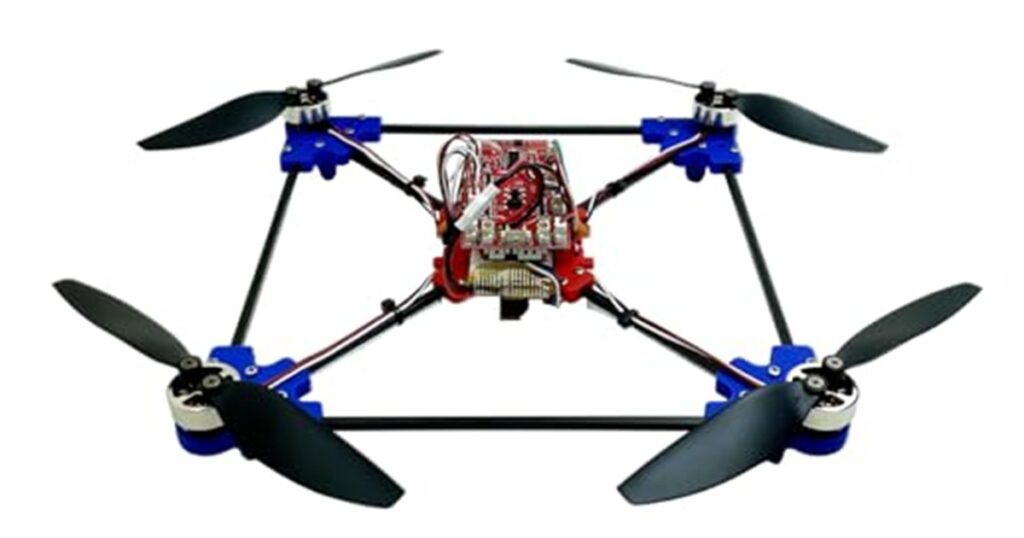
Most flat-pack projects reward you with a shelf. This one rewards you with four spinning propellers and a very personal reason to check whether you tightened every screw. The EIELEDIY Quadrotor Drone DIY Kit turns a pile of rods, circuit boards, motors, and tiny hardware into an aircraft you can actually fly. Finally, a weekend project with ambitions beyond holding a houseplant.
The appeal starts before takeoff. Instead of opening a box and discovering a finished drone beneath a protective bag, you get the components that make the thing work. The skeleton stays visible when you’re done, too. Thin black rods connect blue motor mounts to an exposed red center assembly, with wiring right there in the open. It looks like a small engineering experiment that has politely declined to wear pants.
That exposed construction is the point. This is a build-and-learn kit for people who want to understand a quadcopter, not simply acquire another remote-controlled object to charge. EIELEDIY pitches it as a STEM project with brushless motors, optical-flow positioning, and a collection of flight functions that become much more interesting once you have assembled the machine using them.
You build the drone before you become its pilot
The seller estimates about an hour and a half for assembly. Treat that as a project estimate, rather than an appointment with the sky. Sorting components, reading diagrams, and checking your work can take longer, especially if this is your first encounter with a flight-control board. The listing itself rates the build five out of five for difficulty and recommends it for users over 14.
In other words, the little screws are not decorative. The kit asks you to assemble the fuselage and motors, so patience belongs on the workbench alongside the parts. This is a better match for someone who enjoys figuring out why something fits a particular way than someone whose preferred instruction is “press the big button.” There will be big buttons later. First, there is a project.
Related posts:
 This Home Security Surveillance Drone Automatically Deploys When It Senses Intruders
 You Can Now Get a Flamethrower Drone Attachment, and It’s Perfect For Wasp Nest Removals
 Air PIX Pocket Sized Drone Lets You Get The Perfect Selfie, Controlled By Your Phone
 This Personal eVTOL Aircraft Takes Off Vertically and Parks in a Garage
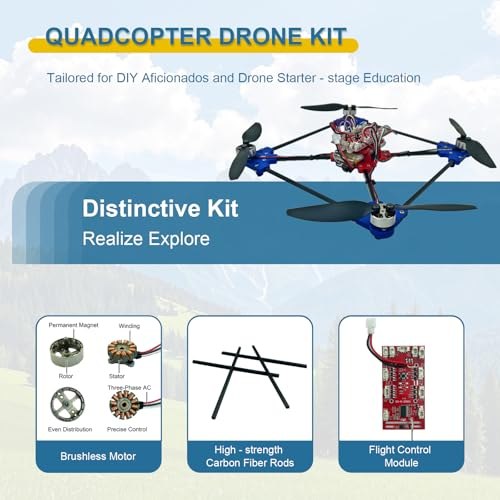
The seller identifies carbon-fiber rods, brushless motors, and a flight-control module among the main components. Those parts give the finished aircraft its distinctive open-frame appearance. You can trace the shape of the chassis with your eyes, see where the motors sit, and appreciate that a flying machine is a collection of cooperating pieces rather than a mysterious plastic shell.
The included printed manual is described as covering component installation and basic drone principles. EIELEDIY also advertises editable presentation courseware for educational use. That gives the kit a second role as a teaching project, provided the person leading it is comfortable supervising the build and working through the instructions. A classroom demonstration becomes considerably more memorable when the completed lesson can leave the table.
Small aircraft, fairly serious homework
There are two different skills involved here: assembling the drone and flying it. Finishing the first does not automatically award mastery of the second. The seller also rates operation as challenging and says proficiency takes practice. That honesty is useful. A neat pile of leftover packaging should not be mistaken for a pilot’s license issued by your kitchen.
- Build the structure: assemble the frame, motor components, and central electronics following the supplied instructions.
- Learn what the parts do: the manual and advertised courseware are intended to explain the basics behind the finished drone.
- Start with the simpler flight functions: one-click takeoff and landing are included in the listed controls.
- Practice before performing: speed adjustment, headless mode, and flips add options once you are comfortable with the aircraft.
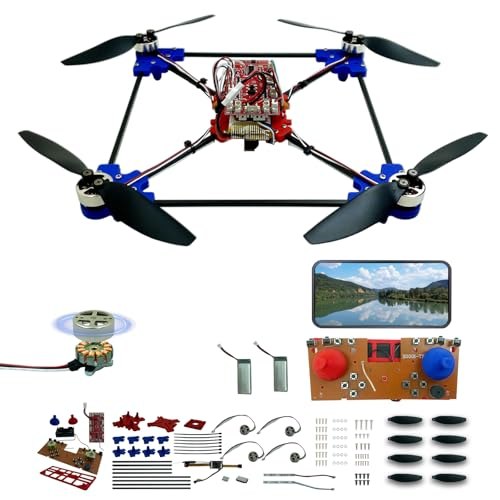
- Keep the spares organized: replacement propellers are included, which is reassuring for a project that combines learning with gravity.
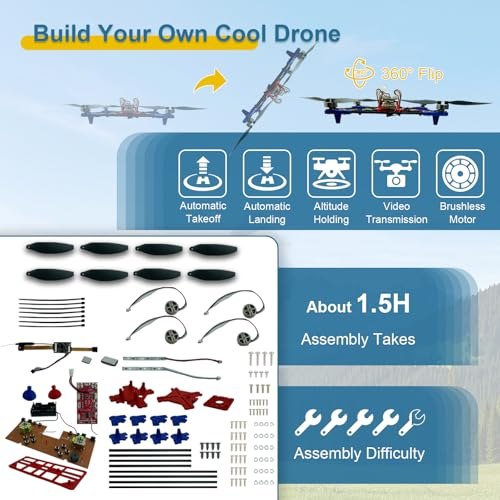
The parts layout in the seller’s images makes the hands-on nature hard to miss. This is not a decorative model with a motor added as an afterthought. It is a functioning quadrotor assembled from separate pieces, including a controller whose circuit-board styling matches the aircraft. Your completed setup has the visual charm of a science fair project that took itself seriously and earned permission to roam.
| Detail | What the seller lists |
|---|---|
| Project type | DIY quadrotor drone with manual assembly |
| Motors and frame | Brushless motors and carbon-fiber rods |
| Estimated build time | About 1.5 hours; individual experience will vary |
| Recommended builder | Users over 14; challenging assembly and operation |
| Flight functions | Optical-flow positioning, headless mode, speed adjustment, one-click takeoff/landing, 360-degree roll |
| Learning materials | Printed manual and advertised editable presentation courseware |
| Spare parts | Replacement propellers included |
The controller also skipped the fancy enclosure
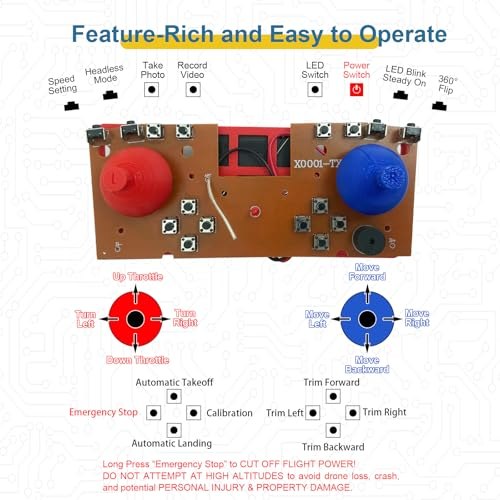
The remote is a wonderfully literal piece of hardware: a visible circuit board, a red control stick on one side, a blue one on the other, and buttons arranged around them. The seller’s diagram labels controls for takeoff, landing, calibration, trimming, speed, and headless mode. There are also labeled photo and video buttons. It has the look of something you might find on a lab bench, except this lab bench is about to demand a little airspace.
Real-time video viewing is among the advertised functions, alongside a video module. That does not establish premium camera quality, a stabilized cinematic image, or the kind of footage used to sell luxury beachfront property. The attraction here is the complete learning project and the chance to explore its controls. Nobody needs a dramatic soundtrack to appreciate a machine they assembled lifting off successfully.
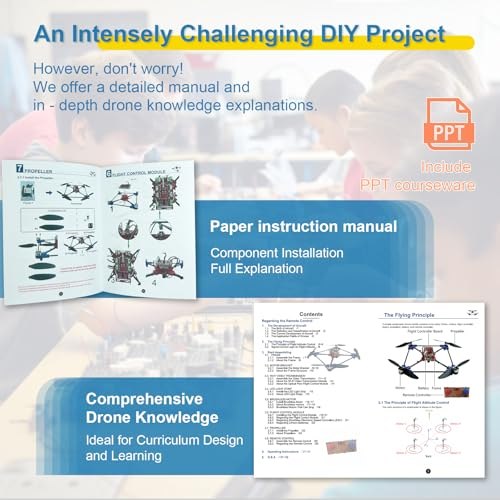
Optical-flow positioning is part of the seller’s hovering feature set. It is worth keeping expectations specific: this listing describes that positioning function, not an obstacle-dodging autopilot or a promise that the drone will rescue every beginner mistake. Give the aircraft appropriate clear space and follow its supplied operating instructions. An open frame makes the components easy to see; it does not make spinning propellers less real.
The seller advertises up to 30 minutes for a single flight. That is a claimed maximum, not a result from our own flight test, and should not become a guarantee on your weekend schedule. Assembly, setup, flying style, and conditions all matter to the experience of a kit aircraft. For a first session, a controlled takeoff and landing is already a respectable achievement. The ceiling fan does not need a rival.
A gift for the person who likes the getting-there part
This makes the most sense for a patient tinkerer, an older student interested in robotics, or an adult who wants a small mechanical challenge with a satisfying payoff. The construction is part of the entertainment. Someone who loves sorting hardware into little trays may find that more appealing than an immediately ready-to-fly gadget. Someone who loses interest during step two of a sandwich recipe probably will not.
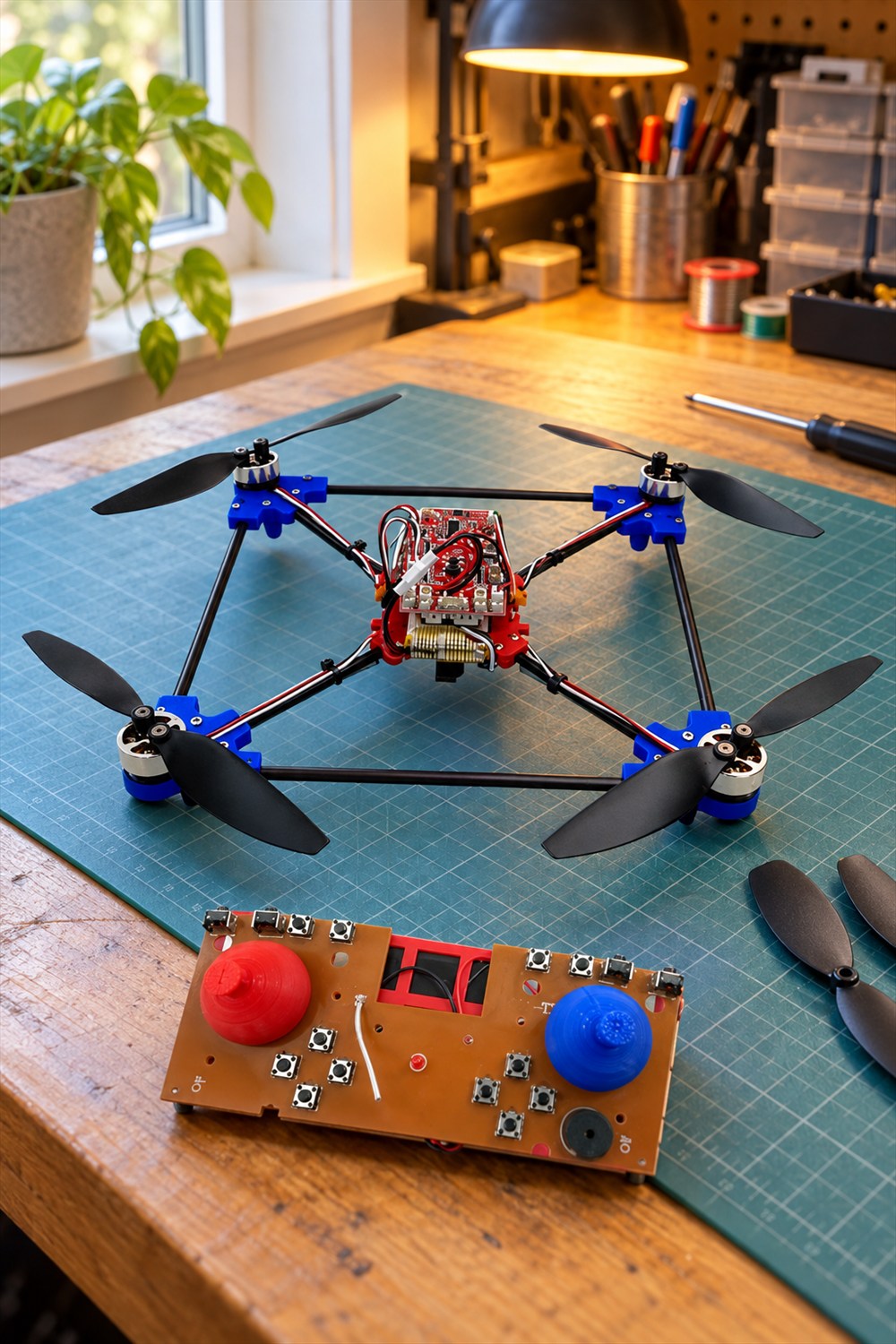
Its visible electronics also make it a conversation starter once it is sitting still. The rods, blue mounts, and red center assembly leave very little doubt that you built something. It could live on a hobby shelf between sessions without pretending to be a miniature military aircraft or a glossy camera platform. It is proudly a kit, complete with the pleasant implication that its owner knows where at least most of the screws went.
There are practical limits to that enthusiasm. Expect to read, assemble carefully, and troubleshoot rather than assuming every step will be effortless. The listing notes that flight-control algorithms can differ slightly between batches. That makes the instructions supplied with your particular kit more useful than memorizing somebody else’s button sequence. The seller advertises technical support, but that is a reason to keep your order information handy, not a substitute for taking your time.
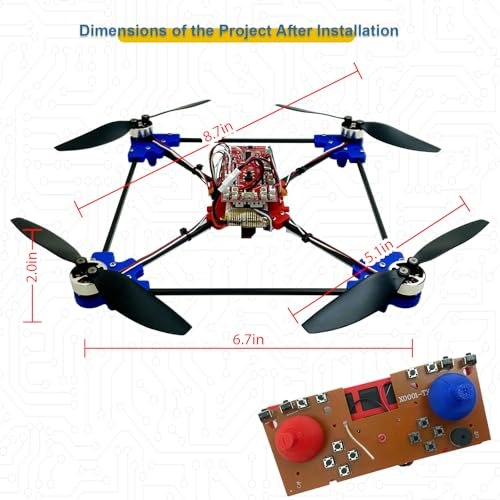
Product images: EIELEDIY listing on Amazon.
The details before you clear the workbench
- Product: EIELEDIY Quadrotor Drone DIY Kit.
- Main draw: build a functioning open-frame drone instead of receiving a finished aircraft.
- Hardware: brushless motors, carbon-fiber rods, exposed central electronics, and a distinctive two-stick controller.
- Features: optical-flow positioning, one-click takeoff and landing, adjustable speed, headless mode, and 360-degree rolls.
- Learning commitment: approximately 1.5 hours of assembly according to the seller, with challenging construction and flying practice expected.
- Audience: users over 14 who enjoy careful hands-on projects.
- Useful extras: spare propellers, a printed manual, and advertised presentation courseware.
The kit is listed on Amazon for $69.99 at the time of writing, with the current new offer sold by HYIC and shipped by Amazon. Check the selected offer for current price and availability. If your idea of a good afternoon involves tiny components, a diagram, and the possibility of a victorious first hover, this is a much livelier reward than another shelf. The houseplant will have to wait.
| Pros | Cons and considerations |
|---|---|
| Assembly is a meaningful part of the experience | Seller rates the project as challenging |
| Open frame shows the motors, rods, and electronics | Exposed components call for careful handling |
| Multiple flight functions to explore | Piloting still requires practice |
| Manual and courseware support learning | Better suited to patient builders over 14 |
| Spare propellers included | Spare parts do not eliminate crash damage |
| Advertised real-time video and long flight duration | Camera quality and maximum endurance are not independently verified here |
Save this find.
Thank yourself later.
Your next great gift idea. Your someday space. Your collection of wonderfully weird things.
Save to PinterestPick a board. Keep the inspiration.
This DIY Drone Kit Turns a Pile of Parts Into a Flying Quadrotor
Where to find This DIY Drone Kit Turns a Pile of Parts Into a Flying Quadrotor
OddityMall may earn a commission from qualifying purchases at no extra cost to you.
Related posts:
This Home Security Surveillance Drone Automatically Deploys When It Senses Intruders
You Can Now Get a Flamethrower Drone Attachment, and It’s Perfect For Wasp Nest Removals
Air PIX Pocket Sized Drone Lets You Get The Perfect Selfie, Controlled By Your Phone
This Personal eVTOL Aircraft Takes Off Vertically and Parks in a Garage