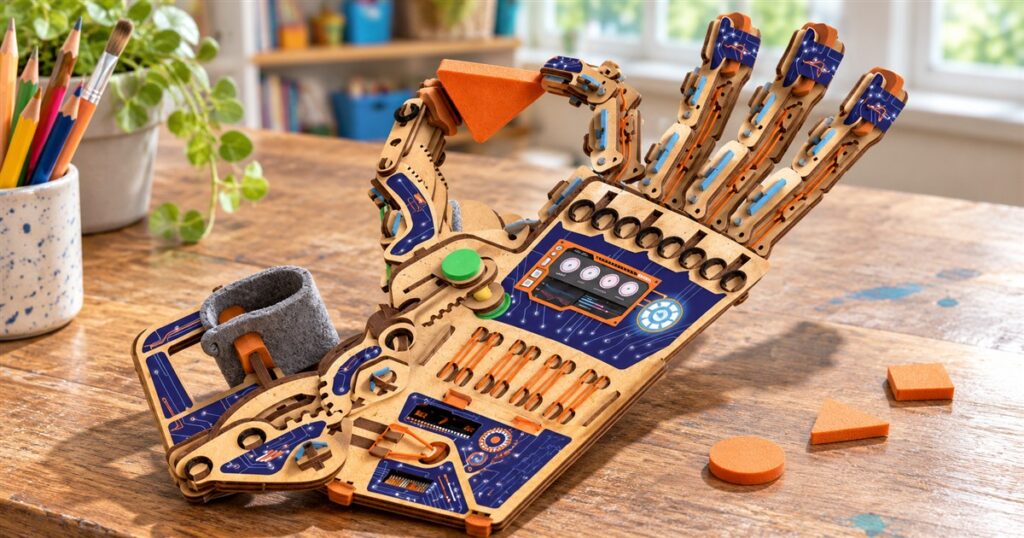
Every child eventually discovers that making a robot hand is a much better use of an afternoon than tidying the hand they already own. Smartivity has turned that perfectly reasonable conclusion into a wooden construction kit. Build the fingers, put on the finished contraption, and suddenly picking up a little block becomes an event worthy of a very small science-fiction soundtrack.
The Smartivity Robotic Mechanical Hand is a wearable, manually controlled model aimed at kids ages 8 to 14. It starts as a collection of parts and becomes an articulated hand that responds to its wearer. There is an appealing amount of machinery on show: layered wooden fingers, visible connections, bands, and a wrist section that looks ready for an extremely polite robot invasion.
The useful distinction is that the building is part of the toy. This is not a finished plastic fist waiting for someone to find the batteries. The project asks its builder to put the mechanism together, then gives those carefully assembled joints a job. That job might be stacking a block. The builder may describe it as advanced robotic materials handling. Both descriptions are acceptable.
A mechanical hand you actually control
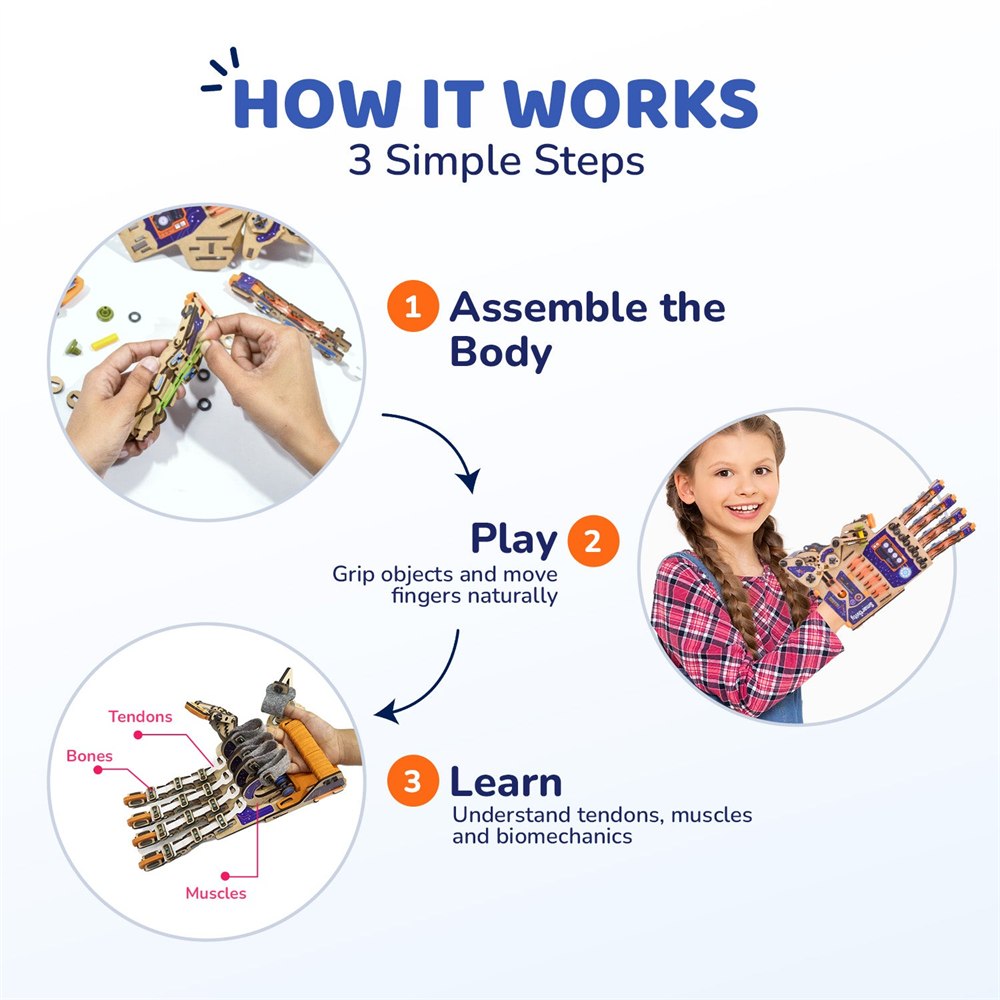
Once assembled, the model is worn on the hand, with finger straps providing the connection between the wearer and the wooden mechanism. Moving your fingers operates its articulated digits. Smartivity describes the process as an introduction to anatomy and biomechanics, using a visible model to explore ideas such as joints and tendons.
That visible movement is the main attraction. With a conventional toy robot, the interesting work often happens inside a sealed body. Here, the connections remain part of the spectacle. A child can watch how a movement at one end travels through the structure and changes the position of a finger at the other. The little pause before a successful grip is half the fun.



The name includes “robotic,” but the control comes from the person wearing it. It is a hands-on mechanical toy, not an autonomous robot or a programmable electronic arm. The blue panels that make it look like superhero equipment are decorative stickers. They are not working screens, despite looking considerably more official than most household remote controls.
The afternoon starts with assembly
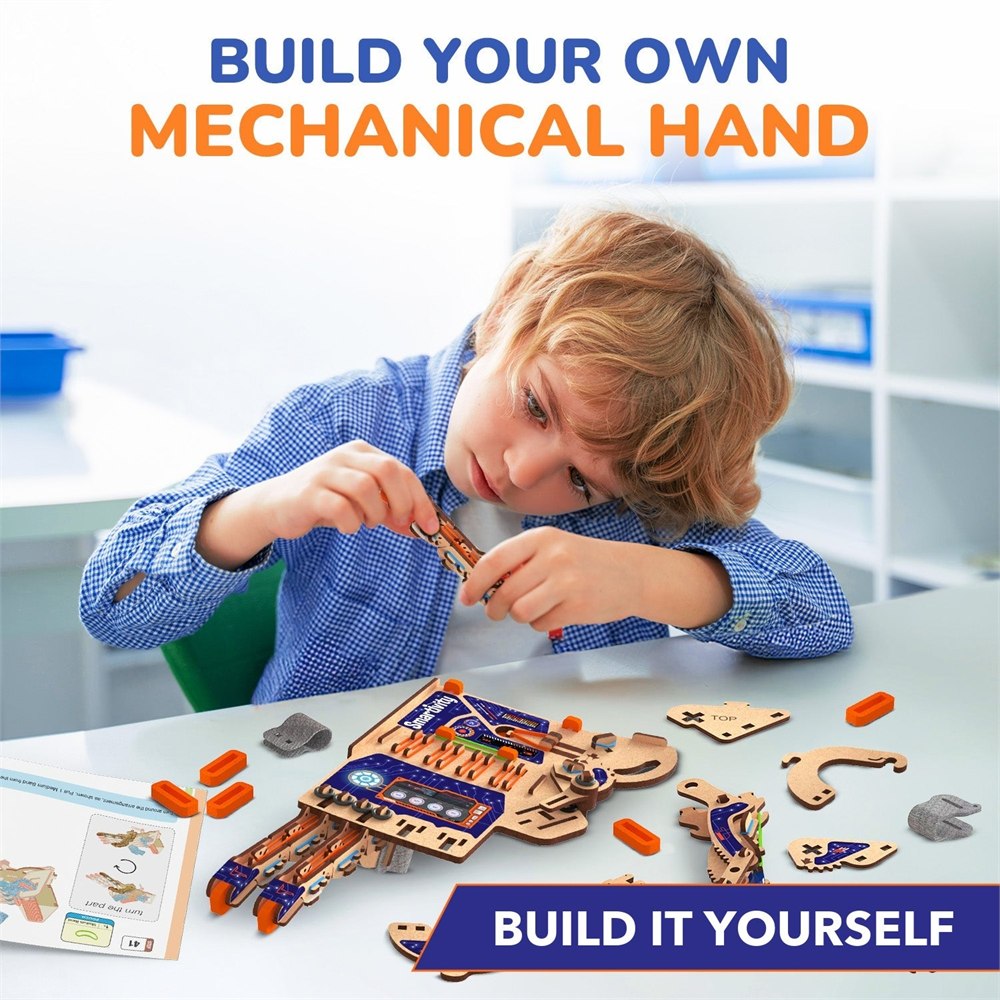
Smartivity uses engineered wood for the structure. Flat components become the frame, joints, and fingers through the assembly process, with a step-by-step manual to guide the work. The result keeps the cut edges and layered construction visible, which gives it some of the charm of a miniature workshop project.
This is a good fit for someone who enjoys understanding how pieces connect. The maker rates the kit’s DIY level as medium on its Amazon comparison chart. That is a useful expectation to set before wrapping it: the build is an activity in its own right, rather than a brief obstacle between opening the box and getting to the toy.
A clear table will make that activity more pleasant. Small parts, a manual, and an expanding wooden hand deserve more room than the narrow strip beside someone’s cereal bowl. Keeping similar pieces together and working through the illustrated sequence also makes it easier to see what belongs where. Your future robot operator may still insist they can do everything from the picture on the box. The manual has a stronger case.
The manufacturer includes instructions and learning activities, while the decorative stickers let the finished assembly lean into its superhero appearance. The components remain recognizably mechanical underneath the decoration. There is something satisfying about a toy that looks fanciful while leaving its actual method of operation out in the open.
- Build first: assemble the wooden structure and moving fingers with the step-by-step manual.
- Wear and control: use the finger straps to make the mechanical digits respond to your own movements.
- Try a grip: use the included shapes for picking-up and stacking challenges.
- Look closely: follow the visible joints and connections as the hand changes position.
- Make it yours: add the included decorative stickers to the assembled model.
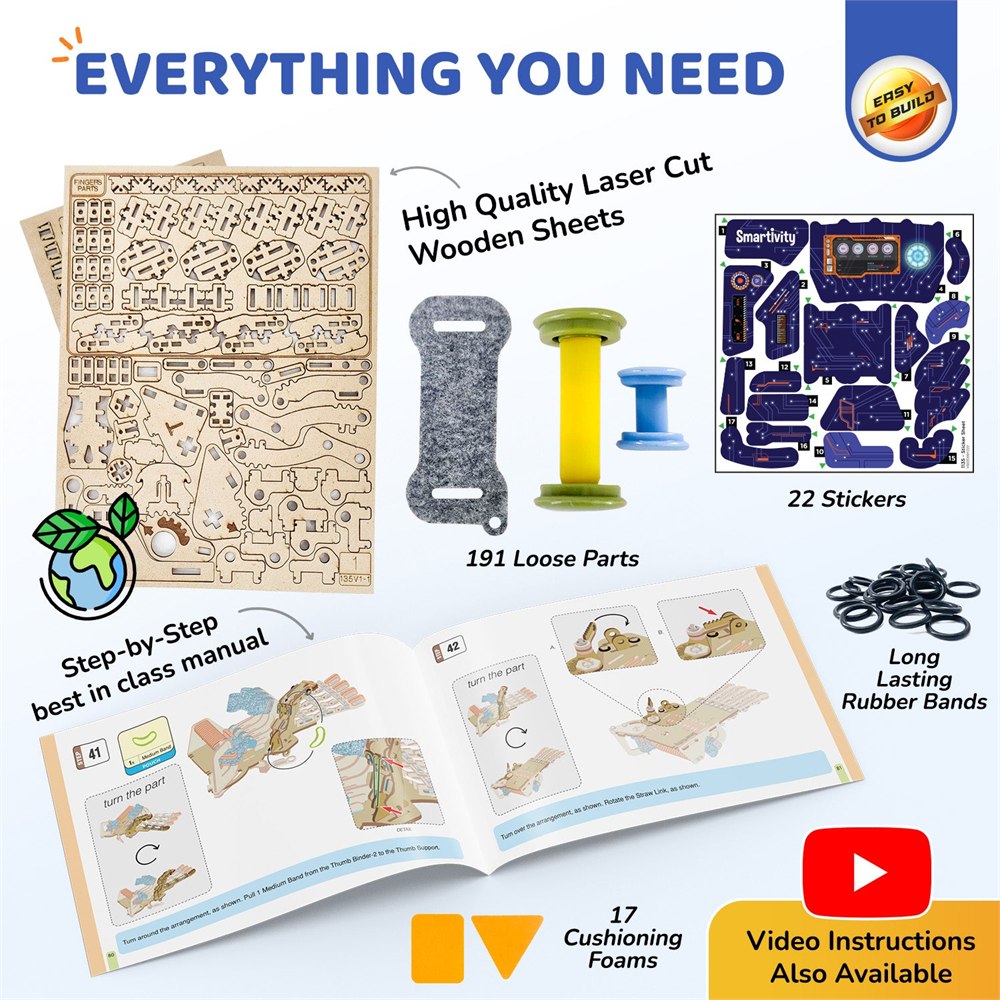
What is in the kit?
The official product description lists the mechanical hand project, shaped blocks for challenges, step-by-step instructions, STEM explanations, and experiments. Manufacturer imagery also shows the wooden sheets, bands, finger straps, and sticker sheet. It is a mix that makes sense: the construction supplies produce the hand, and the small objects give that hand something immediately useful to attempt.
It is worth separating the included challenge pieces from the household objects shown in promotional demonstrations. A picture of a toy holding a cup does not turn the cup into a box accessory. More importantly, it does not make a newly assembled wooden mechanism the obvious choice for carrying your favorite mug across the kitchen. Start with the little practice objects and enjoy the process of getting the grip right.
| Detail | What to expect |
|---|---|
| Product | Smartivity Robotic Mechanical Hand construction kit |
| Recommended audience | Ages 8 to 14 on the Amazon listing |
| Main structure | Engineered wood with visible moving parts |
| Control | Wearer’s finger movements through straps and mechanical connections |
| Build level | Medium in the maker’s comparison chart |
| Activities | Assembly, gripping, stacking and exploring movement |
| Decoration | Included stickers; the illustrated panels are not electronic displays |
The real appeal is the transition from loose parts to a working object. A finger that was a small pile of components now bends. A set of connections that initially looked mysterious now has a visible purpose. Those are concrete discoveries, and they do not require a glowing scoreboard to announce them.
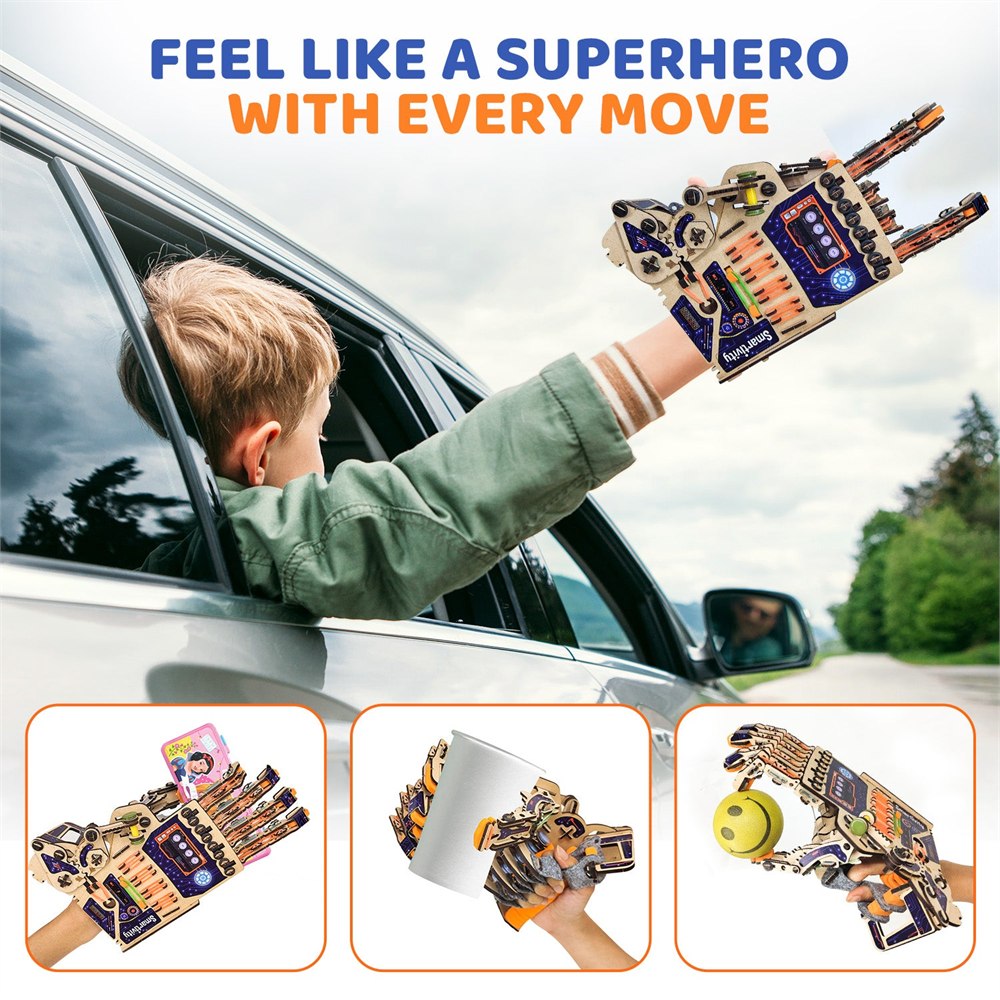
A gift for the child who wants to know how it works
The age range is a starting point, not a promise that every builder will have the same afternoon. Someone who loves construction kits may enjoy following the steps independently; another child may prefer building alongside an adult. Either way, the attraction is the same: there is a finished mechanism to operate when the assembly is done.
It also creates a natural shared project. One person can keep track of the next illustration while the other checks a connection, then both can watch the first successful movement. This is the sort of collaborative achievement that can lead to a disproportionate amount of celebration over a foam triangle. The triangle has done nothing to deserve the attention, but here we are.
Smartivity presents the kit as a way to explore anatomy, engineering, and mechanical movement. Those topics are easy to connect to what is happening on the table. You can compare the model’s bending segments with your own fingers, notice how different positions change a grip, and experiment with placing a block more carefully. No need to turn every moment into a formal lesson; the mechanism already supplies plenty to discuss.
It remains a construction toy with small components and moving joints. Follow the supplied age guidance and assembly instructions, and handle it as a model rather than a strength-enhancing glove. Its best trick is making ordinary hand movement interesting, not helping anyone rearrange the furniture.
The details before you give someone an extra hand
The finished design has a wonderfully specific personality. Natural wood keeps it looking like something assembled in a workshop, while the navy and orange decoration suggests a costume department has been allowed to improve the workshop’s equipment. It is elaborate enough to invite inspection without hiding the mechanism that makes it enjoyable.
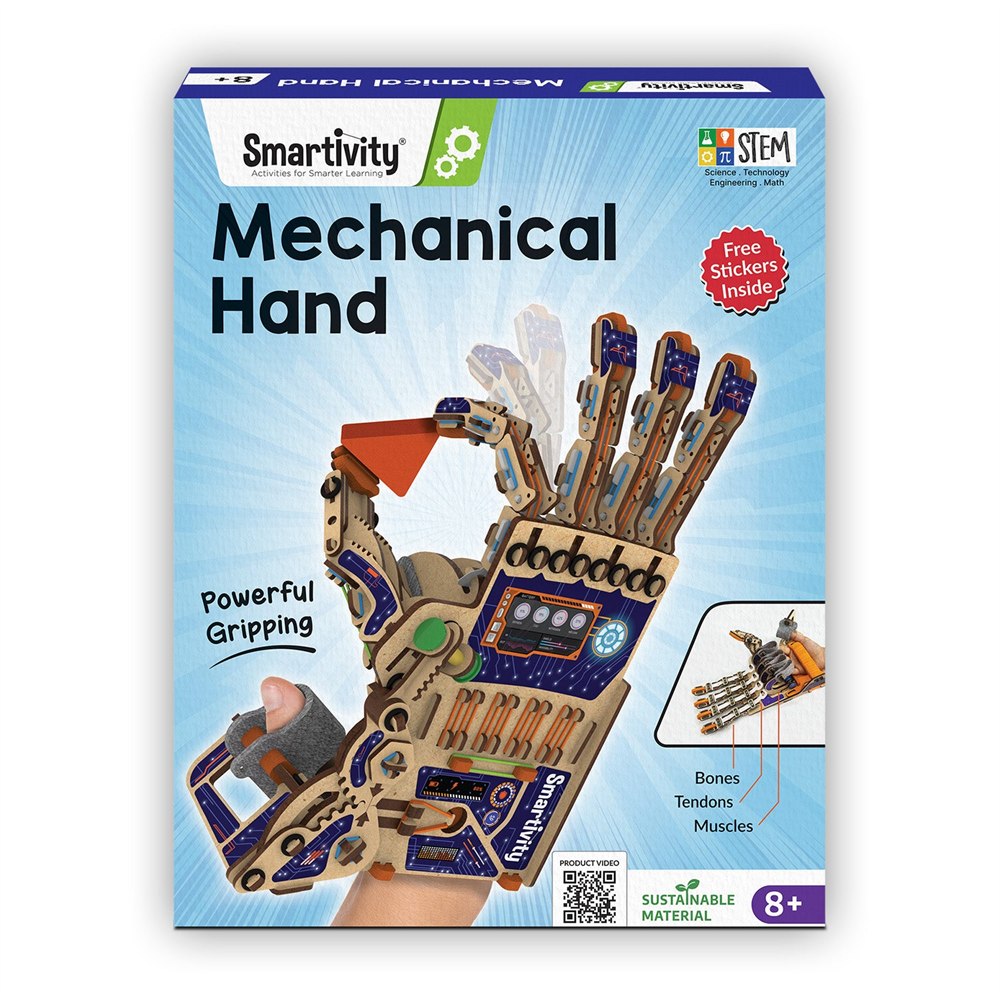
Product images courtesy of Smartivity.
- Wearable mechanical hand that the builder assembles and operates.
- Recommended for ages 8 to 14 in the Amazon listing.
- Engineered-wood construction with articulated fingers and visible connections.
- Finger straps translate the wearer’s movements into mechanical motion.
- Includes instructions, decorative stickers, and shaped blocks for challenges.
- Designed for screen-free building, gripping, and experimentation.
At the time of writing, Amazon listed the kit for $23.99, in stock, sold by Smartivity Labs USA and shipped by Amazon. The price and availability can change. For the right builder, the attraction is less about owning a robot and more about putting one small piece of robot logic together yourself. Also, requesting a high five becomes a much more interesting administrative procedure.
| Pros | Cons |
|---|---|
| Combines a construction project with a usable moving model | Assembly is required before the main play activity |
| Visible joints make mechanical movement easy to observe | Small components need an organized workspace |
| Wearable controls make the finished hand interactive | Manual operation; no autonomous or programmable functions |
| Includes objects for gripping and stacking challenges | It is a toy mechanism, not a heavy-duty gripper |
| Decorative stickers add a playful finish | The display-like graphics are decoration only |
At a glance
Product snapshot
- Listed price
- $23.99Prices and availability can change. Check the seller for current details.
- Where to find it
- Amazon.com
- Category
- Toys