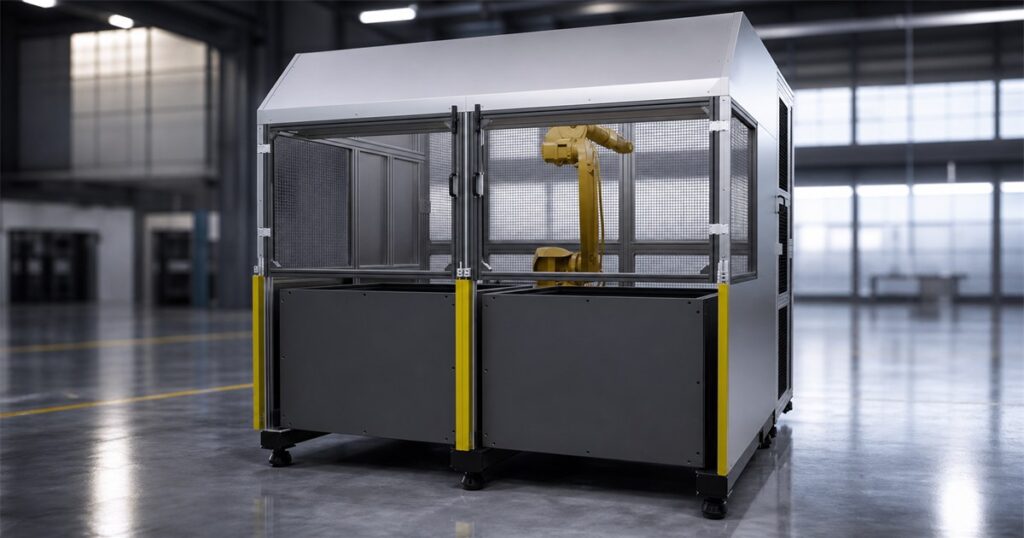
There are two kinds of chores in this world: the ones you avoid because they are boring, and the ones factories avoid because they require a small committee of robot people, vision people, fixture people, safety people, and one exhausted manager quietly wondering whether the conveyor belt has feelings. Apera AI’s VuePod is for that second category, which means it is basically a Roomba for bins full of metal parts, if the Roomba lived in a safety cage and could casually feed a production line.
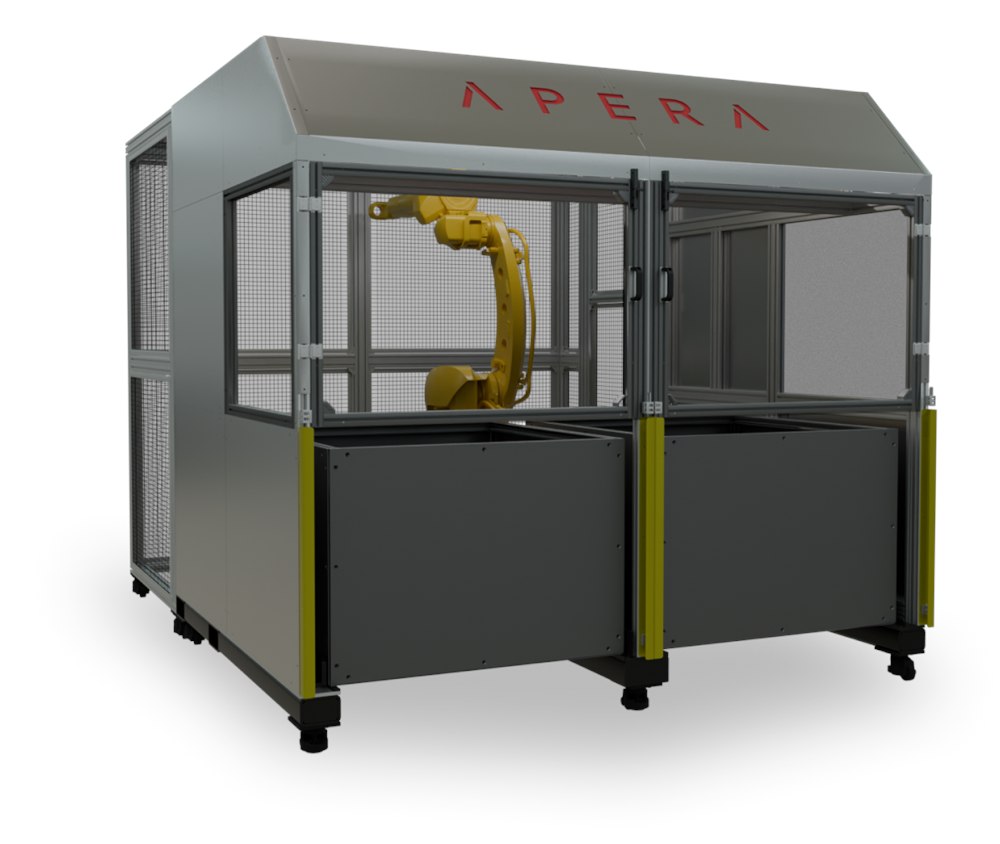
The VuePod is a self-contained, self-configuring bin-picking robot cell built for machine tending and fixture loading. Instead of selling manufacturers a vague promise called “we can probably robotize that after several meetings,” Apera AI is packaging the whole thing as a product: the enclosure, robot, cameras, magnetic gripper, regrip station, HMI, safety system, and the company’s 4D Vision platform all arrive together like a very serious vending machine for industrial competence.
That is the weirdly delightful part. Bin picking sounds simple until you imagine a robot staring into a crate of shiny stamped metal parts that are all tangled, tilted, overlapping, reflecting light, and generally behaving like a drawer of loose silverware after an earthquake. Humans can reach in, grab the best-looking piece, flip it around, and shove it into a jig with only a modest amount of workplace sighing. Robots, historically, have needed a lot more babysitting.
VuePod’s pitch is that it plans the whole job on its own. It figures out a picking strategy, corrects part orientation, validates the pick, and handles path planning inside a complete cell that is already designed around the hardware. In normal-person language, it is a robot station that tries very hard not to turn every new bin of parts into a six-month engineering group project.
A Factory Robot Cell That Shows Up With Its Homework Done
Apera says the cell ships ready to run with the vision trained and the robot pre-programmed. It is built for automotive suppliers and OEMs working with ferrous metal parts, especially the small-to-medium stamped parts that show up in body shops and machine-tending stations. The launch configuration is not trying to be a universal robot oracle for every object on Earth. It has a defined job: pick one SKU of ferrous parts from bins, reorient them when needed, validate the pose, and load them into a fixture, jig, or conveyor.

That narrower focus is what makes it interesting. A lot of robotics products speak fluent brochure and then quietly require a custom integration odyssey. VuePod is more like, “Bring me the metal things. I have a house. I have a robot arm. I have thoughts.” It is still industrial equipment, obviously, not something you put next to the espresso machine unless your espresso machine has a PLC and a union contract.
The setup process is meant to be three steps: connect, calibrate, and teach placement. Power and ethernet go in, upstream and downstream PLC signals connect to the safety system, and the cell runs an auto-calibration routine on first boot. Then the operator places a single part in the fixture through the HMI so VuePod can learn the drop location. After that, the machine is designed to run without on-site robot programming or vision software expertise.
- It is self-contained: the robot, enclosure, safety hardware, vision system, bins, HMI, and regrip station are part of the product rather than a separate custom puzzle.
- It self-calibrates: the cell uses an auto-calibration routine and configures its cameras instead of asking a human to spend the week negotiating with pixels.
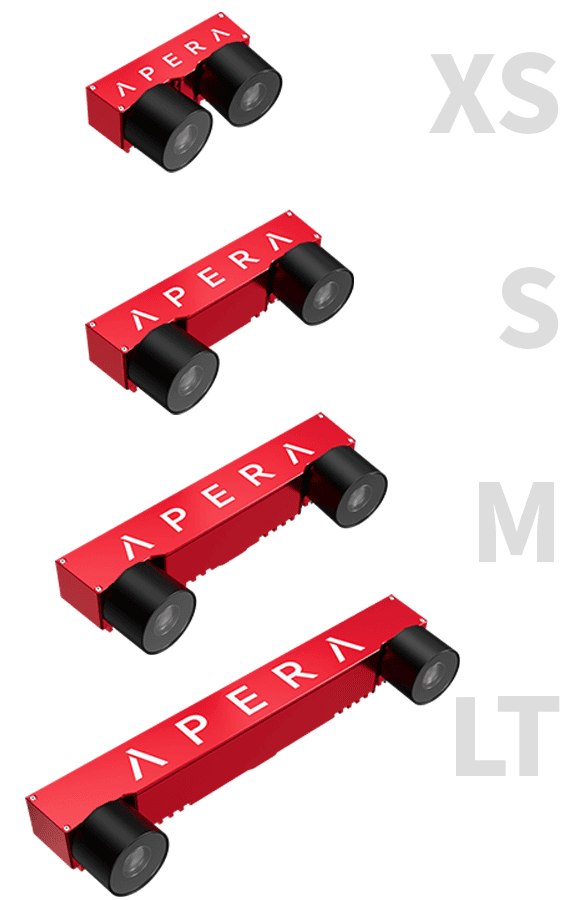
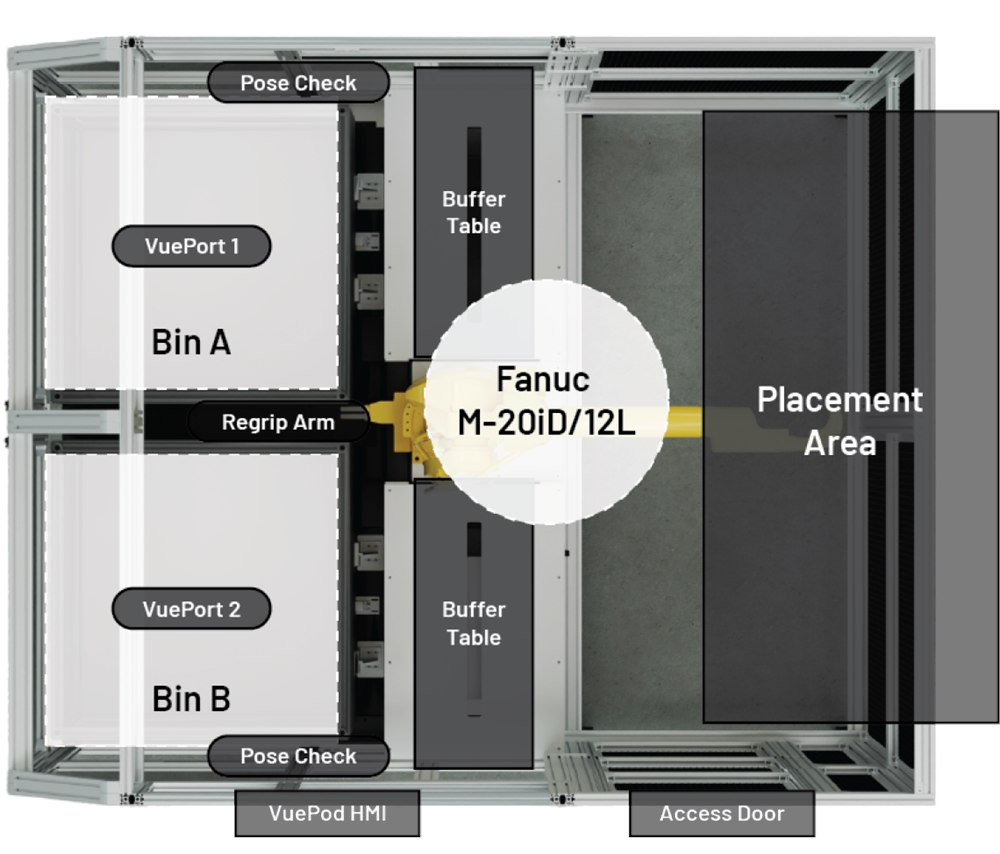
- It validates each pick: dual VuePort pose-check cameras confirm the part before it is handed off to the machine.
- It handles reorientation: an integrated rotary regrip station corrects part orientation before placement.
- It is aimed at ferrous parts: the launch model uses a magnetic gripper for small-to-medium stamped metal parts.
That last detail matters because magnets are wonderfully blunt instruments when used correctly. The single magnetic gripper is meant to cover the supported part range, which keeps the cell from becoming a tiny warehouse of custom end effectors. The tradeoff is that VuePod V1 is built around ferrous metal, not plastic doodads, plush collectibles, or the emotionally complex pile of cables under your desk.
What VuePod Is Built To Handle
The product page lays out a fairly specific first configuration, which is refreshing in the way only industrial specs can be refreshing. It supports small-to-medium ferrous stamped sheet metal parts up to 15 inches at the longest dimension and up to 4 kilograms. The bin setup uses two single-SKU now-and-next bins, with forklift and AMR access for bins up to 48 x 48 x 34 inches. Inside the cell is a Fanuc M-20iD/12L robot, pre-programmed so the site team does not have to write robot code during installation.
| VuePod Detail | What Apera AI Lists |
|---|---|
| Supported parts | Ferrous metal, small to medium, up to 15 inches long and up to 4 kg |
| Application | Single-SKU machine loading into a fixture, jig, or conveyor |
| Robot | Fanuc M-20iD/12L, pre-programmed |
| Gripper | Magnetic gripper covering the supported part range |
| Validation | Dual VuePort pose-check cameras validate every pick |
| Setup target | On-site integration in under 3 days |
The whole system is built on Apera’s 4D Vision platform, which the company describes as stereo perception with automatically generated pick points. In practice, the cell is trying to close the awkward gap between “the robot can see the part” and “the robot can actually get the part into the right place without creating a tiny factory blooper reel.” It uses vision, simulation, pose checking, and the regrip station to catch the problems that make bin-to-fixture loading annoying.
The operator interface is deliberately limited, too. Apera says day-to-day operation runs through a wall-mounted HMI where operators can start and stop the cell, monitor diagnostics, initiate bin swaps, and re-teach placement if a jig moves or gets replaced. That is a very different energy from handing someone a robotics software console and saying, “Good luck, the future depends on your mouse accuracy.”
The Funny Part Is That It Is Trying To Be Boring
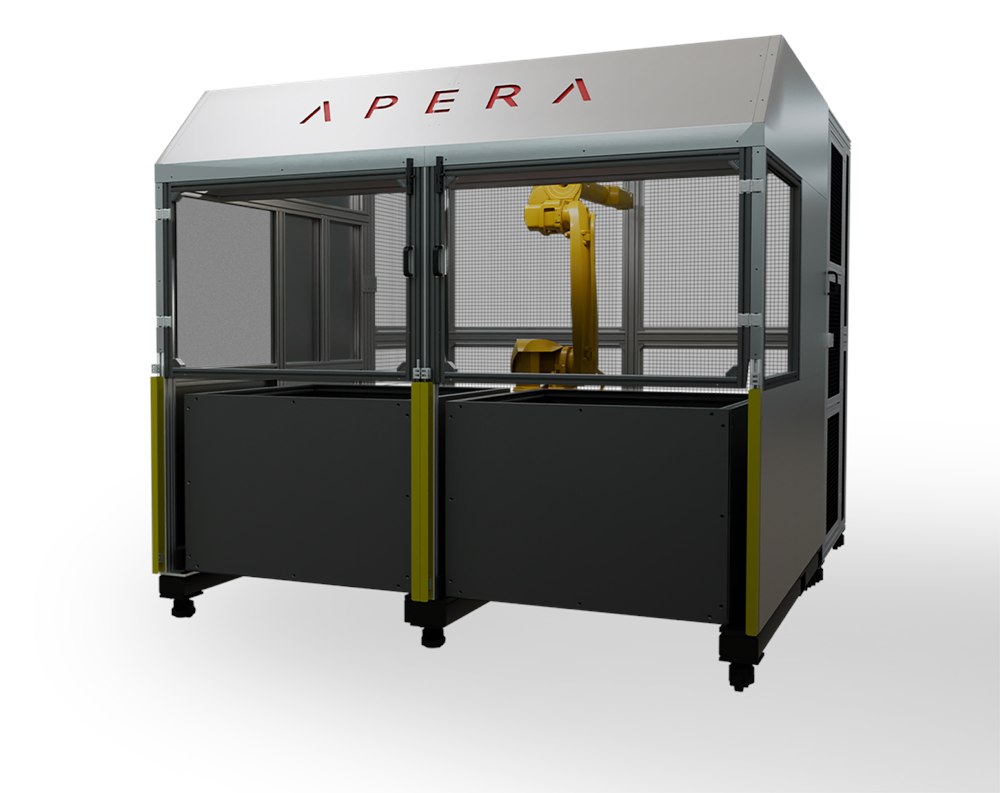
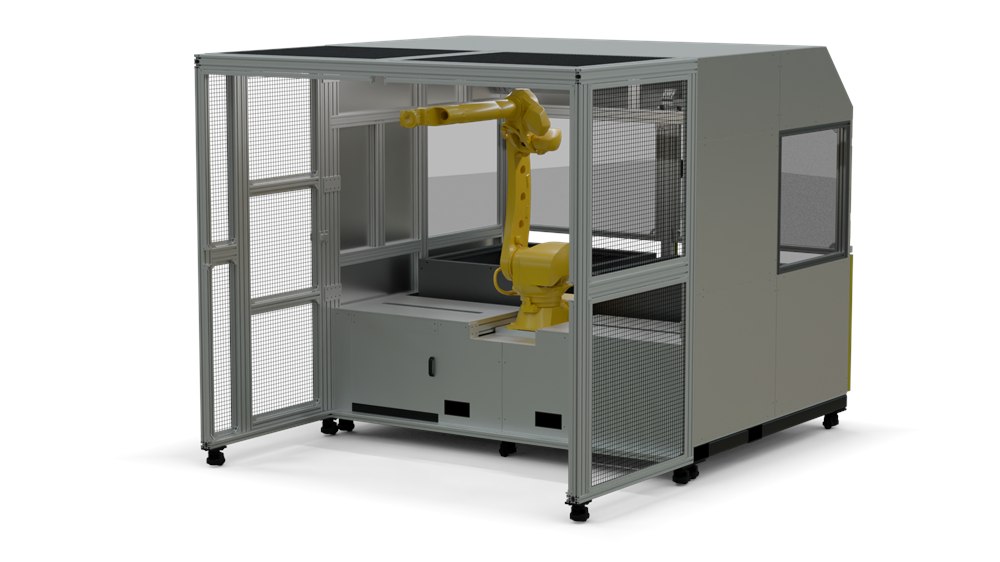
VuePod is not visually subtle. It looks like a compact room built specifically to keep a yellow robot arm from making bad choices in public. The enclosure is big, gray, mesh-sided, and serious, with the arm visible inside like it has been grounded until it learns to respect the safety manual. But the actual point is to make bin picking less dramatic, less bespoke, and less dependent on a fragile sequence of experts appearing at exactly the right time.
That is why Apera’s announcement frames it as a product rather than a project. The company unveiled VuePod at the 2026 industrial robotics show on June 23, 2026, and said it is available now through an early access program. The official page also describes a Production Readiness program at Apera’s Detroit facility where prospective customers can send one or two bins of best-fit ferrous parts, get a live VuePod run, and receive cycle time and placement accuracy data before committing.
For manufacturers, that is the industrial equivalent of asking a suspicious appliance to prove it can fold a fitted sheet before you let it move in. Send the parts, watch the machine try the job, then decide whether this robot cell deserves a spot on the line or should go back to robot finishing school.
Apera lists an on-site setup target of less than three days from delivery to first pick, and says time to first pick can be as fast as four weeks after purchase order. The ROI model on the official page points to under one year payback for triple-shift operation and under two years for double-shift operation. Those are not universal promises for every factory, of course, because manufacturing math has many ways to become spicy. They are the model Apera is using for the best-fit machine-tending stations VuePod is designed around.
The roadmap is also deliberately practical. Apera says future configurations being explored include dual-SKU loading from two bins, finished goods handling for a full machine-tending loop, and repack applications. Translation: the robot might eventually graduate from “please feed this machine one kind of metal piece” to a more ambitious plant-floor existence, but V1 is focused on doing the defined job well.
Who This Giant Robot Appliance Is Actually For
This is not a consumer gadget, and that is part of why it belongs in the OddityMall zone of fascination. It is a real industrial product with a weirdly appliance-like premise: instead of hiring a team to engineer a custom bin-picking cell from scratch, qualified customers can apply for a self-contained system that arrives with the hard parts already bundled together.
Apera says early access is aimed at Tier 1 or Tier 2 automotive suppliers and OEMs with identified machine-loading use cases involving ferrous metal parts, especially teams ready to move from approval to deployment during the program window. In other words, it is for the people whose daily problems include phrases like “PLC signals,” “fixture loading,” and “why is this stamped part upside down again.”
- Product: Apera AI VuePod self-configuring bin-picking robot cell
- Main function: picks ferrous metal parts from bins, regrips them, validates pose, and loads fixtures, jigs, or conveyors
- Launch timing: unveiled at the 2026 industrial robotics show on June 23, 2026
- Best fit: automotive suppliers and OEMs with single-SKU machine-tending applications
- Setup claim: under 3 days on-site integration, with first pick possible as fast as 4 weeks after purchase order
- Price: quote required; public early-access pricing is not displayed
VuePod is available through Apera AI’s early access process, with applications reviewed for fit. Since pricing is not publicly listed, the practical price note is “ask Apera and prepare your most industrial email voice.” The product page points buyers to apply for early access rather than add one to a cart, which is fair, because a self-configuring bin-picking cell is not exactly a stocking stuffer unless your stocking is a loading dock.
| Pros | Cons |
|---|---|
| Turns a custom bin-picking build into a packaged robot cell | Only suited to specific industrial users, not general shops |
| Self-calibration and HMI operation reduce the need for on-site robotics expertise | Launch model is focused on ferrous metal parts |
| Integrated regrip station helps correct part orientation before placement | Single-SKU loading limits broader mixed-part jobs for now |
| Dual pose-check cameras validate picks before machine handoff | Quote-only pricing means no simple public price comparison |
| Official setup target is measured in days instead of months | Early access availability means qualification is required |
| Large enclosed design makes the robot cell visually spectacular | Requires real factory floor space and integration planning |
Where to find This Self-Configuring Bin-Picking Robot Cell Turns Factory Part Chaos Into A Product
OddityMall may earn a commission from qualifying purchases at no extra cost to you.