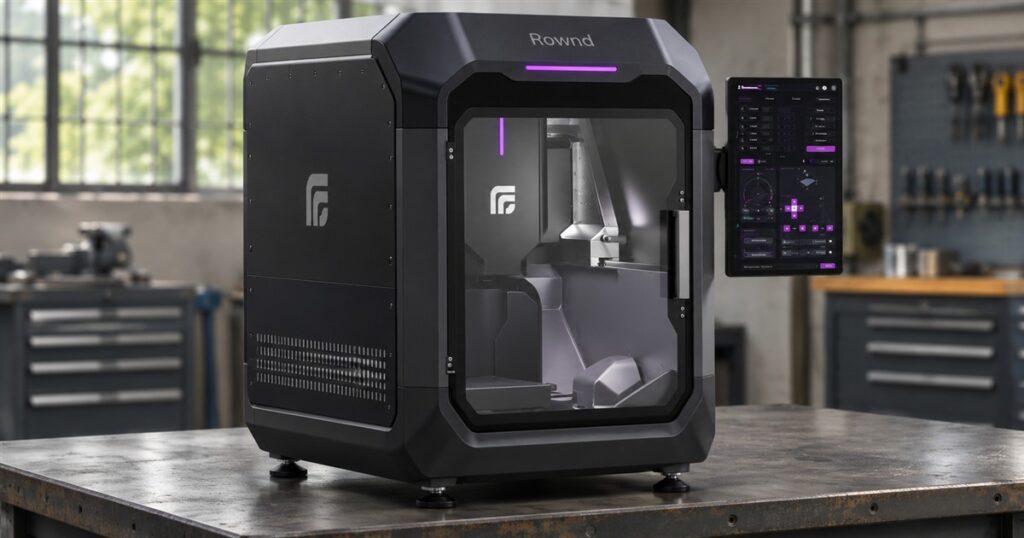
There is a particular stage of workshop ownership where a drawer full of tools stops being enough. You begin looking at a complicated metal part and thinking, “I could make that.” The Rownd 5X desktop 5-axis CNC mill is aimed squarely at that moment, preferably before you attempt to carve an aluminum impeller with optimism and a cordless drill.
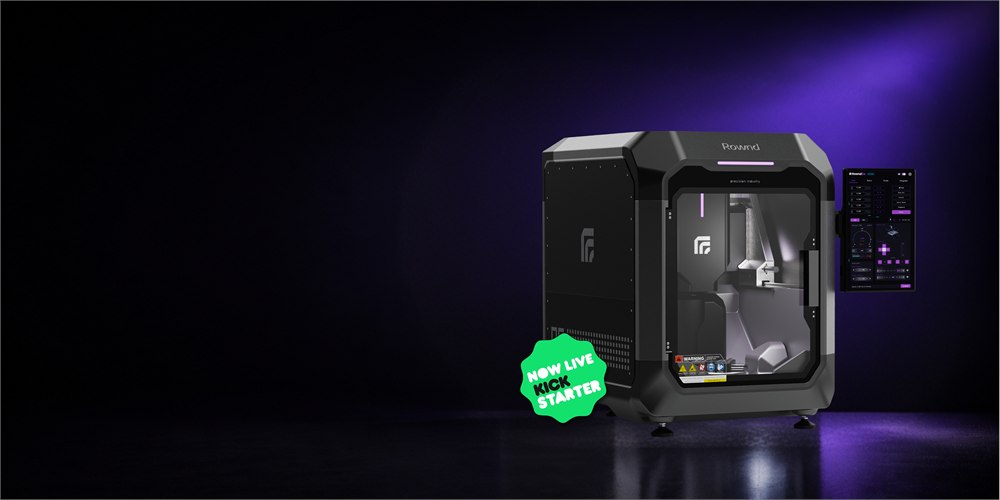
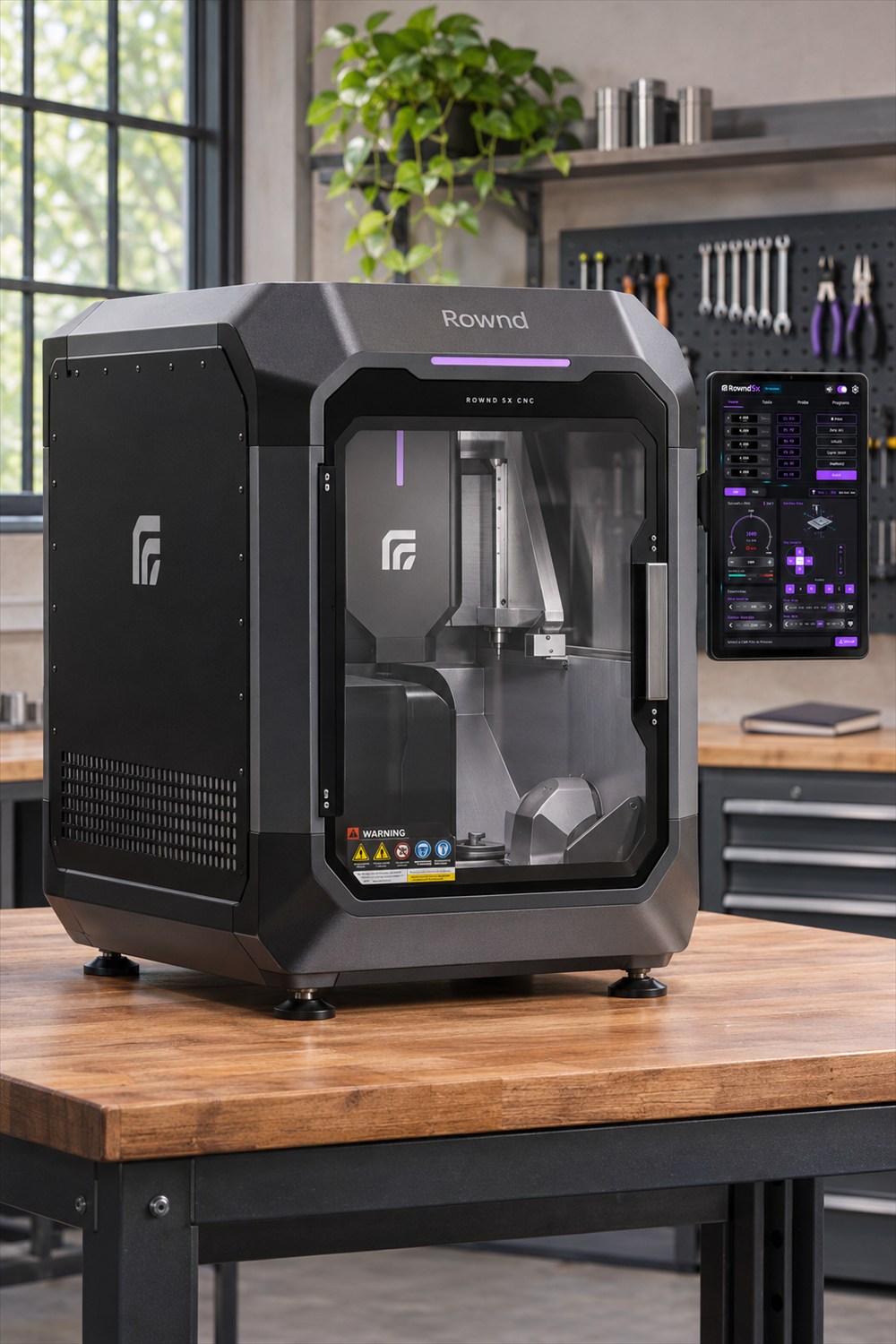
Rownd Precision’s enclosed milling machine combines five-axis motion, a ten-position automatic tool changer, and a large touchscreen in a format intended for engineers, makers, educators, and small workshops. It takes the subtractive route to making things: a cutting tool removes material from a workpiece until the desired shape remains. Your lovely block of metal gets smaller. Your collection of metal chips gets considerably more ambitious.
The interesting part is how much movement Rownd puts inside the enclosure. Alongside conventional three-axis machining, the 5X supports both simultaneous five-axis milling and indexed 3+2 work. Those are different capabilities with different uses, and having both gives a workshop more options than simply approaching every part from directly above.
A workpiece that can change its angle
In indexed machining, the machine positions the workpiece at an angle before making the cut. Simultaneous five-axis machining allows the additional axes to move during cutting. Think of the difference between turning an object to inspect another side and continuously rotating it while following a curved surface. The second trick demands considerably more choreography.
Rownd lists a full 360-degree C-axis rotation and an A-axis travel range from minus 45 to plus 90 degrees. The practical attraction is access: reaching different faces and contours with less manual repositioning. Anyone who has spent more time setting up a part than actually working on it will understand the appeal. The clamps have had enough starring roles.
Related posts:


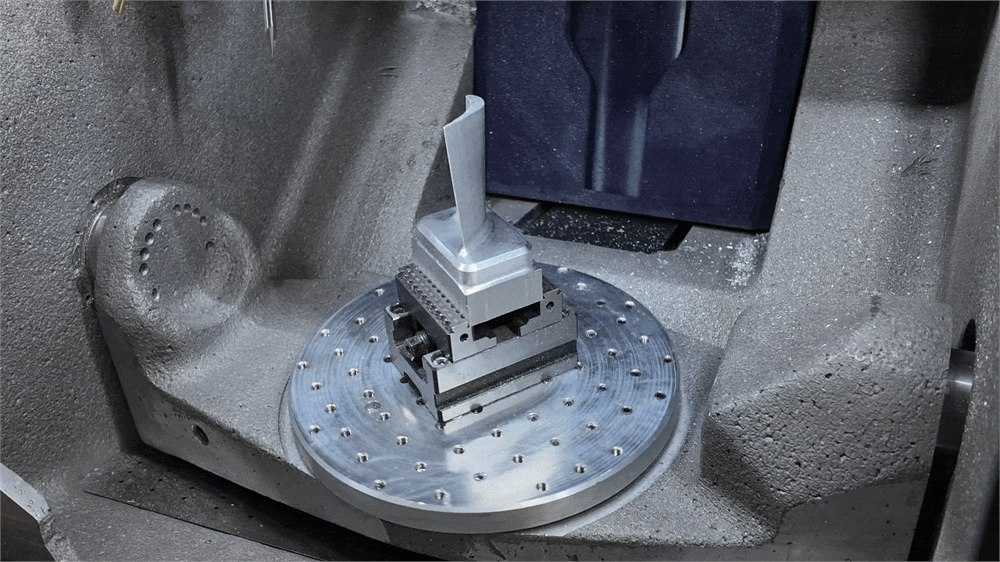
This does not mean every shape becomes easy, or that a machine can cut through fixtures to reach a hidden surface. Workholding, tool access, and a suitable machining strategy still matter. Five-axis capability expands the possibilities; it does not relieve the operator of thinking about where everything is going to move.
That distinction is part of what makes this product interesting for small engineering shops and teaching spaces. It brings several machining approaches together in one enclosed system, giving users a way to explore more involved parts without treating every new angle as a separate manual setup.
Ten tools waiting for their turn
The automatic tool changer holds ten ISO20 tools. A machining job can need different tools for different operations, so keeping several ready can reduce interruptions between steps. Instead of repeatedly stopping to swap tools by hand, the machine can handle those changes as part of an appropriately prepared program.
This is useful because it tackles the repetitive part of the process. The operator still chooses the tooling and prepares the job. The machine gets the less glamorous assignment of fetching the next cutter without wandering off to look for the wrench that was definitely just here.
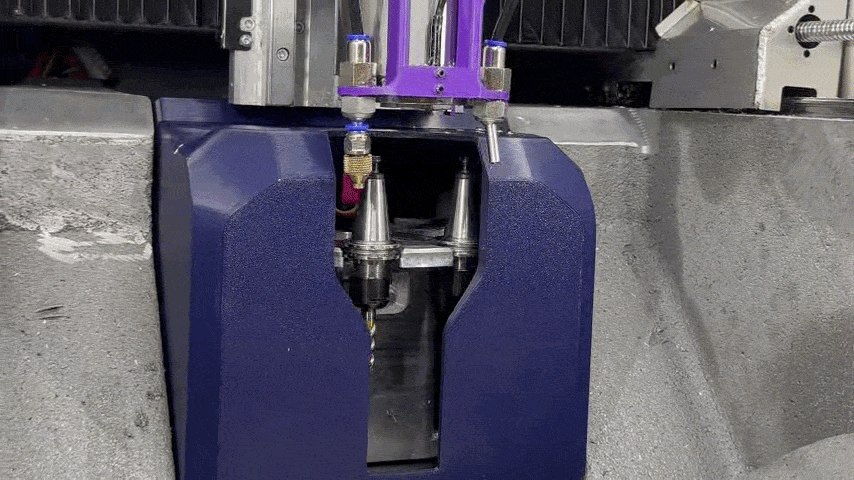
Rownd pairs that tool system with a water-cooled 2.2 kW spindle rated up to 24,000 rpm. The published specification also lists mist cooling for the tool. Those are separate details: spindle cooling concerns the spindle itself, while the cutting operation has its own cooling arrangement.
The main workflow features are easy to appreciate together:
- Simultaneous five-axis motion for machining that calls for coordinated movement.
- Indexed 3+2 and conventional three-axis modes for other jobs.
- Ten automatic tool positions using ISO20 holders.
- A 13.3-inch touchscreen for setup, monitoring, and control.
- A fully enclosed machining area that keeps the cutting process behind a physical enclosure.
The working area has two different numbers
One number rarely tells the whole story with a machine that can tilt and rotate a workpiece. Rownd publishes a three-axis working area of 265 by 240 by 180 mm, while the five-axis machining capacity is listed as a 200 mm diameter by 180 mm envelope. These describe different modes and should not be treated as interchangeable measurements.
In particular, those figures describe machining space, not the outside dimensions of the machine. They also do not promise that every object of that size will work with every fixture and tool. Before planning a project around the outer limits, the actual setup deserves a proper check. The laws of geometry remain stubbornly unimpressed by enthusiasm.
| Published specification | Rownd 5X |
|---|---|
| Machining modes | Simultaneous 5-axis, indexed 3+2, and 3-axis |
| 3-axis working area | 265 × 240 × 180 mm |
| 5-axis machining capacity | 200 mm diameter × 180 mm |
| Spindle | 2.2 kW, up to 24,000 rpm, water-cooled |
| Automatic tool changer | 10 tools, ISO20 holders |
| Positioning repeatability | ±0.02 mm, manufacturer specification |
| Display | 13.3-inch touchscreen |
The quoted positioning repeatability is another figure worth reading carefully. It describes the manufacturer’s positioning specification; it is not a blanket promise that every finished part will have that tolerance. Tooling, material, setup, and the program all play a role in the result. A tidy specification table cannot do your entire machining plan for you.
A touchscreen helps, but the CAM work still matters
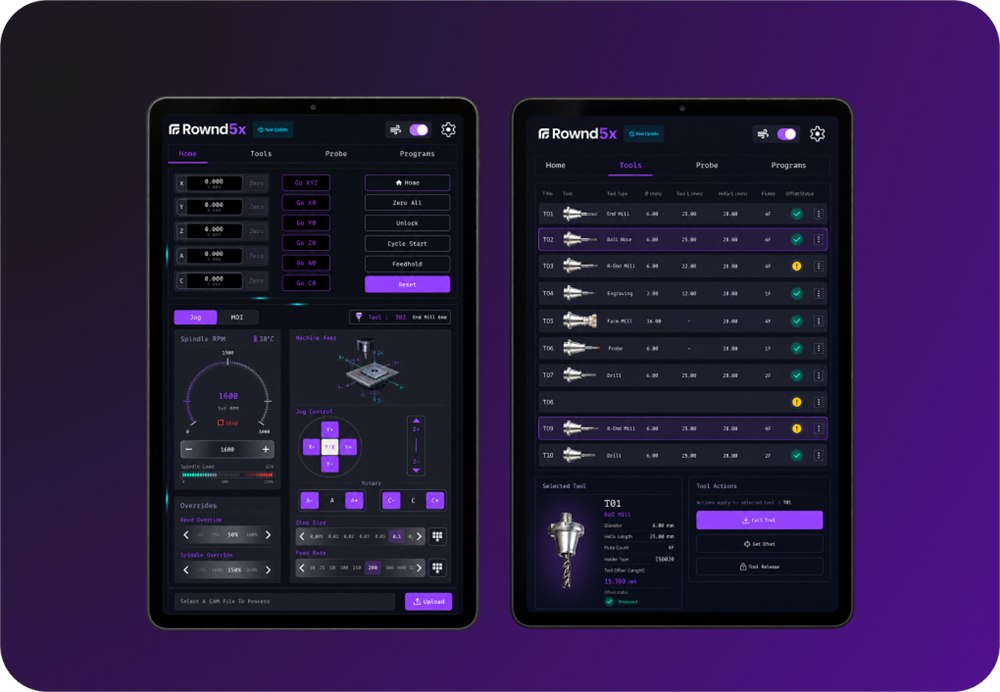
The portrait-format touchscreen gives the machine a surprisingly modern face. Rownd’s interface images show controls and tool information collected on the display, which is a welcome sight if your mental picture of machining involves a mysterious panel of buttons and one person in the building who knows what they mean.
For preparing jobs, Rownd names Fusion 360, SolidCAM, Mastercam, and Siemens NX among compatible CAD/CAM options, and says custom post-processors are provided free. A post-processor is the part of the workflow that translates a machining plan into instructions suited to a particular machine. Compatibility should still be checked against the exact software, features, and configuration you intend to use.
The touchscreen is therefore a control interface, not a promise that complex five-axis toolpaths appear by magic. Designing the part, choosing tools, planning cuts, and checking the program remain meaningful work. This is attractive equipment for someone interested in machining, rather than an appliance for someone hoping to avoid learning about it.
What it is intended to cut
Rownd lists aluminum alloys including 6061 and 7075, brass, copper, engineering plastics such as POM and PEEK, composites, and soft metals. That gives prospective users a useful picture of the intended material range without turning the machine into a universal answer for every substance in the garage.
Potential projects might include custom housings, brackets, prototype parts, and small components with angled features. Whether a particular project makes sense depends on its geometry and machining requirements. The appealing idea is being able to make a purpose-built part instead of searching endlessly for a commercial component that is almost right.
There is also an obvious teaching appeal. Watching a workpiece change orientation while a cutter follows a planned route makes the relationship between a digital model and a physical part unusually visible. It is an impressive demonstration, although instruction and supervision still belong in the room. A window is not a substitute for knowing how the machine works.
Price, delivery plans, and the workshop reality check
Rownd advertises a planned Kickstarter price of $5,999 and says production shipments are planned to begin in the second quarter of 2027. Treat that as crowdfunding pricing and a proposed production timeline, rather than an in-stock machine with a guaranteed delivery date. Final specifications can change as development continues.
Power requirements deserve direct confirmation before making room for it. The technical table lists 230V at 50Hz or 208–240V at 60Hz, while the FAQ also mentions 110V. Those statements need clarification for your particular configuration and location. “Desktop” is a description of the product category, not permission to assume the nearest household outlet is suitable.
The same practical approach applies to installation space, support, tooling, and the complete purchase package. A capable mill can be an exciting addition to a workshop, but the useful question is whether its final configuration fits the work you actually want to do. Buying ten tool positions solely because ten is more than nine is a wonderfully human impulse, though perhaps not a complete business plan.
- Product: Rownd 5X desktop CNC mill from Rownd Precision.
- Main attraction: Simultaneous five-axis motion plus indexed and three-axis modes.
- Tool handling: Ten-position ISO20 automatic tool changer.
- Controls: 13.3-inch touchscreen and a fully enclosed machining area.
- Availability: Crowdfunding project with planned Q2 2027 production shipments.
- Before committing: Confirm final specifications, electrical requirements, package contents, and delivery terms.
Product details and inline images: Rownd Precision. This is a machine for the person whose next project keeps becoming more complicated, and who would quite like their workpiece to keep up.
| Pros | Cons and considerations |
|---|---|
| Supports simultaneous five-axis and indexed machining | Complex work still requires suitable CAM planning and operator knowledge |
| Ten automatic tool positions reduce manual changes | Tooling and setup must be chosen for each job |
| Enclosed format and large touchscreen | Installation and electrical requirements need confirmation |
| Published capacity covers a useful range of small parts | Fixtures and tool access affect usable capacity |
| Designed for workshops, engineers, and educators | Crowdfunding delivery timing and final specifications can change |
Save this find.
Thank yourself later.
Your next great gift idea. Your someday space. Your collection of wonderfully weird things.
Save to PinterestPick a board. Keep the inspiration.
This Desktop 5-Axis CNC Mill Changes Ten Tools Automatically
At a glance
Product snapshot
- Listed price
- $5,999 planned Kickstarter pricePrices and availability can change. Check the seller for current details.
- Where to find it
- Rownd Precision
- Category
- Gadgets