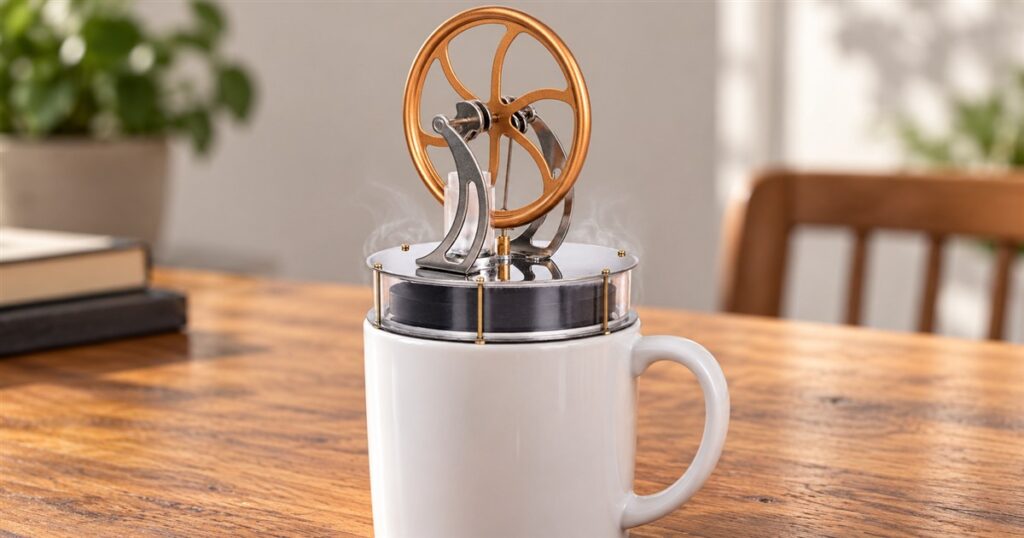
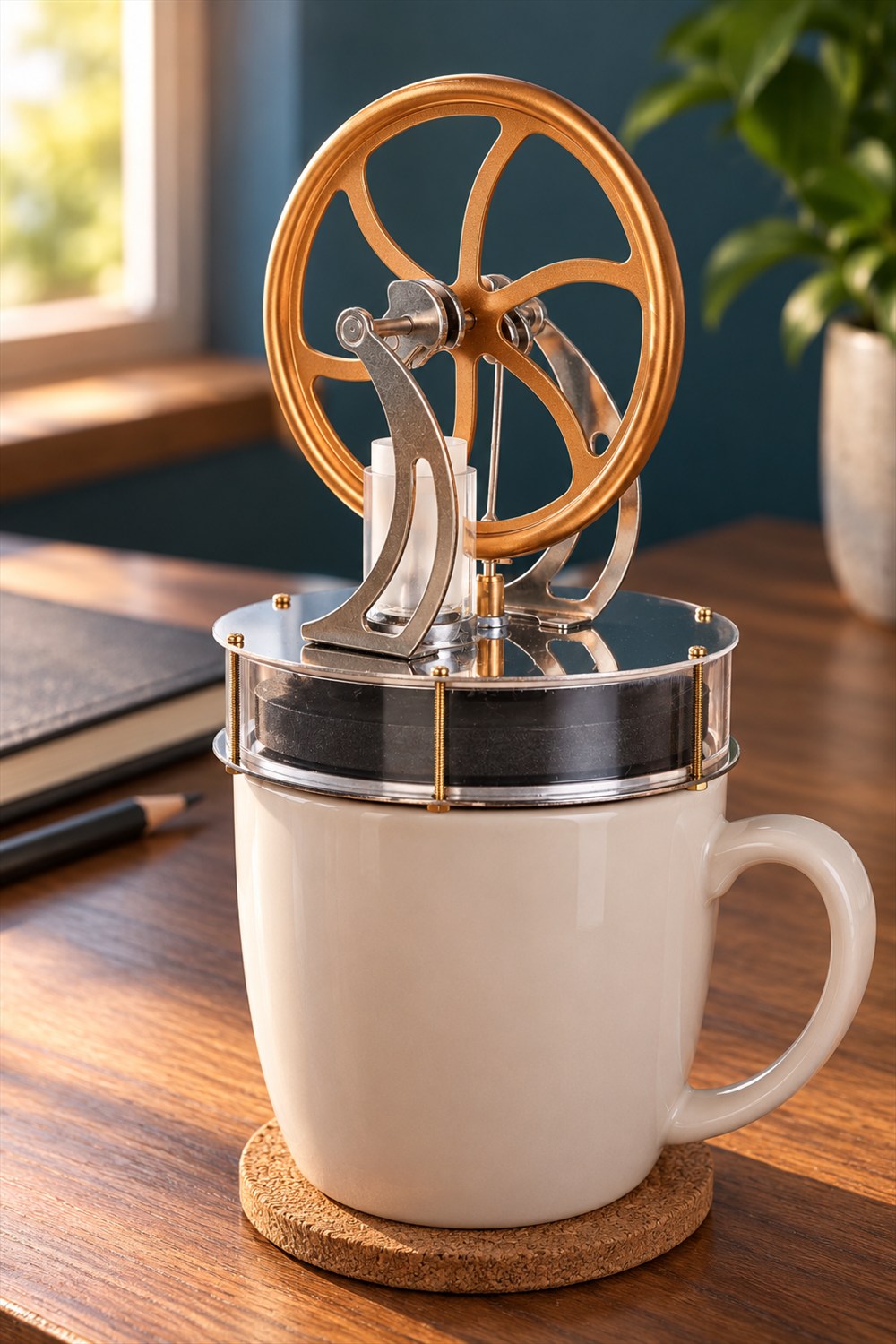
Your coffee already powers one unreliable machine every morning: you. The Sunnytech LT001 low temperature Stirling engine gives it a second job, turning the heat above a mug into the motion of a tiny exposed mechanism. Set the engine over a cup of hot water or coffee, gently nudge its flywheel, and your desk suddenly looks like it has a very small industrial district.
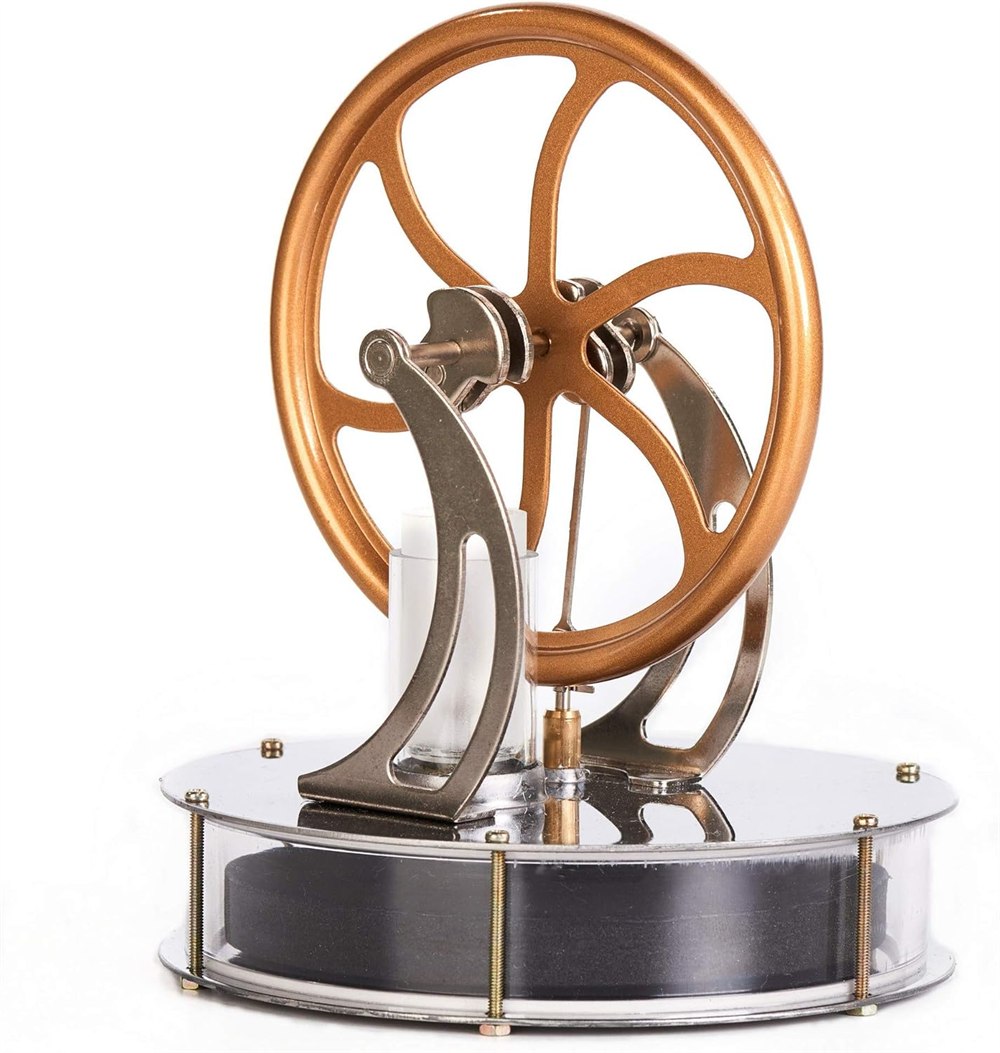
This is a working heat-engine demonstration, complete with a gold-colored wheel, connecting rods, a glass cylinder, and a shiny circular base. There is no battery compartment to feed and no app demanding your birthday. The appeal is right out in the open: heat goes in, parts move, and someone nearby immediately leans over to ask what on earth you have put on your drink.
Sunnytech calls it the LT001, which sounds appropriately serious for something that can turn a coffee break into an informal physics lesson. It is a desktop educational model, not a practical power station. It will not charge your phone, run your laptop, or rescue the office printer from whatever spiritual crisis it is experiencing.
A little engine with a very visible job
The design makes the moving bits the main attraction. An upright flywheel sits between curved metal supports above a low, round chamber. Thin rods connect the wheel to the mechanism below, while the clear cylinder lets you see part of the action instead of trusting a mysterious sealed box.
Its finish is more miniature workshop than plastic science-fair volcano. The seller identifies a mirror-finished stainless-steel base, a glass cylinder liner, and a zinc-alloy flywheel. On the gold version, the warm-colored wheel stands out against the silver structure. That color combination gives the whole thing a slightly antique laboratory look, minus the ominous bubbling beakers.


The exposed construction is useful as well as attractive. You can watch the relationships between rotating and reciprocating parts. Instead of a diagram with arrows and an explanation you promise to read later, there is a mechanism doing the explaining on the table in front of you.
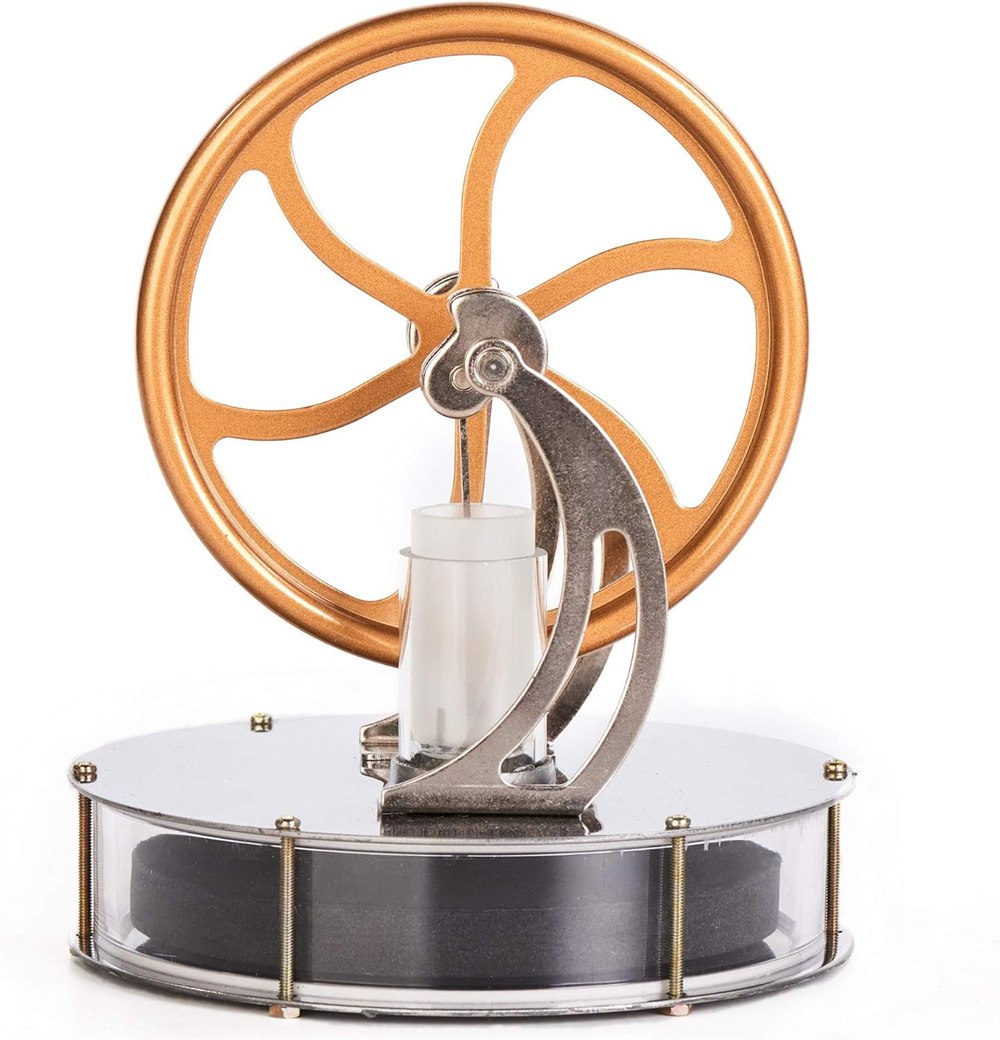
What actually makes it spin?
A Stirling engine works by repeatedly heating and cooling gas inside the engine. As the gas moves between warmer and cooler regions, its pressure changes. The mechanism turns those changes into motion, with the flywheel helping carry it through the cycle. The important ingredient is a temperature difference, not a secret electrical connection hiding under the mug.
For the familiar coffee-cup demonstration, the hot drink warms the lower part of the engine while the upper side remains cooler. Once enough of a difference develops, a gentle push starts the wheel. Your mug has temporarily acquired a mechanical hat, and it is considerably more interesting than the coaster you bought because it matched the curtains.
Despite the word “steam” appearing in the product’s long marketplace name, this is not a little steam boiler. You do not fill the engine with coffee or pour water into the glass cylinder. The cup supplies heat from outside; the model demonstrates a heat-engine cycle using its own internal working gas.
Sunnytech also describes operation over ice. That makes sense for a demonstration built around a difference between temperatures rather than a requirement for one particular hot beverage. Different conditions affect how it behaves, so the fun lies in observing it, not treating every spin as a precision measurement.
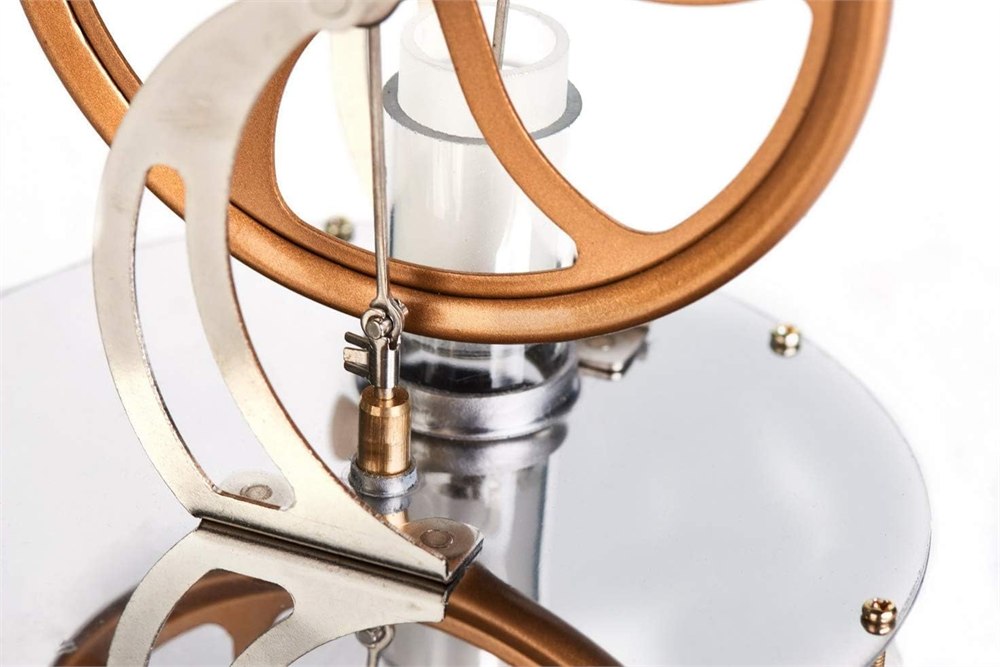
Give the coffee break a laboratory upgrade
Getting the basic demonstration going is deliberately simple. The seller’s instructions call for a cup of hot water, the engine placed on top, and a gentle push of the flywheel. Choose a stable cup that supports the base securely, and keep the setup on a level surface. A wobbling mug is an unnecessary contribution to experimental science.
It is a good fit for someone who likes understanding ordinary things by watching them work. A teacher can use it as a visible demonstration, a mechanically curious teenager can follow the linkages, and a grown adult can spend a surprising amount of time watching the wheel while claiming to be thinking deeply about a spreadsheet.
- For a desk: the visible wheel and rods provide a small, mechanical conversation piece.
- For a demonstration: hot water can supply the temperature difference without a separate flame burner.
- For curious observers: exposed moving parts make it easier to connect motion with the underlying idea.
- For gifting: the seller shows a dedicated illustrated product box rather than a loose collection of mysterious metal bits.
There is a useful distinction between being easy to demonstrate and being impossible to mishandle. The wheel, rods, and glass cylinder deserve gentle treatment. This is the sort of object you show someone before letting them enthusiastically investigate it with both thumbs.
| Detail | What the LT001 offers |
|---|---|
| Product type | Low temperature Stirling engine demonstration model |
| Heat source for the basic demo | A cup of hot water or coffee beneath the base |
| Visible components | Flywheel, connecting rods, glass cylinder, and circular chamber |
| Listed materials | Stainless-steel base, glass cylinder liner, zinc-alloy flywheel |
| Approximate model dimensions | 3.94 inches wide and 5.51 inches high, as shown in the seller’s diagram |
| Lubrication | Seller describes the model as oil-free |
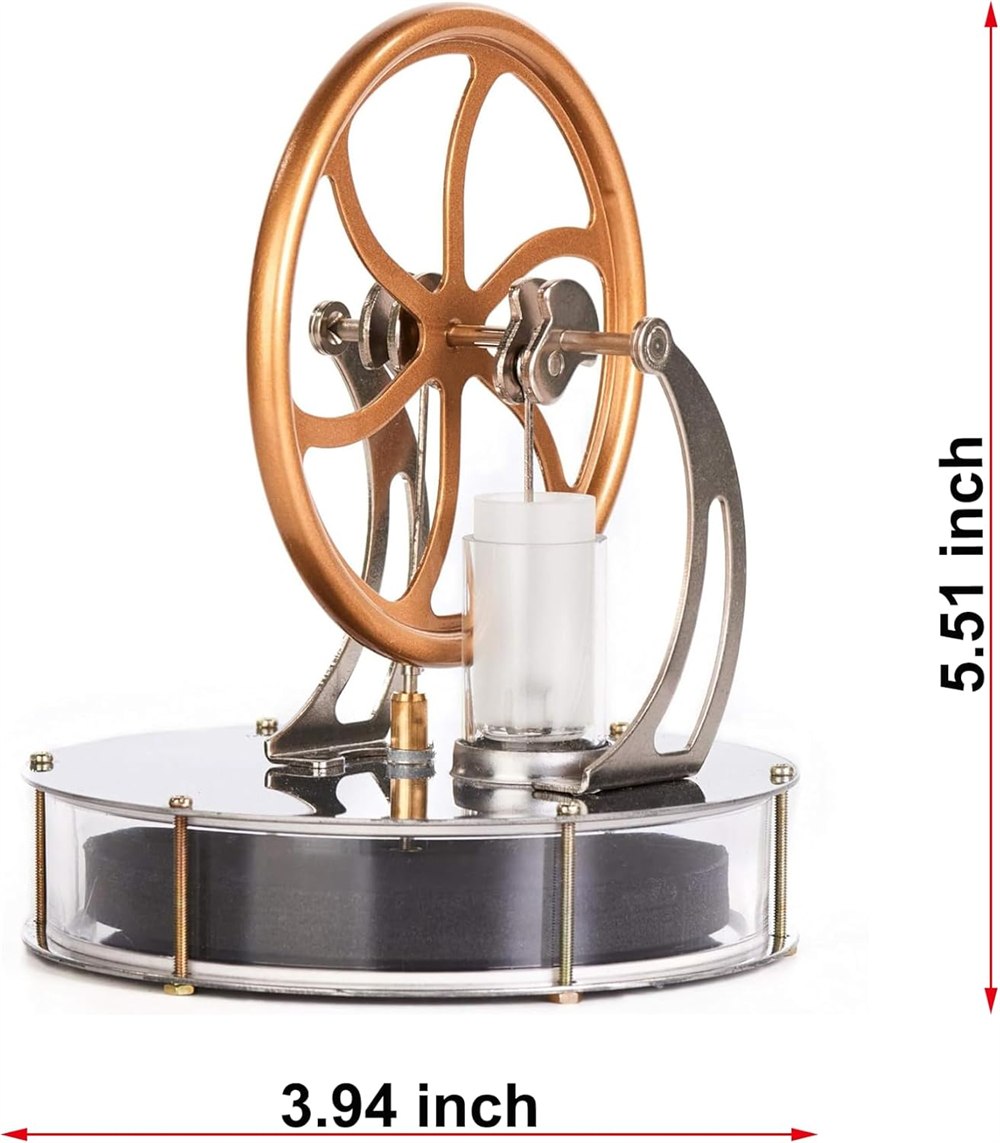
A few things the tiny factory cannot promise
The model runs while conditions provide enough of a temperature difference to keep it moving. A cooling cup eventually offers less useful heat, so a slowing wheel is expected. There is no universal runtime for every mug, room, and drink. Your enormous insulated travel vessel and a little ceramic teacup are not identical laboratory equipment, however strongly they both believe in caffeine.
The seller suggests watching the engine slow as the coffee cools, but that should be taken as part of the novelty rather than a drinking-temperature guarantee. Wheel speed is not a calibrated thermometer. If your main requirement is knowing whether a drink is comfortable to sip, the little brass-colored wheel should not be appointed head of quality control.
Sunnytech specifically warns against burning the base or putting the engine on a stove because plastic parts can be damaged. Low temperature is the point here. Do not borrow operating instructions from a different Stirling model that uses an alcohol lamp; engines with similar-looking wheels can have very different heating arrangements.
Likewise, oil-free does not mean “add whatever lubricant is in the garage and see if it improves things.” Follow the supplied care instructions. With a small demonstration mechanism, gentle handling is a much more sensible first instinct than automotive enthusiasm.
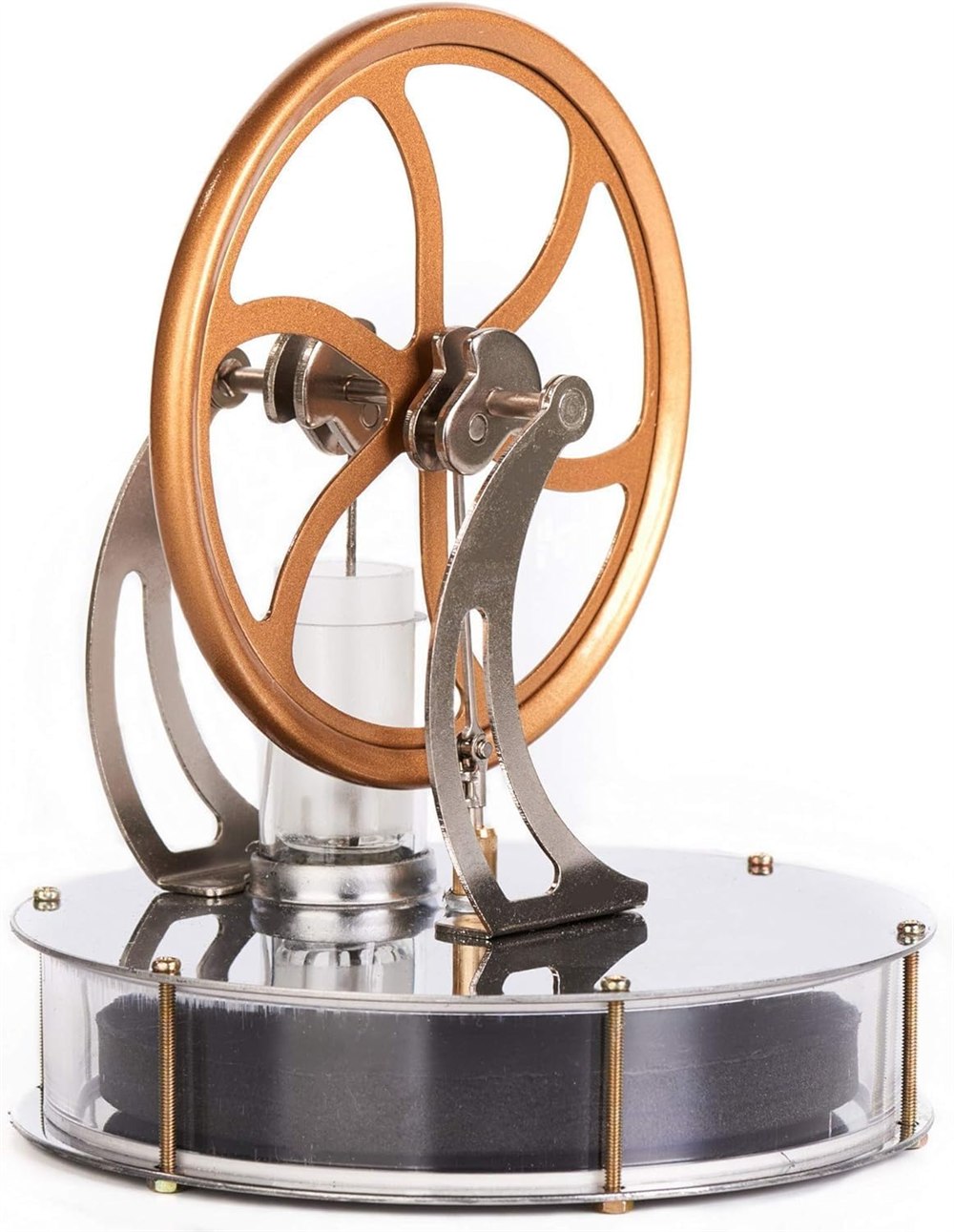
Small enough to keep, interesting enough to explain
The seller’s dimension graphic puts this model at roughly four inches across and five and a half inches high. That is small enough to occupy a modest patch of desk when it is not on a mug. Its proportions also make the wheel easy to spot, which matters for an object whose entire party trick is visible movement.
It will appeal most to people who enjoy mechanisms for their own sake. There are flashier desk toys and more useful coffee accessories, but few combine an ordinary hot drink with such an immediate “wait, how?” moment. The question is the gift. The engine simply gives everyone something shiny to point at while asking it.
And when the demonstration is over, it still looks like a small piece of machinery rather than an abandoned school project. The polished base, gold wheel, and exposed supports give it enough visual character to earn its place on a shelf. No one needs to know how many times you have already spun it today.
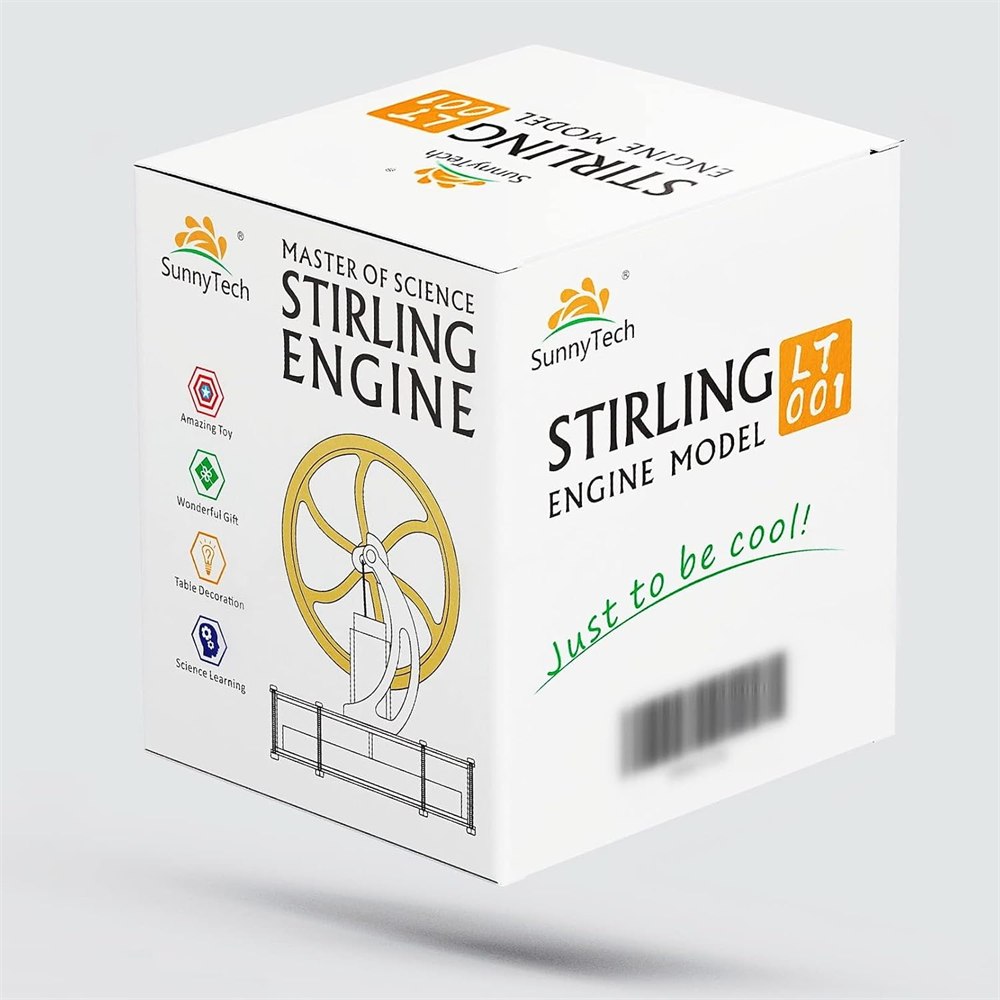
Product images: Sunnytech on Amazon.
- Model: Sunnytech LT001 low temperature Stirling engine.
- Core trick: converts a temperature difference into visible mechanical motion.
- Basic setup: place over a suitable cup of hot water and gently start the flywheel.
- Appearance: gold-colored wheel, silver base and supports, exposed rods, and glass cylinder.
- Best audience: mechanically curious gift recipients, science enthusiasts, and demonstration-minded teachers.
- Main limitations: requires suitable temperatures, gentle handling, and no direct stove or flame heating.
The gold LT001 was listed on Amazon for $39.99 at the time of writing, sold by stirlingtechonline and shipped by Amazon. Check the selected version and current offer before ordering, since the listing also shows other finishes. It is a modestly sized way to give your coffee a second career, and this one does not involve keeping you awake through another meeting.
| Pros | Cons |
|---|---|
| Visible mechanism makes the demonstration engaging | Exposed rods and glass need careful handling |
| Runs from a temperature difference without batteries | A cooling drink eventually stops supplying enough useful heat |
| Compact dimensions suit a desk or shelf | Needs a stable cup that securely supports the base |
| Distinctive gift for someone interested in physics | Demonstration model, not a useful electricity generator |
| Hot-water operation avoids a separate flame burner | Direct flame or stove heating can damage plastic parts |
Save this find.
Thank yourself later.
Your next great gift idea. Your someday space. Your collection of wonderfully weird things.
Save to PinterestPick a board. Keep the inspiration.
This Coffee-Cup Stirling Engine Turns Heat Into a Spinning Desk Demonstration
Where to find This Coffee-Cup Stirling Engine Turns Heat Into a Spinning Desk Demonstration
OddityMall may earn a commission from qualifying purchases at no extra cost to you.