Somewhere in a home workshop, a tiny multicolored dragon is being born beside a pile of discarded plastic large enough to qualify as its extended family. Multicolor 3D printing is wonderful. Watching a printer flush filament just to change colors is less charming. Co Print’s Quadro takes a different approach: give four filaments their own toolheads and let the heads take turns.
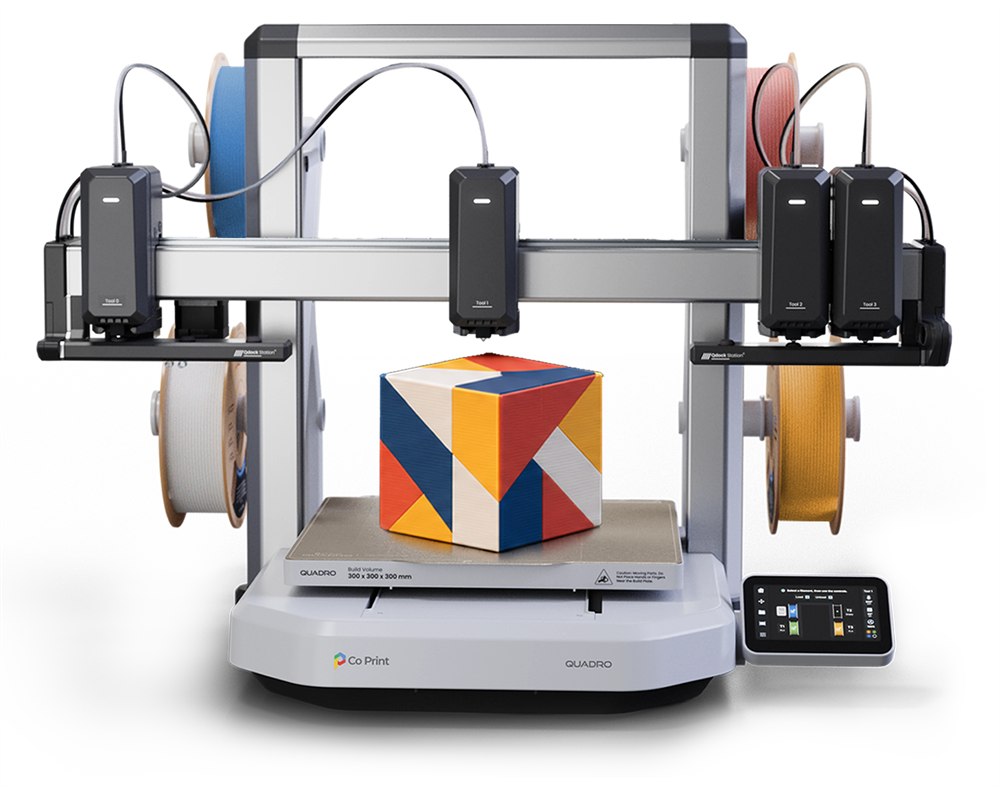
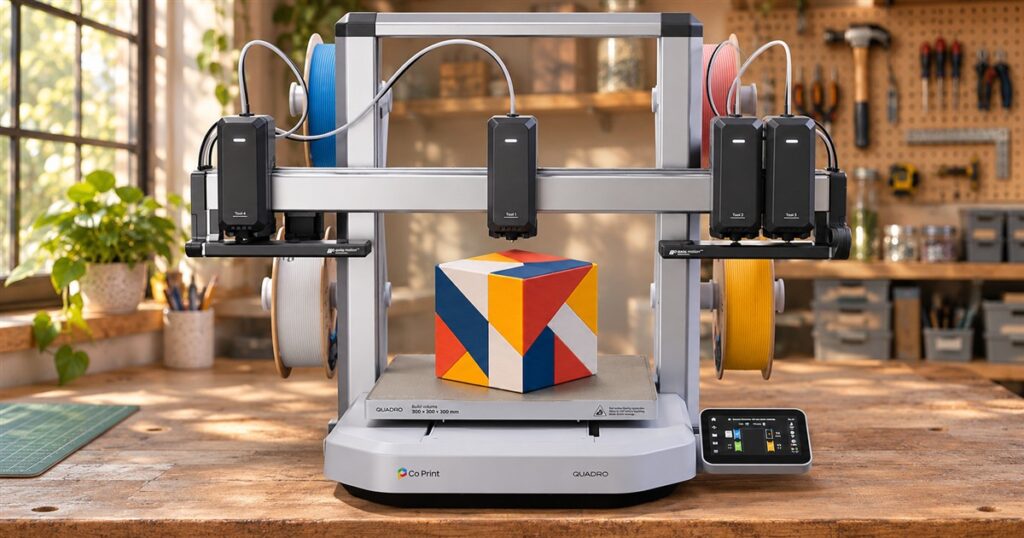
The Quadro is a four-toolhead multicolor 3D printer with an open frame, a moving print bed, and a horizontal rail that looks rather busy. Four tall black toolheads share that rail. One can work over the model while the others wait at the sides, keeping their respective filaments ready for the next handoff.
Co Print calls the arrangement IQEX. The useful part is easier to understand than the acronym: changing colors does not require repeatedly pulling one filament out of a shared nozzle and feeding another into it. Each color already has a nozzle of its own. Your little plastic dragon has acquired a production crew.
Four toolheads, one shared workspace
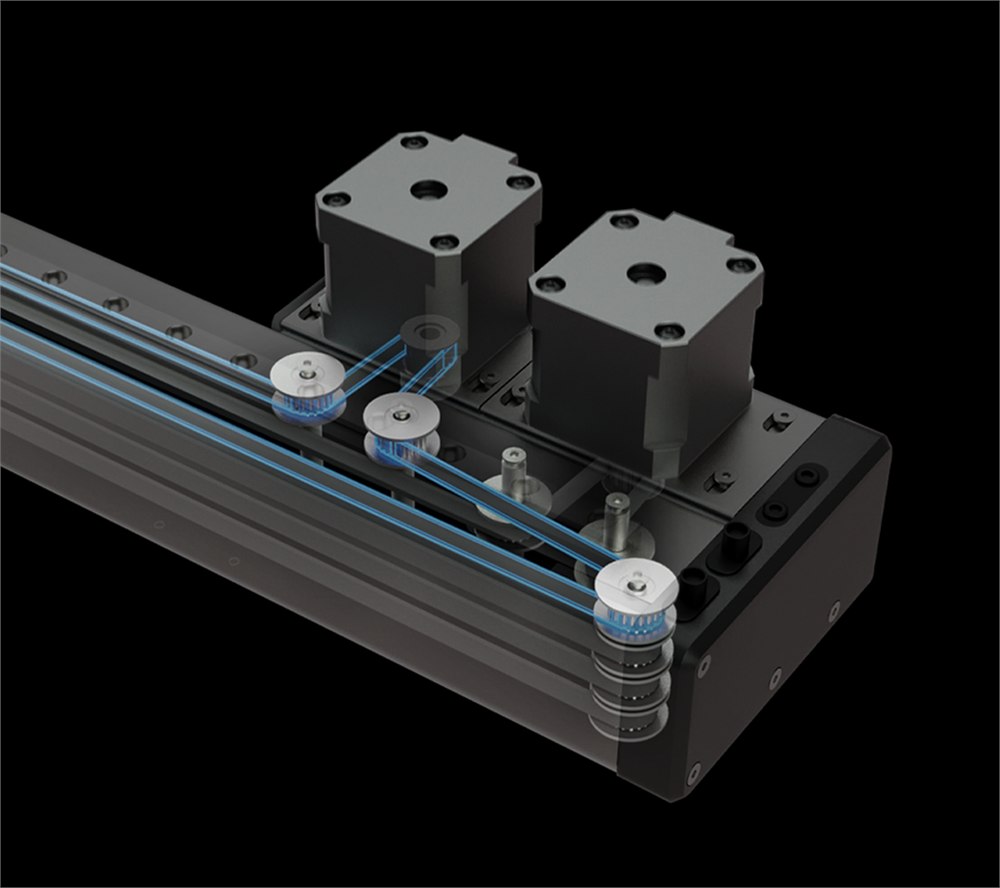
Each toolhead has its own stepper motor and moves independently along the same X-axis. According to Co Print, one head can start returning to its parking position while the next moves into the printing area. That overlapping movement is central to the design’s appeal.
The company advertises tool changes of about one second, using coordinated control of seven stepper motors. That is a manufacturer performance claim, rather than a promise that every model will finish at the same dramatic pace. A print with frequent color changes stands to benefit differently from a single-color bracket that spends the afternoon minding its own business.
Four heads also do not mean four separate printers are simultaneously building four unrelated projects. The core workflow described here is different heads taking turns on the same print. Co Print’s November progress update described copy and mirror printing as features still in development, so those should not be the reason to buy the machine today.
The parked heads have somewhere to behave
The parking areas are called QDock Stations. Co Print says inactive toolheads are sealed there to help prevent stray filament from leaving strings or marks on the print. It is a small detail with a practical job: keep an off-duty nozzle from contributing unsolicited decoration.
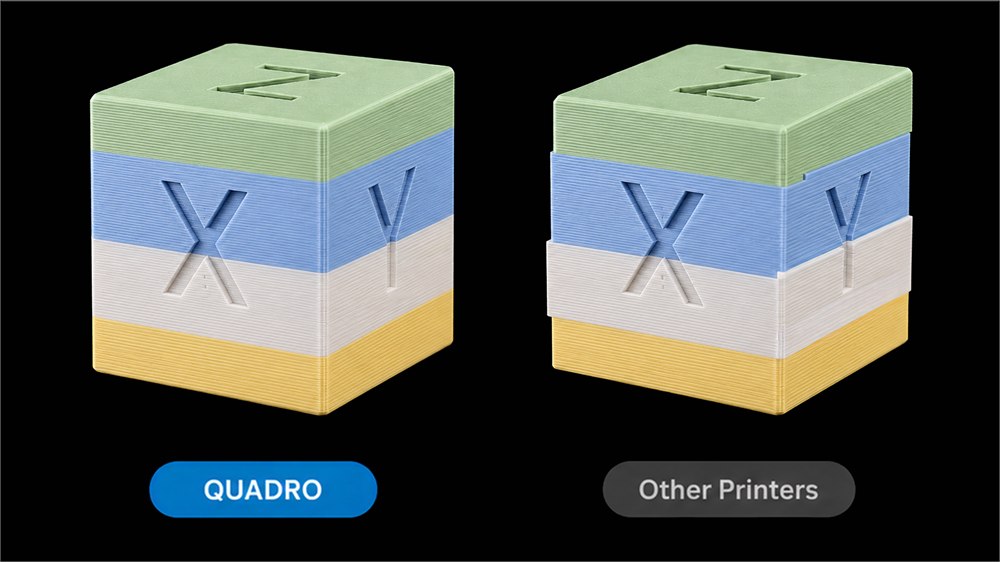
Alignment matters just as much as parking. When several nozzles contribute to the same object, they need to agree on where that object actually is. Quadro’s advertised 360-degree calibration system measures nozzle offsets from multiple directions and corrects differences between the heads.
The manufacturer illustrates the benefit with stacked multicolor calibration cubes. Those pictures explain the intended result, but they are promotional comparisons, not an independent head-to-head test. The underlying goal is straightforward: color boundaries should meet where the model says they belong.
Less purging still leaves a few details
Co Print claims up to 90 percent less filament waste than conventional single-nozzle multicolor systems. The phrase “up to” is doing useful work here. Model geometry, color-change frequency, and print settings all affect how much plastic a particular job consumes.
Separating the filaments removes the need to purge one color out of a shared nozzle before introducing the next. Quadro can still use a small prime tower to stabilize flow when a nozzle resumes printing. That tower has a purpose, even if nobody invited it to the finished-model photo.
A Zero Waste Mode uses the model’s infill instead of a separate tower on compatible models. Compatibility is the key qualifier. Think of this as an option for suitable jobs rather than a guarantee that every file will produce absolutely no surplus plastic.
- Four dedicated toolheads keep four filaments ready without sharing a single nozzle.
- Independent motion lets the next head approach while the previous head parks.
- QDock Stations seal idle heads to help manage ooze and stringing.
- Automatic offset calibration aims to align the heads with one another.
- A prime tower can stabilize flow; compatible models can instead use infill in Zero Waste Mode.
These are changes to the printing process, not an excuse to stop looking at a sliced model before starting a job. The attraction is reducing the waste and waiting associated with repeated color swaps. A printer still needs a suitable file, sensible settings, and an owner willing to learn its habits.
A roomy bed for ambitious plastic plans
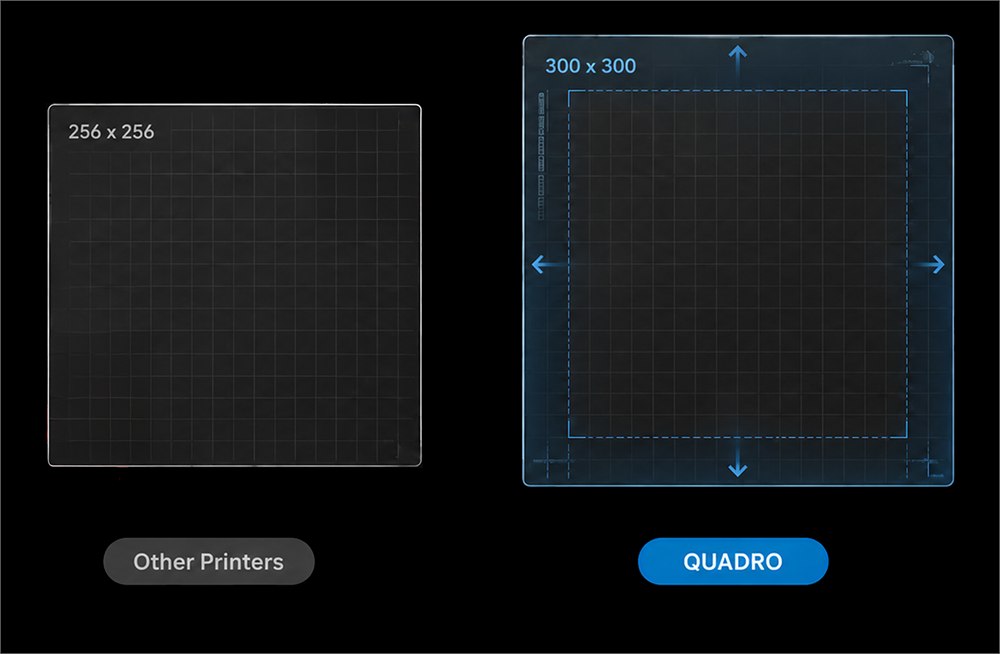
Quadro’s stated build volume is 300 by 300 by 300 millimeters. Co Print says the physical plate measures 305 by 305 millimeters, allowing a true 300-millimeter printable area in both horizontal directions. All four toolheads can access that full printing area.
That gives the machine room for larger models or several smaller parts arranged together. Whether a particular helmet, costume component, or organizer fits still depends on the actual file. “Big build volume” is useful information; “your enormous idea definitely fits” requires a ruler.
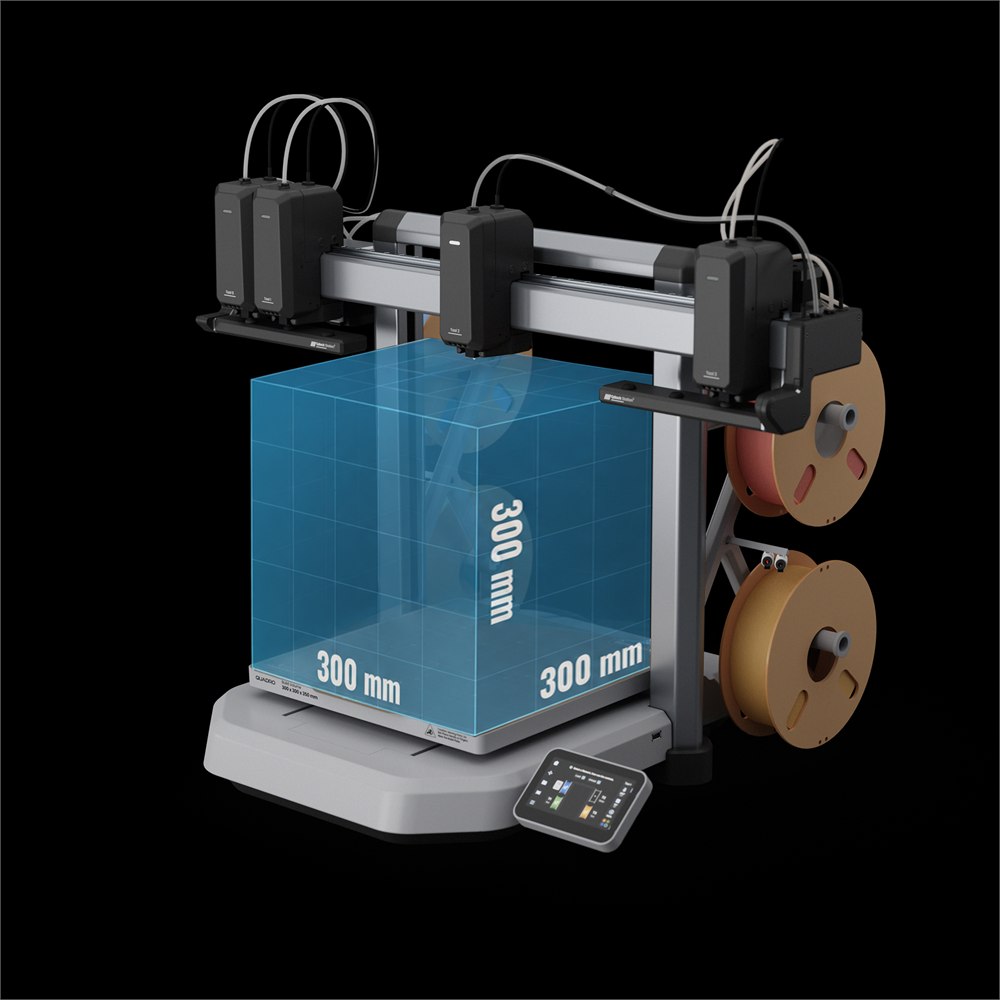
| Detail | What Co Print specifies |
|---|---|
| Toolhead arrangement | Four independently driven heads on one X-axis |
| Build volume | 300 × 300 × 300 mm |
| Physical build plate | 305 × 305 mm |
| Advertised tool change | About one second |
| Idle nozzle management | Sealed QDock parking stations |
| Material flexibility | Multiple materials, including higher-hardness TPU |
The manufacturer also emphasizes a rigid metal structure, including an aluminum bed support and a dual-motor bed carriage. Nearly 70 percent of the machine is described as metal. Those details explain the design priorities without telling us, by themselves, how a finished production unit will perform over years of use.
More than four colors of the same thing
Dedicated heads also open the door to different materials within a job. Co Print specifically discusses higher-hardness TPU and combinations involving support materials such as PVA or PLA. That is potentially more interesting than giving a desk ornament a particularly elaborate hat.
The word “different” does not make every possible material pairing compatible. Temperature requirements, adhesion, and the geometry of a part still matter. The useful point is that Quadro provides separate filament paths and nozzles for a multi-material workflow, rather than asking one nozzle to handle every change.
For a hobbyist, the appeal could be colorful models or functional experiments. For a design studio, it could be a prototype that needs distinct materials or clearly separated colors. Neither use requires pretending that every household has an urgent shortage of tiny printed creatures. Some households simply enjoy making them.
A campaign machine with production work underway
Co Print launched Quadro’s Kickstarter campaign on November 12, 2026. Its earlier progress update showed a pilot production line with assembly, calibration, and burn-in printing. That is useful context for understanding where the project stands, while remaining different from a conventional printer already sitting on a retailer’s shelf.
The pilot-line photos show machines and components being prepared in batches. Co Print says the pilot process helps identify problems before mass production. Backers should still assess the campaign’s current delivery estimates and terms as part of the decision, since crowdfunding involves development and fulfillment uncertainty.
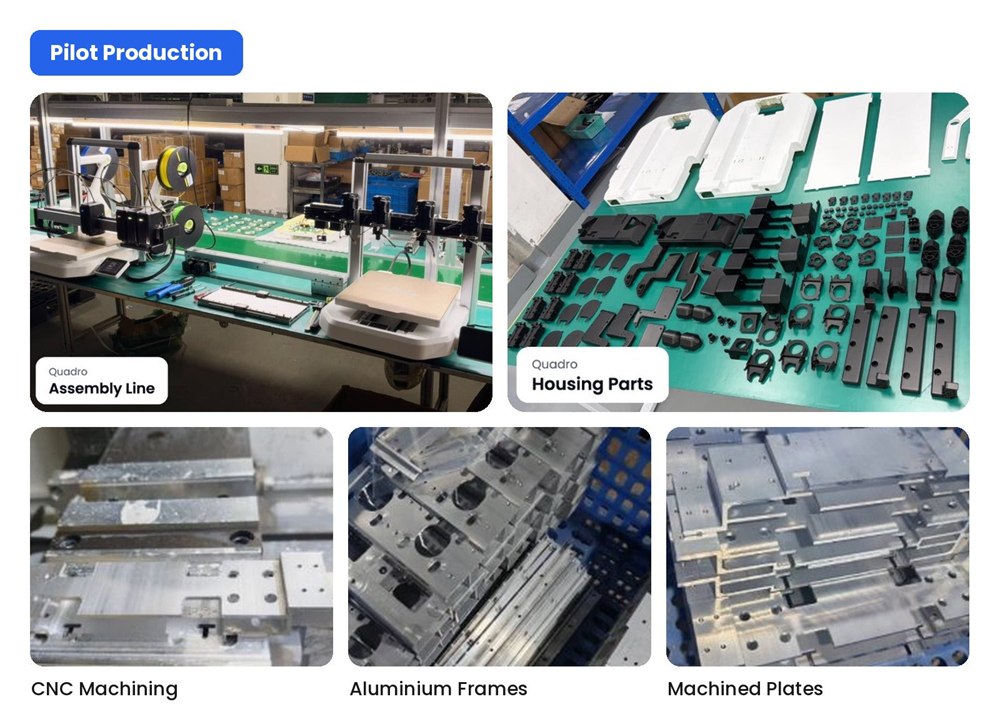
Images: Co Print, including its production progress update.
- Product: Co Print Quadro four-toolhead multicolor 3D printer.
- Four independently driven heads share one horizontal rail.
- All heads reach the stated 300 × 300 × 300 mm build volume.
- QDock parking and automatic offset calibration support the multi-head workflow.
- Reduced waste and fast tool changes are manufacturer claims that depend on the job.
- Available through a Kickstarter campaign, with production and fulfillment still relevant considerations.
Co Print announced a limited $649 Super Early Bird pledge against an $899 MSRP. Those are the announced launch figures; current reward availability, shipping, and any applicable charges should be checked on the campaign before backing. The manufacturer links to Kickstarter from its Quadro product page.
Quadro’s most appealing trick is easy to appreciate: leave each filament in its own head and make the handoffs quicker. If your favorite part of multicolor printing is the finished object rather than the growing pile of purge scraps, that is a fairly compelling job description for four little coworkers on a rail.
| Pros | Cons and considerations |
|---|---|
| Dedicated heads avoid shared-nozzle color purging | Some jobs still need a prime tower |
| Four heads access the full stated build area | The open machine needs suitable workspace |
| Supports multicolor and multi-material workflows | Material combinations still require planning |
| Independent movement enables quick handoffs | Speed and waste savings vary by print |
| Pilot production has been documented | Crowdfunding delivery remains uncertain |
At a glance
Product snapshot
- Listed price
- Announced launch pledge: $649Prices and availability can change. Check the seller for current details.
- Where to find it
- Co Print / Kickstarter
- Category
- Gadgets