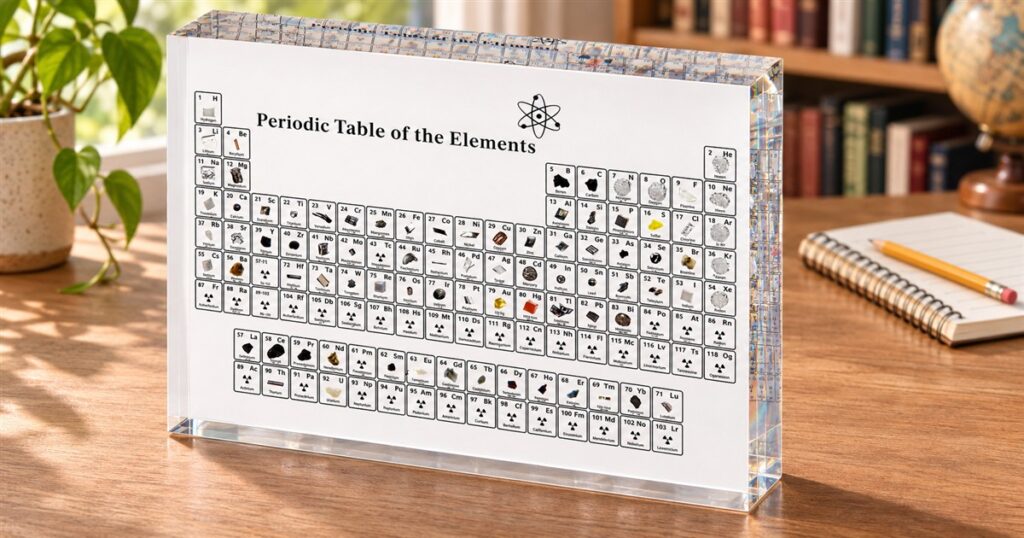
Your desk already contains several elements, but most of them are currently disguised as a stapler, a coffee mug, and whatever is happening inside that ancient charging cable. This periodic table with real elements gives the collection a little more dignity. It gathers 83 samples into a clear acrylic block, turning chemistry homework into something you might actually want to stare at between emails.
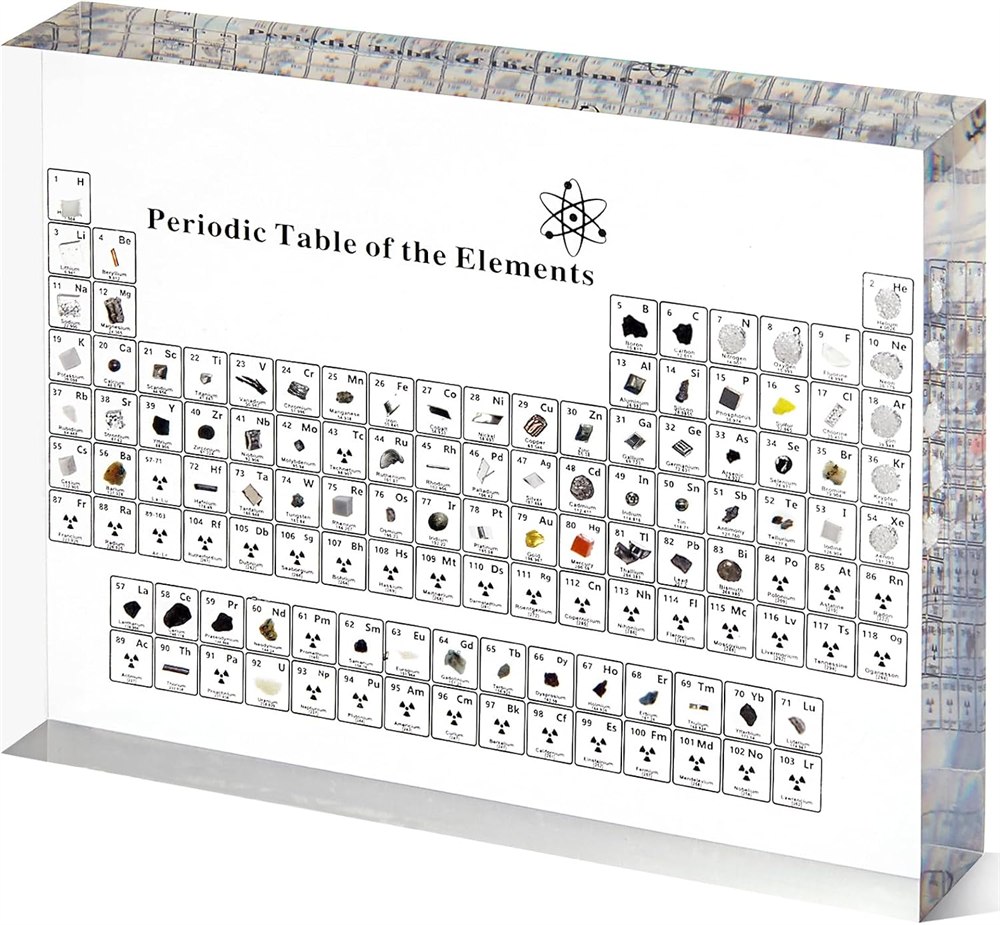
The Mukarisk Large Periodic Table With Real Elements is a tabletop display with tiny specimens arranged inside the familiar periodic-table grid. Instead of looking at a flat chart and imagining what the substances look like, you can examine little pieces embedded beneath the clear surface. Your desk has essentially opened a very small museum. Admission is free, though the curator still expects you to stop leaving rings on the furniture.
The version shown here measures 8 inches wide, 5 inches tall, and 1 inch thick. That makes it a compact object for a desk, shelf, or classroom table rather than a wall-sized teaching chart. It has enough physical depth to feel like a display piece, while the transparent material lets the specimens remain the main attraction.
A chemistry chart with actual things inside
The appeal is immediate: rows of symbols suddenly have little physical objects attached to them. Some samples look metallic, others look like dark fragments, and a few provide small flashes of color. The arrangement rewards looking closely. It is the sort of object that can turn a quick glance into several minutes of leaning forward and quietly remembering that chemistry was more interesting than the exams suggested.
There is an important detail behind the phrase “real elements.” Mukarisk says some samples are simple substances and others are stable compounds. This is not a promise that every occupied square contains a pure elemental specimen. That distinction belongs near the top of the conversation, particularly if you are shopping for someone who can spot a chemistry technicality from across a crowded room.
Related posts:
 These Chemistry Crayon Labels Help Kids Learn Periodic Table of Elements While Drawing
 Lumigrids Projects a Laser Grid In Front Of Your Bicycle To See Terrain Changes at Night
 The WaterLily Off-Grid Generator Can Recharge Your Devices Using River Water and Wind
 This Wooden Laptop Stand Converts Your Existing Desk Into an Any-Height Standing Desk
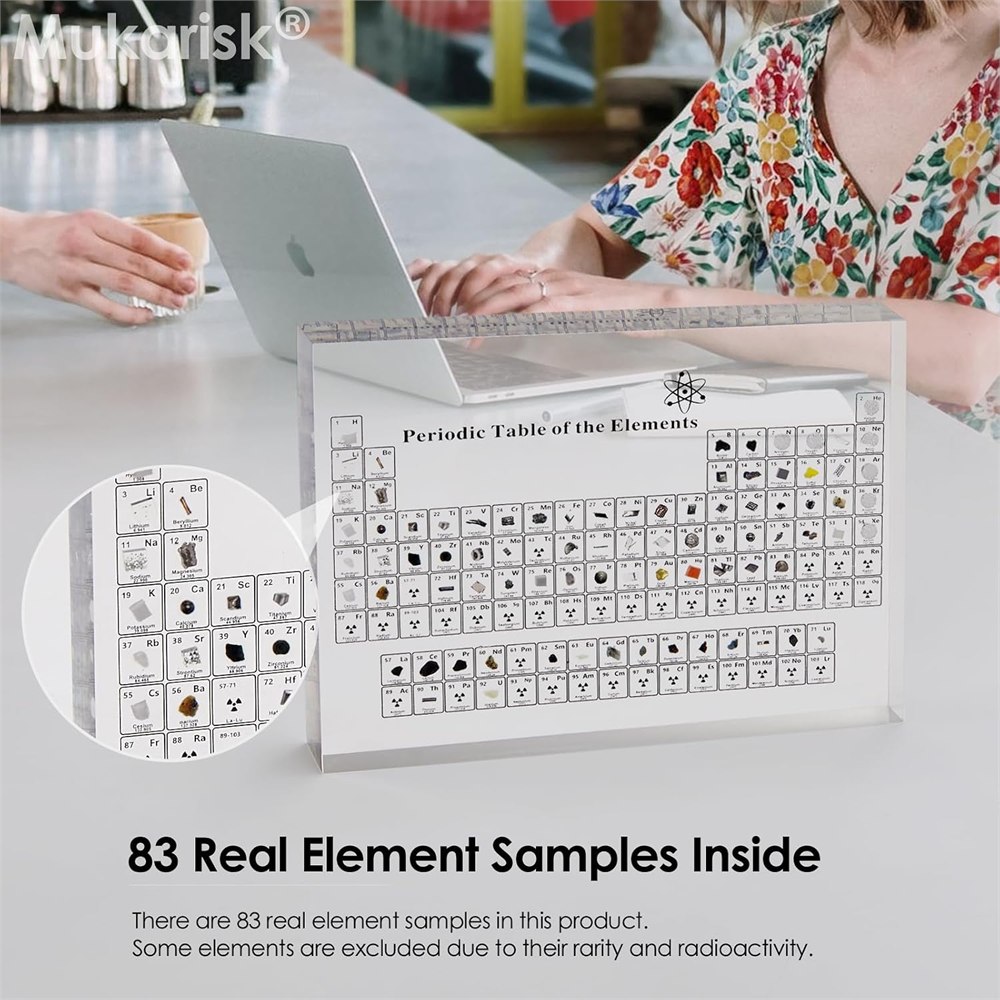
The seller also states that radioactive element samples are not included. The printed table has more positions than the 83 included samples, so a complete-looking chart does not mean every element is physically present. Think of it as a specimen display built around the periodic table, with the grid providing context for what is inside.
That still leaves plenty to look at. The point is the visual relationship between a name, a symbol, and a small material sample. A printed poster can tell you where an element belongs. This adds another layer of curiosity, which is useful when the person doing the learning has already decided the poster is part of the wallpaper.
Clear acrylic, small footprint, considerable desk appeal
The block is made from acrylic, with the samples embedded inside. The clear body and substantial edges give it a different presence from a laminated reference sheet. Looking at it from an angle reveals its thickness, while a front-facing view keeps the grid easier to follow. It is a display you can pick up and inspect, then return to its spot without organizing a collection of loose sample containers.
Those embedded specimens are for viewing. This is not a set of removable materials for experiments, and it should not be treated as one. Anyone hoping to extract a tiny scientific treasure has misunderstood the assignment. The acrylic is the display case, and the display case is doing a useful job.
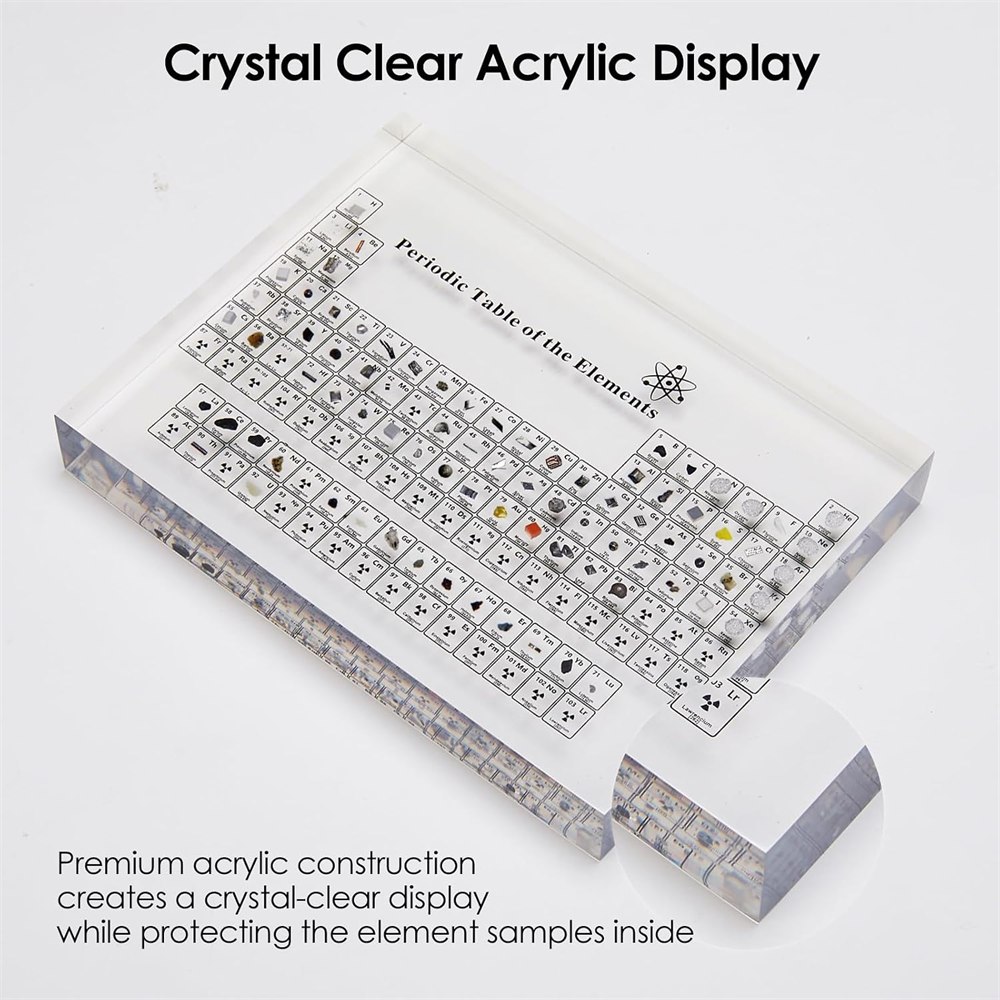
For an office, the attraction is mostly decorative curiosity. For a study space, it can sit beside a book as a visual companion. In a classroom, its compact size makes it more suitable for close inspection than for reading labels from the back row. A little planning about where it will live helps more than imagining it will magically become a giant instructional screen.
- Use it as a close-up specimen display beside chemistry reading or homework.
- Place it on a desk or shelf where visitors can notice the samples.
- Compare the different visible colors, shapes, and textures within the grid.
- Use the labels as starting points for questions about the materials shown.
- Keep expectations focused on viewing embedded samples, rather than conducting experiments.
A good science gift does not have to perform a dramatic trick. Sometimes it just needs to make someone ask a better question. Why do these samples look so different? Which squares contain compounds? Why are some positions left without a specimen? Those questions are more interesting than another object whose entire contribution to the room is blinking blue.
What the large version includes
| Detail | Listed specification |
|---|---|
| Display material | Clear acrylic |
| Sample count | 83 real samples |
| Sample forms | Some simple substances; some stable compounds |
| Large version dimensions | 8 x 5 x 1 inches |
| Radioactive samples | Not included, according to the seller |
| Main purpose | Decorative and educational specimen display |
Size matters here because the listing also offers a smaller option. The dimensions in this article refer to the selected large version. If you are buying for a particular shelf or gift box, check the selected size before ordering. The word “large” is relative; this is still a desktop object, not a chemistry department relocation project.
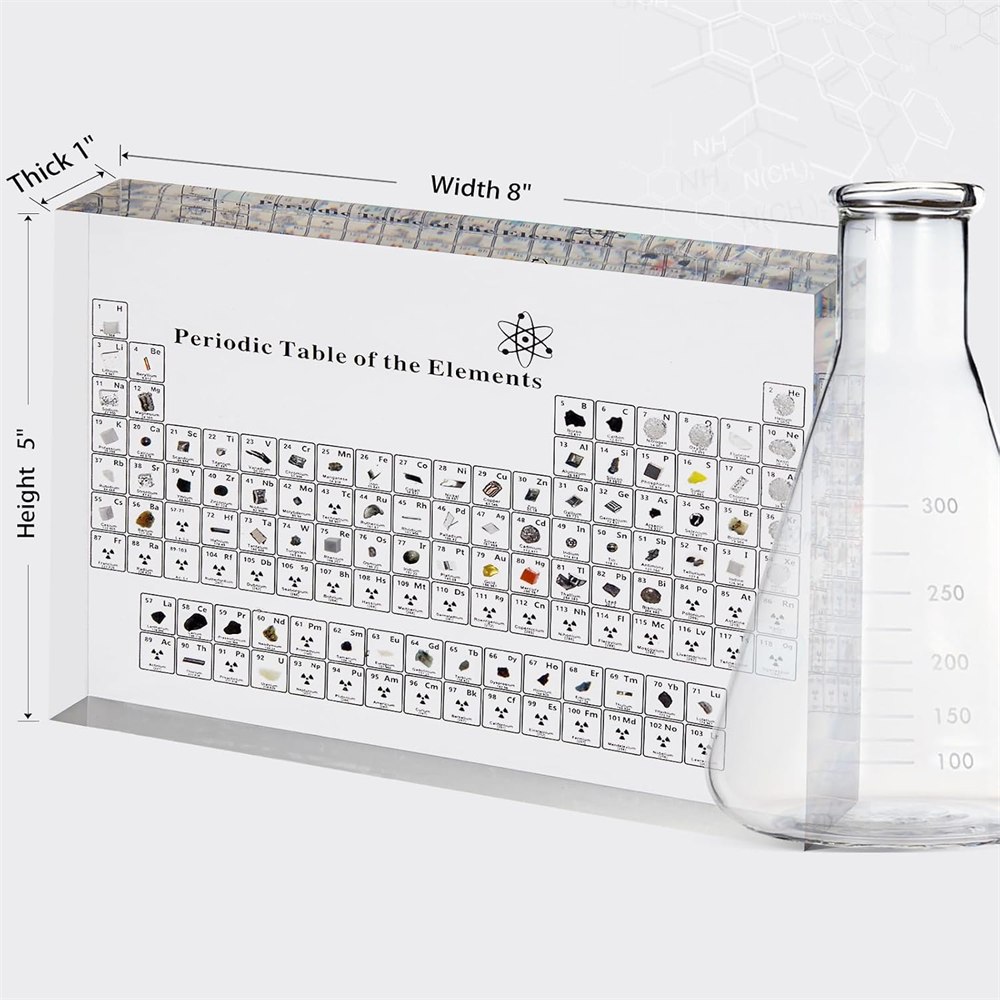
The one-inch depth is also worth noticing. It gives the piece its block-like character and makes the clear edges part of the design. In the seller’s photographs, the table can be displayed upright or viewed lying flat. Which view works best will depend on your space and the angle from which you want to inspect the samples.
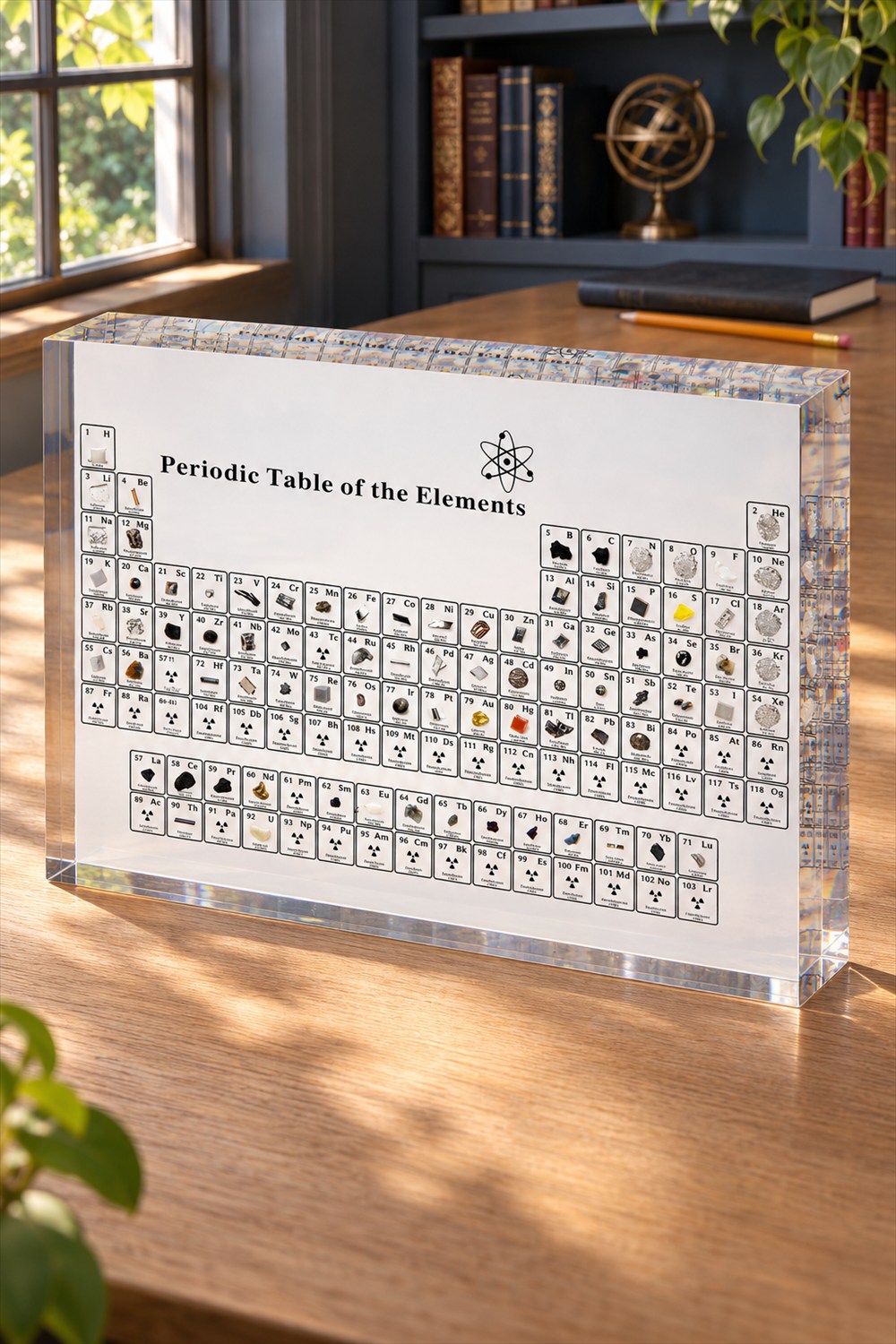
Lighting will affect how a clear object looks in a room. A busy background may compete with the fine labels, while a simpler space behind it lets the arrangement read more clearly. You do not need to build a dedicated museum wing. Giving it a little breathing room on the desk is a sensible start.
A gift for the person who enjoys the footnotes
This fits people who find material objects interesting: science students, teachers, chemistry fans, and adults who still stop at the mineral display in every museum. It has a straightforward visual hook, so the recipient does not need an advanced degree to understand why it is fun. There are actual little samples in there. That is already a stronger opening than most office gifts manage.
For younger learners, an adult can help explain what the display does and does not contain. The compounds-versus-elements distinction is a useful part of that discussion. It keeps the object from becoming a misleading shortcut and gives curious students something more substantial to investigate than simply memorizing a row of symbols.

It also works for someone who likes scientific decor but does not want a room covered in novelty slogans. The printed grid is the design. The samples supply the visual interest. It can share a shelf with books, a small collection, or a remarkably optimistic pile of unread journals without demanding an entire decorating theme.
The limitations are fairly clear. It is not a complete physical collection of every element, not every sample is a pure substance, and the small labels favor nearby viewing. Those are reasonable boundaries for this kind of display. They are also better to know before giving it to the person who will immediately start counting squares.

Images courtesy of Mukarisk on Amazon.
The useful details before it joins your desk
- Mukarisk periodic table display with 83 embedded samples.
- Clear acrylic body with a printed periodic-table layout.
- Large version measures 8 inches wide, 5 inches tall, and 1 inch thick.
- Samples include simple substances and stable compounds.
- Radioactive element samples are excluded according to the seller.
- Suited to close-up viewing, science-themed decor, and educational discussion.
At the time of checking, the large version was listed on Amazon for $45.99, marked in stock, sold by mukarisk, and shipped by Amazon. Price and availability can change. Check the selected size when ordering, and do not assume accessories pictured with another variant are included with this one.
For the right person, the pleasure is in having something real to examine while the rest of the desk mostly asks for attention. It will not answer your emails or finish your homework. It may, however, make procrastination look unusually well educated.
| Pros | Cons |
|---|---|
| 83 samples give the familiar chart physical interest. | Does not contain a sample of every element. |
| Clear acrylic keeps specimens visible and enclosed. | Samples cannot be removed for experiments. |
| Compact 8 x 5 inch display suits desks and shelves. | Small labels are intended for close viewing. |
| Useful conversation piece for science enthusiasts. | Some samples are compounds rather than pure elements. |
Save this find.
Thank yourself later.
Your next great gift idea. Your someday space. Your collection of wonderfully weird things.
Save to PinterestPick a board. Keep the inspiration.
This Periodic Table Displays 83 Real Samples Inside Clear Acrylic
At a glance
Product snapshot
- Listed price
- $45.99Prices and availability can change. Check the seller for current details.
- Where to find it
- Amazon.com
- Category
- Gadgets
Related posts:
These Chemistry Crayon Labels Help Kids Learn Periodic Table of Elements While Drawing
Lumigrids Projects a Laser Grid In Front Of Your Bicycle To See Terrain Changes at Night
The WaterLily Off-Grid Generator Can Recharge Your Devices Using River Water and Wind
This Wooden Laptop Stand Converts Your Existing Desk Into an Any-Height Standing Desk