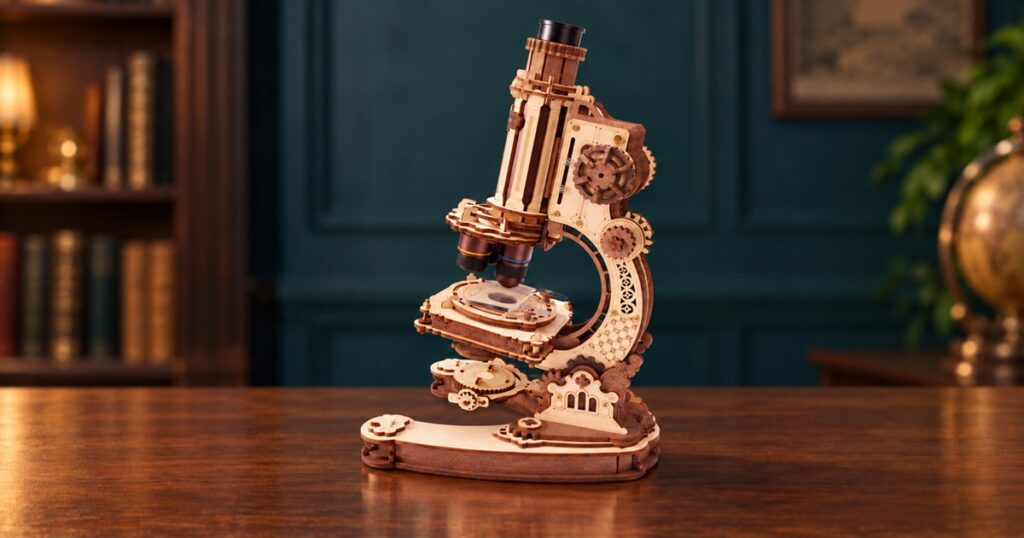
Most wooden puzzles end their careers sitting on a shelf, quietly collecting the very dust you could be studying. The ROKR ST005 working wooden microscope kit has other plans. Build it, put something interesting under the lens, and your desk suddenly becomes the headquarters of a person who has strong opinions about onion skin.
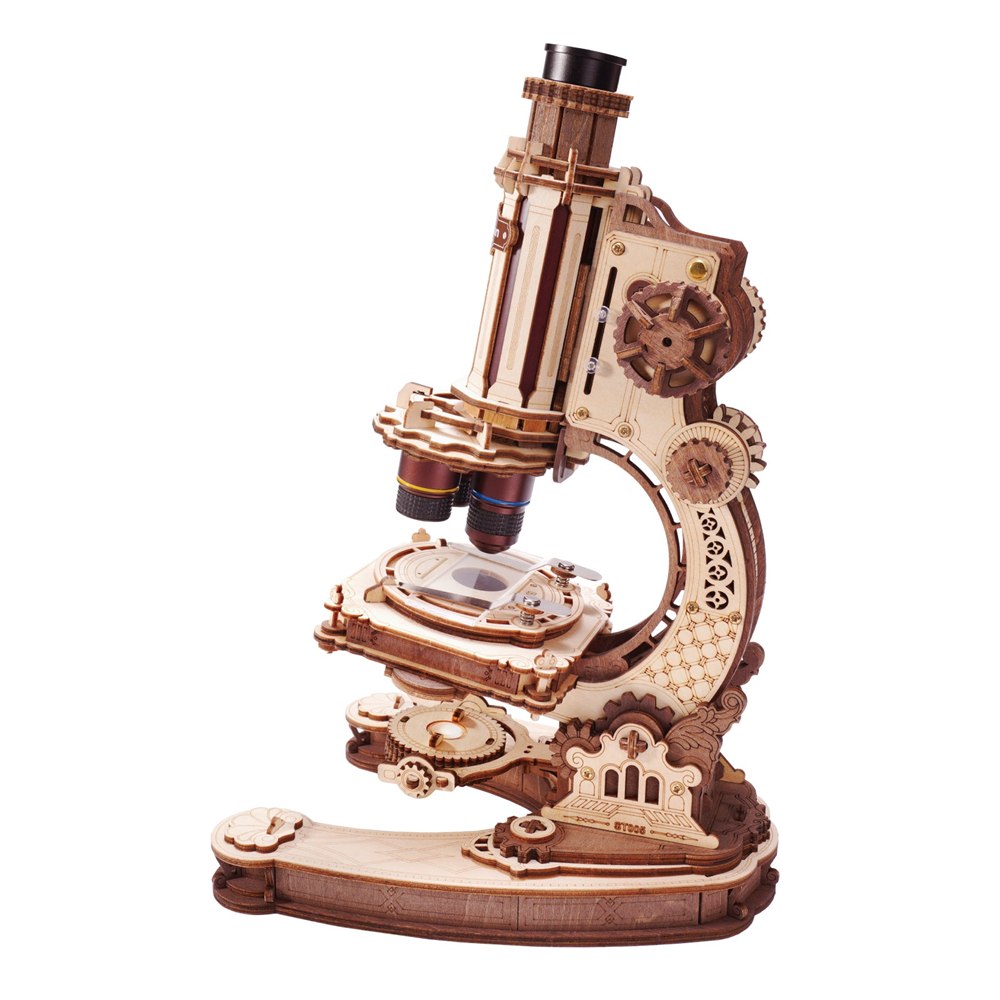
This is a microscope you assemble yourself, with enough exposed gears and decorative woodwork to suggest that your next appointment is with a Victorian inventor. It has a real optical viewing system. The wonderfully unnecessary flourish is making the whole thing look like it belongs beside a handwritten journal containing increasingly alarming sketches.
For the right person, that combination is irresistible. There is the pleasure of making something, followed by the pleasure of discovering that the something actually does a job. Your finished project gets a second act, which is more than can be said for the puzzle currently occupying your dining table under a protective sheet of cardboard.
A little laboratory with a very dramatic wardrobe
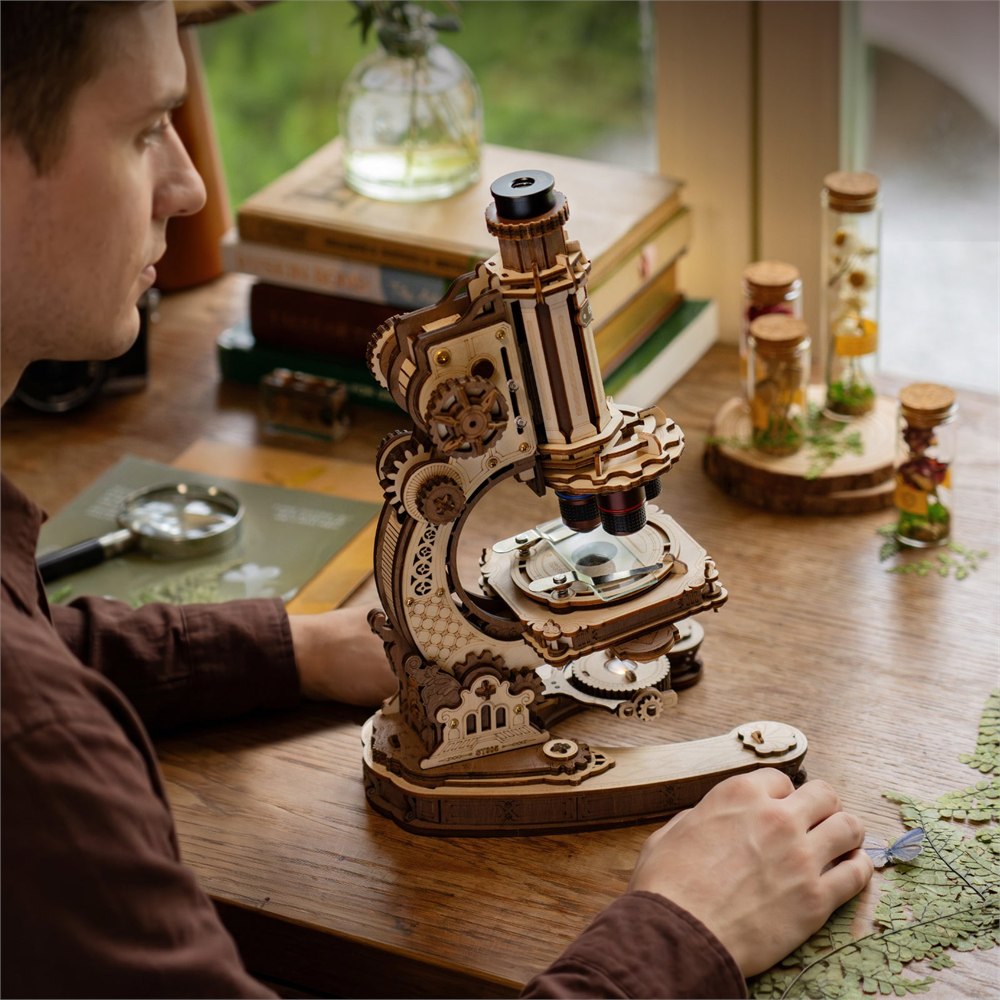
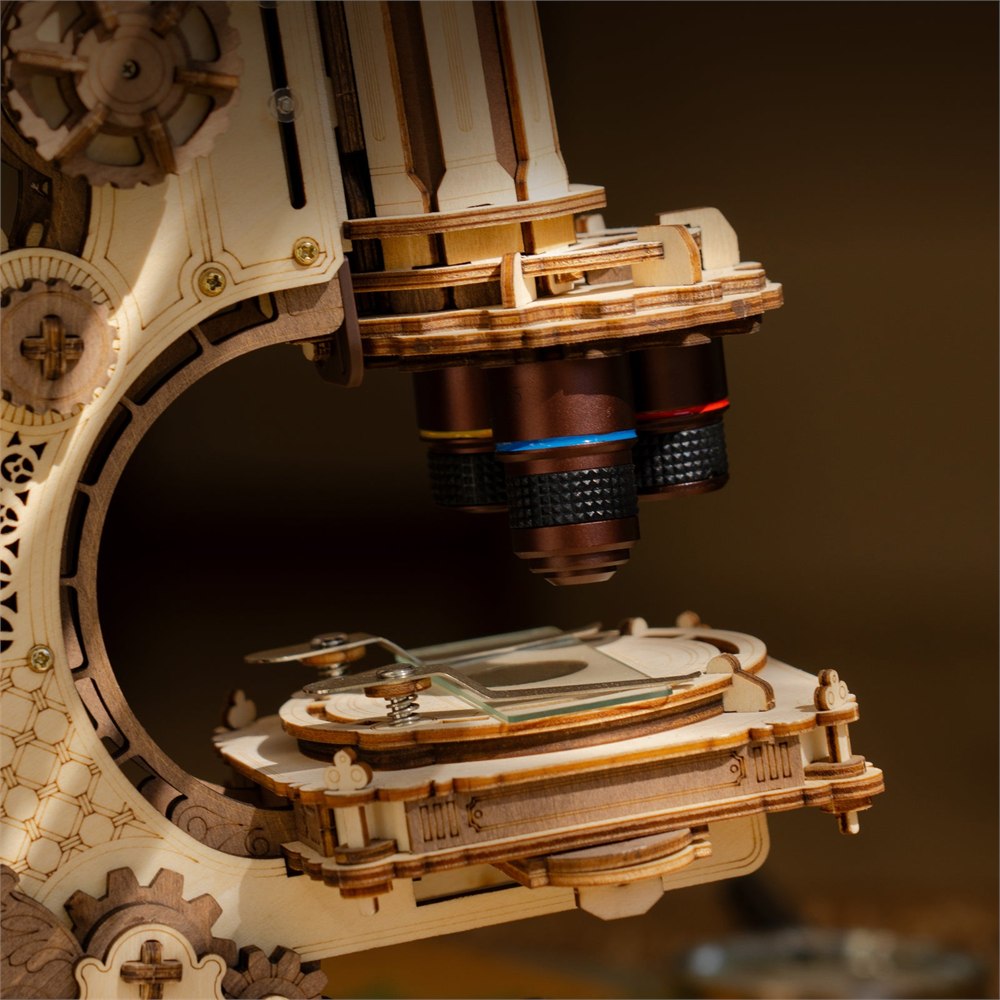
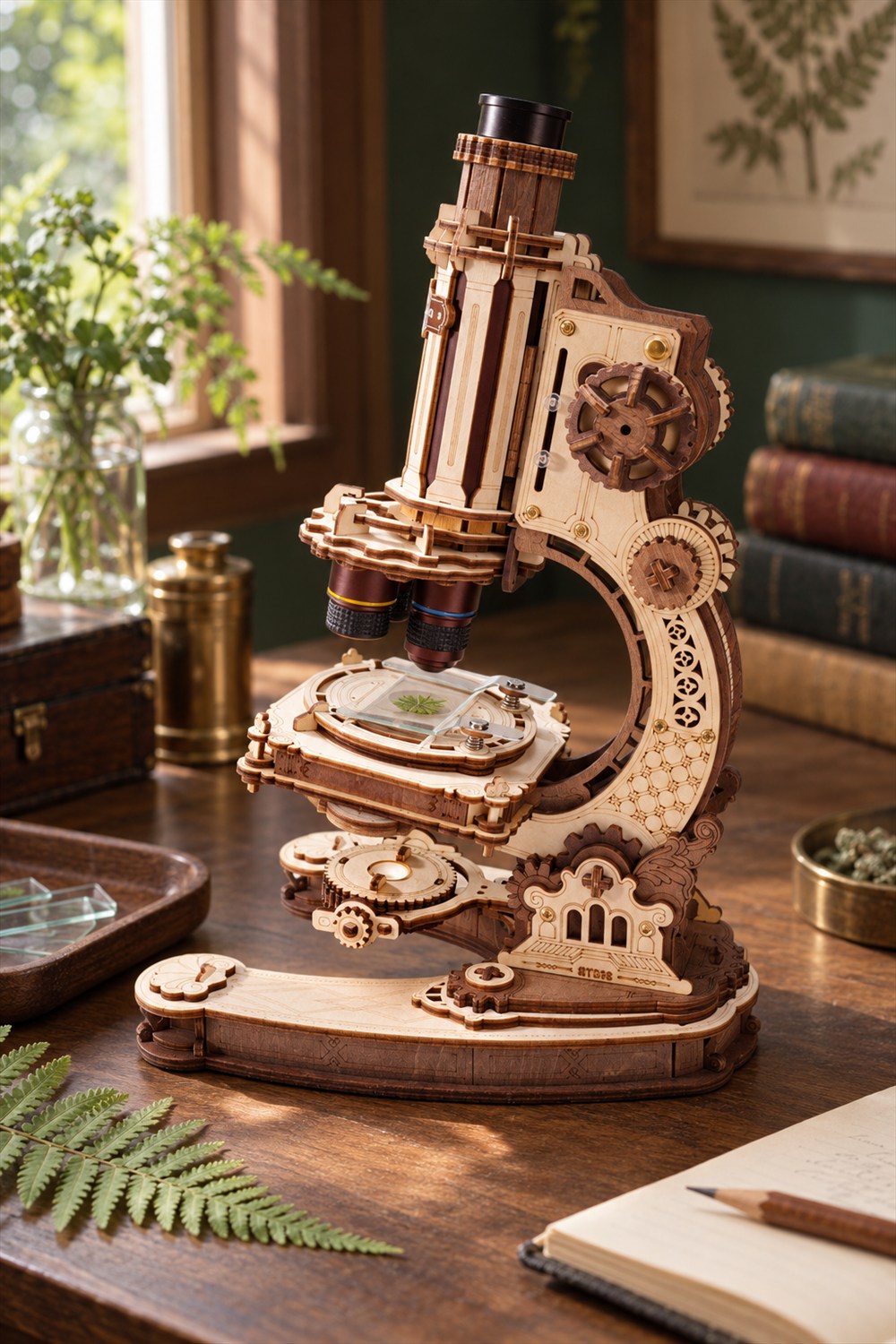
The pale wood faces and dark layered edges give the microscope its distinctive look. Look at the curved support and you will find geometric cutouts, scrollwork, and visible mechanical details. The eyepiece and lens assembly keep the silhouette immediately recognizable, even when the frame seems dressed for an expedition by candlelight.
It is the sort of object that invites someone to lean closer before they have even looked through it. A plain microscope announces that work is happening. This one suggests that work is happening and there may be a secret drawer somewhere. There is no promised secret drawer, sadly. You will have to supply your own intrigue.
Related posts:

That appearance makes sense for a displayable hobby project. You want to see what you spent the afternoon building. Hiding every mechanism behind a smooth shell would be a little like baking a complicated cake and then serving it in an opaque storage bin.
First comes the satisfying pile of pieces
Robotime lists 260 pieces, glue-free assembly, a roughly six-hour build, and a recommended age of 14 and up. Its difficulty rating is four out of five stars. That sounds like an appointment with your work surface, rather than a tiny activity to squeeze in while the kettle boils.
A project like this is appealing precisely because it asks you to slow down. You can spread things out, follow the sequence, and give your hands a problem that does not involve refreshing an inbox. Somewhere along the way, a collection of flat parts starts looking suspiciously like a scientific instrument.
Give yourself room to keep pieces organized and the instructions visible. The dining table is a perfectly reasonable temporary workshop, provided everyone involved understands the meaning of temporary. A tray for small components can also prevent the household cat from launching its own unsupervised research program.
The assembly estimate is a guide, not a race. Nobody is awarding a lab coat to the first person finished. If the relaxing part for you is checking each connection and admiring the mechanism as it grows, taking longer can be the entire point.
Knobs worth turning
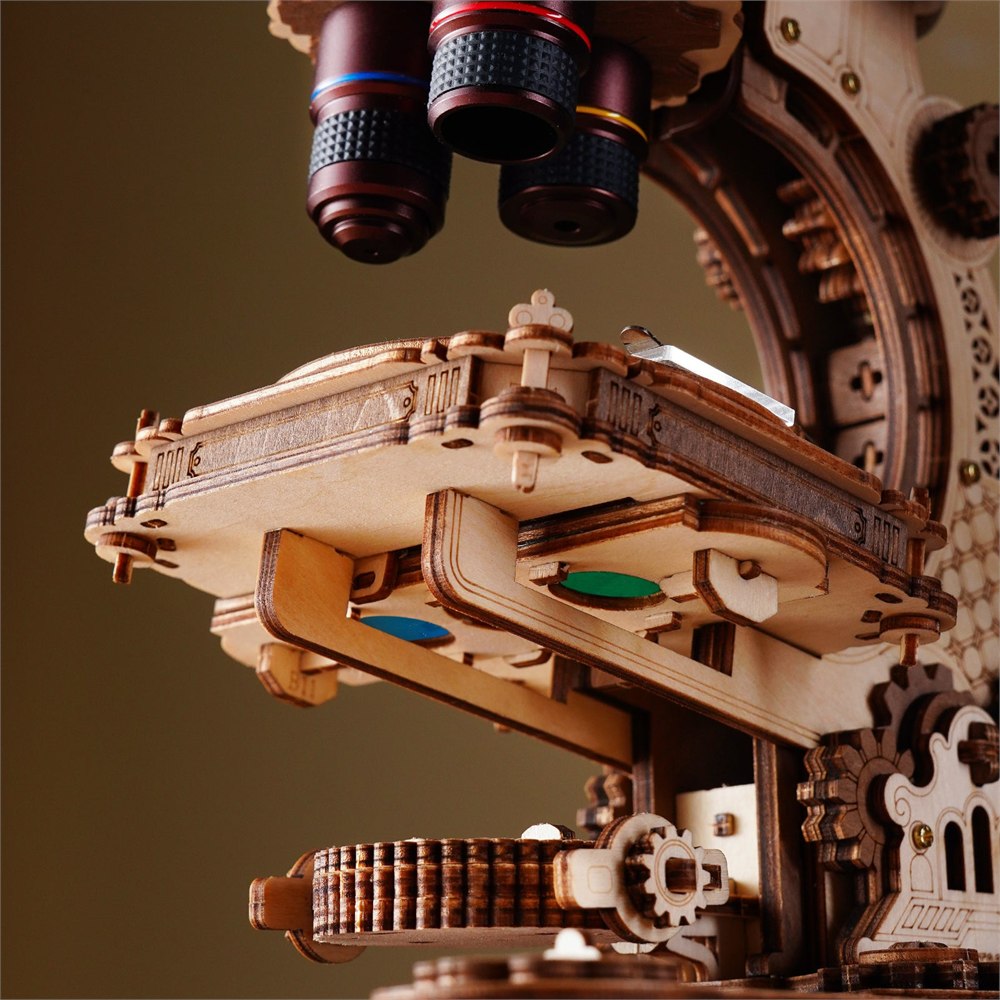
The finished model has a revolving lens selector, a focus adjustment, an LED light, and green and blue filters. Metal clips hold the slide. These are practical controls to explore after assembly, giving the project more to offer than a single triumphant photograph.
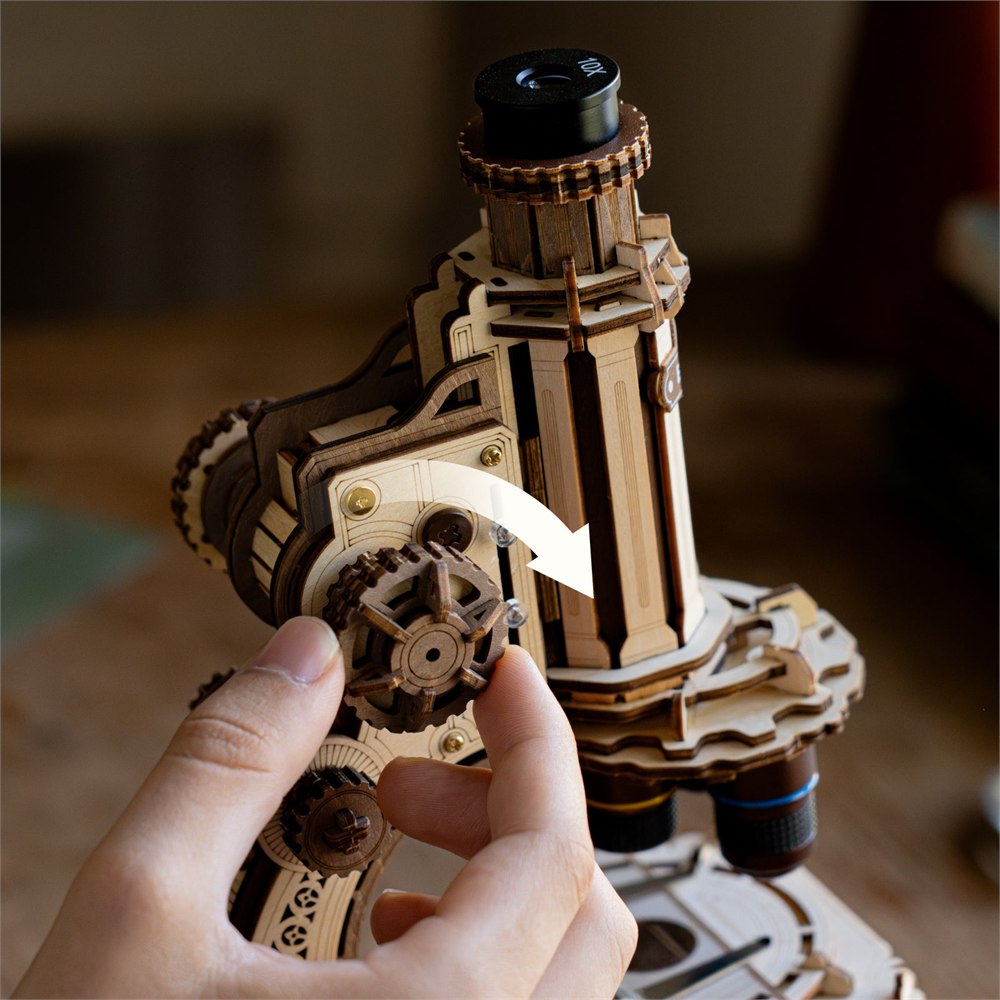
There is something especially enjoyable about operating a mechanism you have just put together. A knob stops being an anonymous control. You know there are parts behind it, because an hour earlier those parts were having a meeting all over your table.
- For the builder: a project that continues to be useful after the final piece goes in.
- For the curious: an excuse to spend time looking closely at ordinary things.
- For the display enthusiast: an instrument with visible gears and ornamental detail.
- For the gift giver: something suited to a person who likes both making and investigating.
Start with the instructions and get comfortable with the adjustments before expecting a glorious scientific breakthrough. Finding a view, changing a setting, and noticing the difference is part of the fun. Even a humble observation can feel surprisingly satisfying when you made the instrument that helped you see it.
| Practical detail | What to know |
|---|---|
| Finished dimensions | 18.5 x 14.5 x 30 cm |
| Lighting power | Two AAA batteries, not included |
| Construction | Wooden model kit with working optics |
| Best starting point | Follow the supplied assembly and operating instructions |

A hobby that rewards a closer look
The appealing part of a microscope is how quickly an ordinary subject becomes a question. Something you would normally ignore gets your full attention. You do not need an elaborate speech about curiosity when there is already an eyepiece waiting on the desk.
It is also a pleasant change of pace from hobbies in which the finished result immediately demands an upgrade. Here, the next activity can simply be sitting down and learning the controls. There is no need to turn a quiet evening into a competition over who has the most impressive setup.
Amazon advertises this ST005 kit with 40X-400X magnification. Treat that as the seller’s specification, rather than a promise that every sample will look spectacular at the highest setting. The appeal here is hands-on building and observation; we have not independently tested the optical performance.
That distinction helps set the right expectations. Buy it because you enjoy the combination of a mechanical puzzle and a usable viewing instrument. If a school assignment or another specific task requires particular optical performance, compare those requirements carefully before choosing your equipment.
Who gets the most fun out of it?
This feels especially well matched to someone whose hobbies overlap. The puzzle person who keeps science books nearby. The science enthusiast who enjoys making things. The friend who has never met a visible gear they did not want to turn, preferably while saying, “Hang on, I think I see how this works.”
It can also make an enjoyable shared project if everyone likes patient assembly. One person follows the instructions while another locates the next piece, with occasional negotiations about who gets the satisfying part. Agreeing to take turns may require more diplomacy than the construction itself.
For someone who wants a ready-to-use object straight out of the box, the build is a substantial part of the purchase to consider. For someone who likes the process, it is the main attraction. Those are two very different birthdays, and knowing which one you are shopping for is useful.

Images courtesy of Robotime.
The small-laboratory shopping notes
- Product: ROKR ST005 working wooden microscope kit.
- Main appeal: assemble a model, then use it for optical observation.
- Design: layered wooden frame, visible gears, and ornate cutouts.
- Controls: selectable lenses, adjustable focus, lighting, and filters.
- Plan for assembly time, a clear work surface, and batteries.
The Amazon listing shows a price of $59.99, sold by ROKR and fulfilled by Amazon. Check the current offer and delivery details before ordering, as those can change. The kit is a rather charming answer to the question of what to give someone who already owns enough ordinary desk ornaments.
Once it is built, you have something to admire and something to do. That is a good arrangement for a hobby purchase. Your shelf gets a little more interesting, your curiosity gets a new outlet, and a completely innocent onion may suddenly find itself receiving an unreasonable amount of attention.
| Pros | Cons and considerations |
|---|---|
| Combines model building with optical observation | Requires assembly before use |
| Distinctive wooden laboratory styling | Decorative design may not suit every desk |
| Several controls to explore after building | Getting familiar with adjustments takes patience |
| Built-in illumination | Batteries must be supplied separately |
| Appealing overlap of puzzles and science | Optical performance has not been independently tested here |
Save this find.
Thank yourself later.
Your next great gift idea. Your someday space. Your collection of wonderfully weird things.
Save to PinterestPick a board. Keep the inspiration.
This Wooden Microscope Kit Becomes a Working Optical Instrument
Where to find This Wooden Microscope Kit Becomes a Working Optical Instrument
OddityMall may earn a commission from qualifying purchases at no extra cost to you.