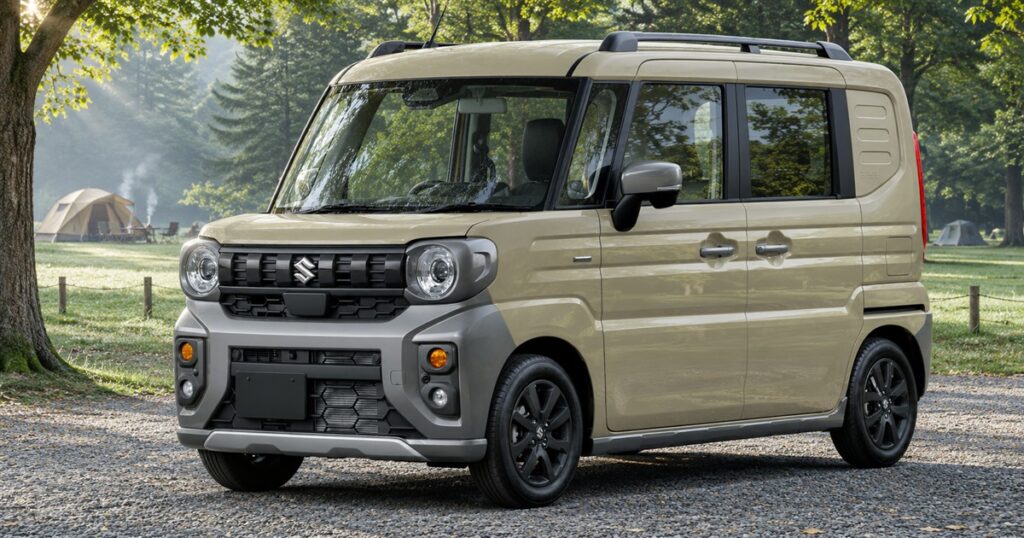
Some people see a tiny van and wonder how many groceries it holds. Others immediately start measuring it for a nap. Suzuki has apparently hired people from the second group, because the new Spacia Base turns its little cargo compartment into a collection of places to work, organize gear, and lie down after announcing that you are definitely going hiking.
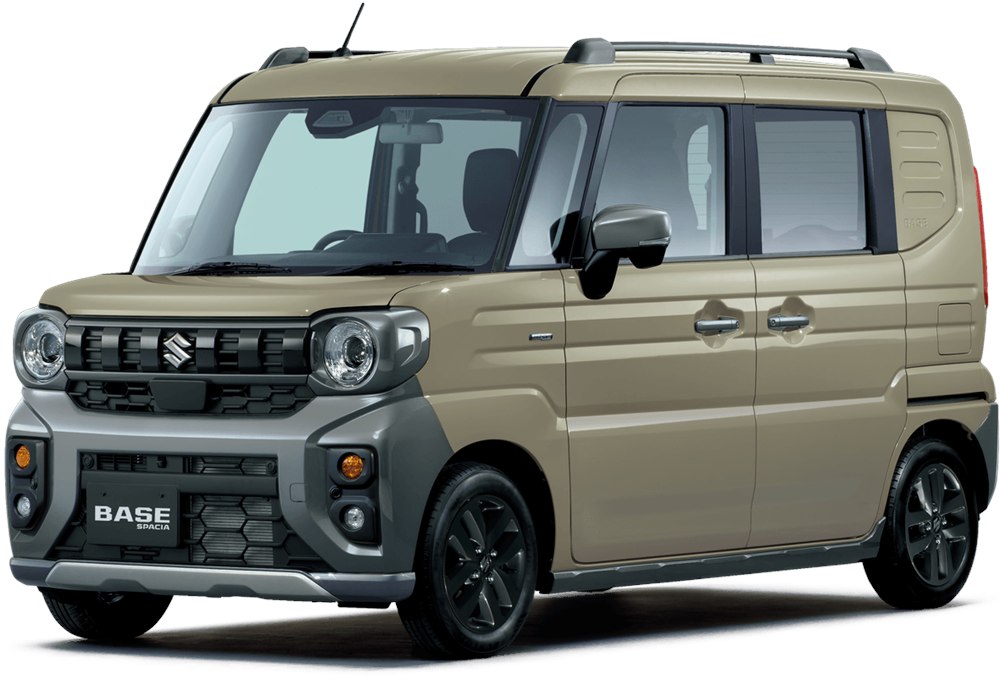
The new Suzuki Spacia Base is a two-seat kei commercial van with a particularly useful party trick: a pair of movable Multi-Boards that change how its rear space works. They can form tables, divide cargo, and help create overnight sleeping arrangements. Think of it as a very small room whose furniture has learned to cooperate.
Suzuki previewed the new model in November and is pointing toward a winter 2026 debut in Japan. The vehicle shown is still under development, so final specifications may change. What is already clear is the basic idea: give two people a useful little vehicle, then let the space behind them have several different jobs.
Two seats, with the rest left to your imagination
The most consequential change is also the easiest to understand. There are no rear passenger seats in this new layout. Two people sit up front, and the area behind them becomes cargo space. You do not have to negotiate with a back bench every time a cooler, a bicycle, or a weekend plan needs somewhere to go.
That makes this an appealing proposition for a particular kind of trip. If your traveling party consists of you and one other person, the missing seats may feel like a very sensible trade. If it consists of two adults and three children, the Spacia Base has already declined the invitation. This is a two-seat vehicle, however inviting its parked lounge arrangements look.
Related posts:
 This Truck Hitch Cargo Holder Doubles as Seating For Tailgating or Camping
 This Retro Boaterhome Is a 3-In-1 Van, RV, and Boat
 The Bunch Electric Cargo Bike Lets You Haul Up To 4 Children In Front Of The Bicycle
 Cargo Socks Are Now A Thing, So You Can Hold Your Phone, Snacks, Or Cash Right in Your Sock Pocket
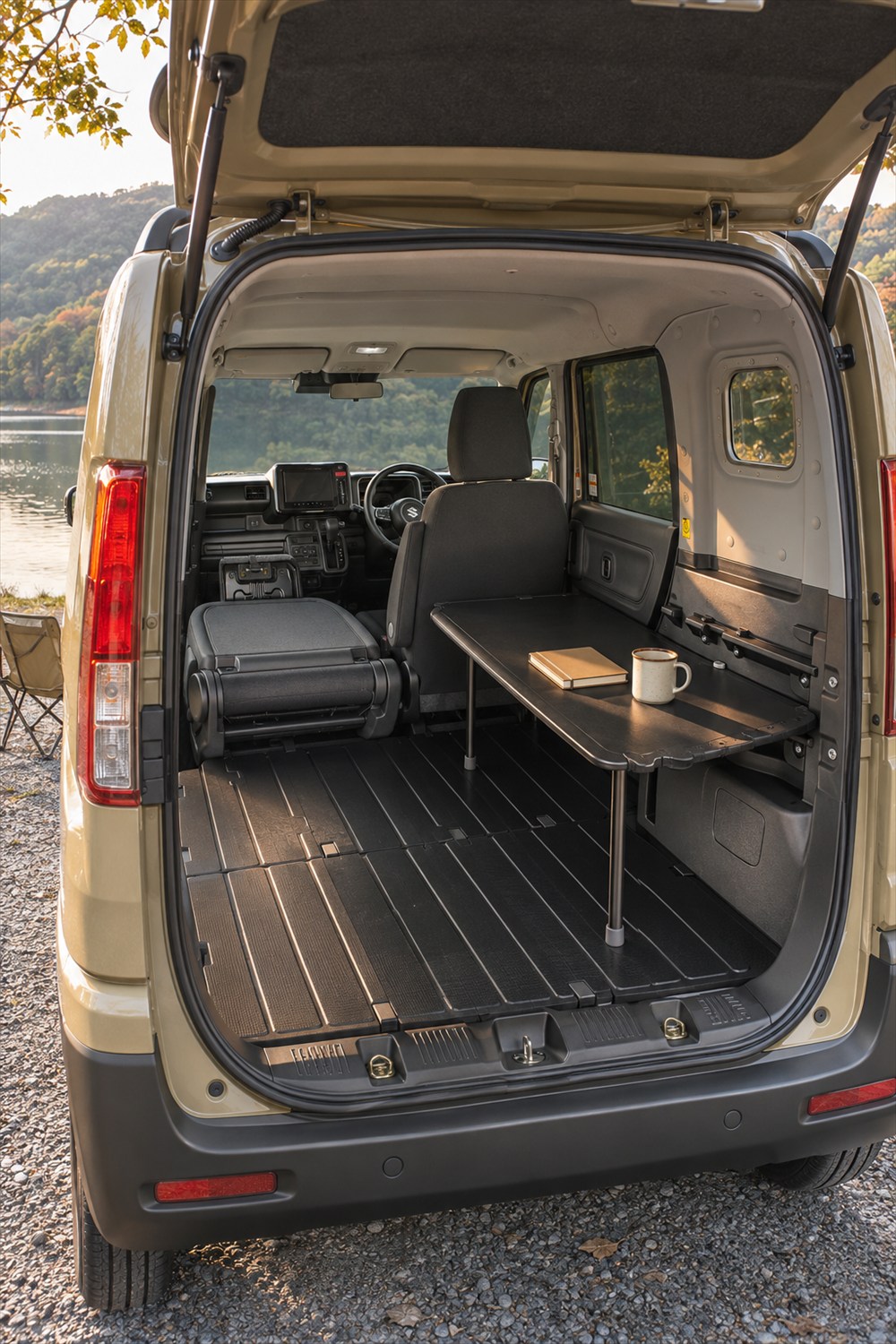
In Suzuki’s photos, the cabin has a straightforward, practical character. The broad cargo floor and attachment points along the sides do more of the work than decorative trim. It looks like a space you would actually load things into, rather than one you would apologize to after carrying a muddy bag.
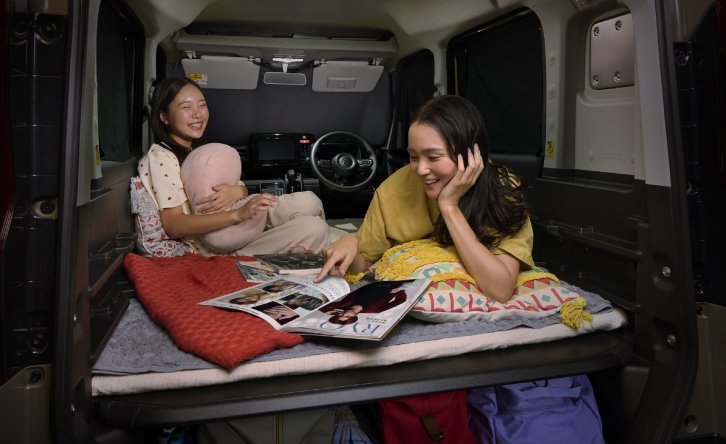
The boards are the clever part
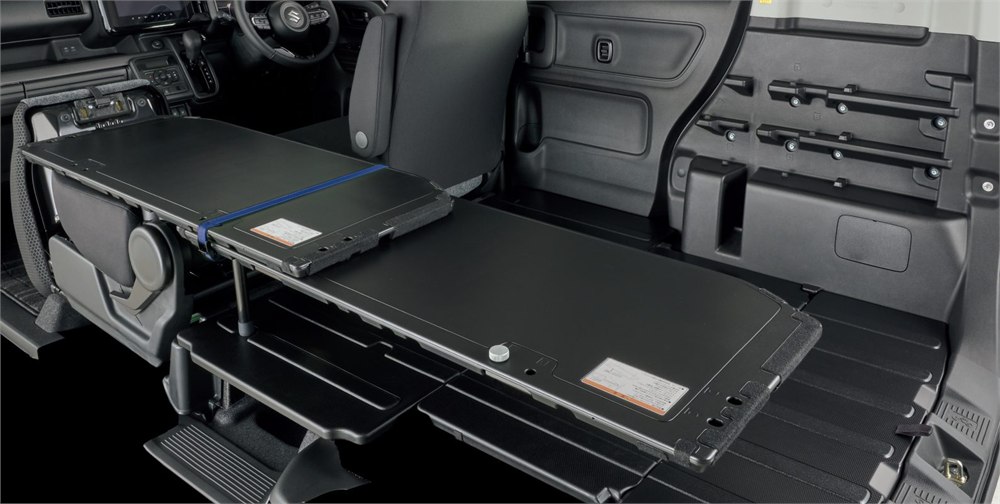
Suzuki says two Multi-Boards and eight support pipes will be standard equipment. Those are the core pieces behind the various layouts, rather than a permanently installed bed or an entire kitchen cabinet stuffed into the back. Rearranging the boards changes the relationship between open floor space, raised surfaces, and divided storage.
The side-table arrangement is particularly easy to appreciate. A board becomes a work surface along the cabin wall, leaving space beside it. You can picture organizing small gear, setting down supplies, or taking a break from balancing everything on your knees. Your knees have been carrying the mobile-office industry for far too long.
Join the boards together, and Suzuki shows a larger table arrangement. That provides a broader surface while retaining room for cargo below. The advantage is flexibility: the same vehicle can carry things on one outing and provide somewhere to sort through them on another, without committing its entire rear compartment to one permanent purpose.
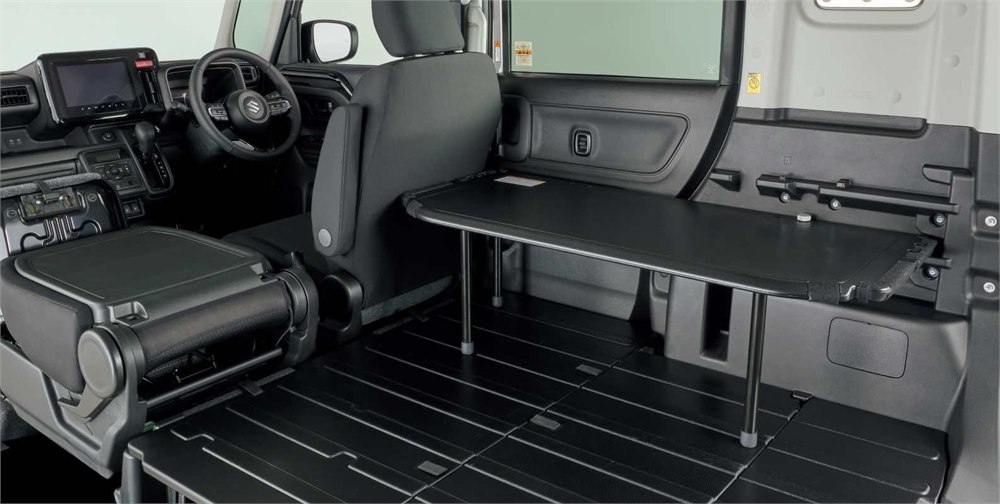
The practical appeal of the system comes down to a few ordinary tasks becoming less awkward:
- Use a side table when you want a work surface without covering the whole cargo area.
- Join two boards for a larger table with storage space underneath.
- Divide the load area to keep different groups of belongings separated.
- Switch to a sleeping arrangement when the driving is finished.
- Use the flat cargo configuration when open loading space matters most.
None of that requires pretending a small van is a luxury motorhome. In fact, the restraint is part of the charm. There is no need to find a permanent home for a dining room when the dining room can go back to being a board. The vehicle keeps its useful-van identity while giving its occupants a few more options once parked.
Seven ways to arrange a very small room
Suzuki illustrates seven Multi-Board configurations. They are worth distinguishing because the differences are useful, particularly if you are choosing between somewhere to sleep, somewhere to work, and somewhere to put the enormous quantity of equipment required for a supposedly simple weekend.
| Configuration | What changes | Useful for |
|---|---|---|
| Solo overnight | Passenger backrest folds forward; boards extend the resting area | A one-person overnight setup |
| Two-person overnight | Front backrests recline rearward with connected boards | A shared parked resting space |
| Side table | A board sits along the cabin side | A compact work surface |
| Large table | Two boards connect into a broader surface | Sorting equipment above stored cargo |
| Front/rear divider | A board separates portions of the load area | Organizing different belongings |
| Front/rear and upper/lower division | The cargo space is split in more directions | More structured loading |
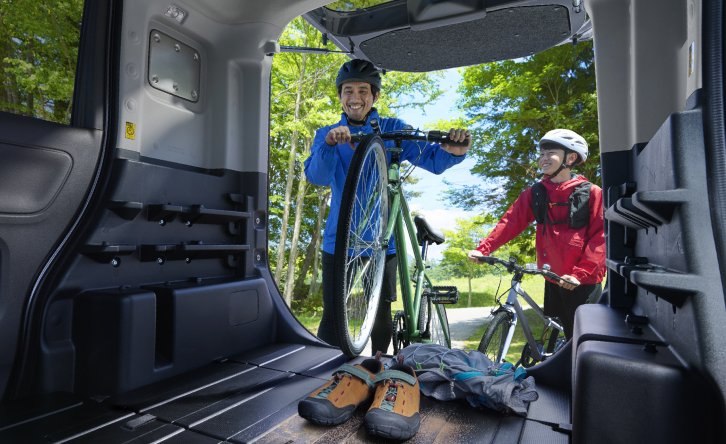
| Full flat | Deck boards create a level cargo floor | Open loading space |
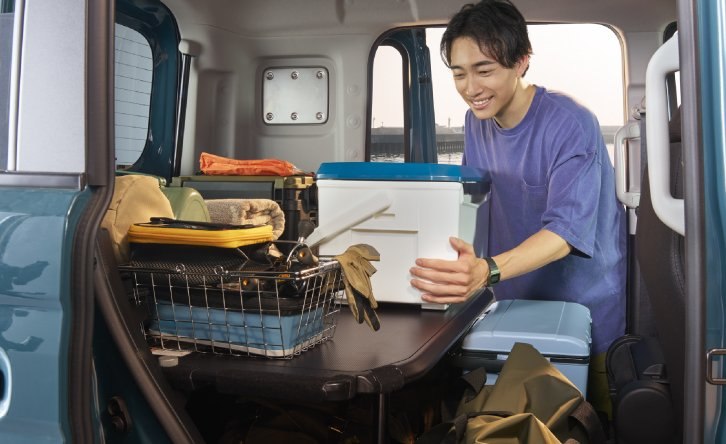
The solo overnight setup uses the passenger side to extend the available resting space while keeping the driver’s seat upright. For two people, Suzuki shows the front seatbacks reclined rearward and the boards joined to form a broader area. Those are different arrangements, so it is worth looking at the actual layout rather than assuming that both work like a fixed bed in a camper.
Soft bedding in the lifestyle photos helps explain the intended use, but it should not be confused with the stated standard equipment. The confirmed board-and-pipe kit is one thing; pillows, blankets, coolers, bicycles, and the pleasant people enjoying their weekend are quite another. You will have to provide your own pleasant people.
The divider modes are less glamorous than a tiny bed, but possibly more useful on an ordinary day. Separating the cargo area gives loose belongings some structure. The version that also creates upper and lower sections adds another way to keep the load organized instead of building one large pile and hoping the item you need is on top.
A practical little van beyond the campsite
The flat-floor arrangement brings the focus back to hauling things. Suzuki’s imagery includes a bicycle being loaded through the rear, along with other everyday and outdoor uses. It is a reminder that the sleeping layouts are an option within the vehicle’s broader job, not the only reason for it to exist.
That matters if a dedicated camper would spend most of its life parked outside your home, quietly judging you for going to work. A configurable cargo van can still have useful weekday duties. Whether this particular layout suits your equipment will depend on the finished vehicle’s dimensions and loading limits, which are details to check once the complete specifications arrive.
Suzuki also previews a mild-hybrid system paired with a turbo engine. It describes recovering energy during deceleration and using stored electricity to assist the engine during acceleration. This is engine assistance, not a claim that the van is a battery-electric camper or that it will power your whole campsite.
The exterior stays wonderfully boxy, with round headlights, dark wheels, and roof rails visible on the preview vehicle. Five colors appear in the teaser, including sand khaki, denim blue, soft beige, silver, and gray. It is the sort of shape that makes a vehicle look ready for a small adventure without needing a ladder, a shovel, and twelve decorative fuel cans bolted to it.
What to know before planning a tiny-van escape
The strongest reason to watch the Spacia Base is its adaptable interior. It promises a useful middle ground for people who want more than a bare load compartment but do not need a permanently fitted motorhome. Its appeal lies in changing the arrangement to fit the day, then changing it again when the day turns into an overnight stay.
- Two-seat kei commercial van with dedicated rear cargo space.
- Two Multi-Boards and eight board support pipes announced as standard equipment.
- Seven illustrated layouts covering sleeping, tables, divided storage, and a flat load floor.
- Mild-hybrid assistance paired with a turbo engine.
- Winter 2026 debut previewed for Japan; development specifications may change.
- Photos show possible uses and props, rather than a promise that every pictured item is included.
Suzuki has not announced pricing or the exact release date in its preview announcement. The current place to follow the vehicle is Suzuki’s Japanese Spacia Base preview. That is a Japanese-market announcement, not confirmation of availability elsewhere. For now, it offers a compelling look at how much useful furniture you can get from two boards and a van with its priorities in order.
Product photos: Suzuki.
| Pros | Cons / considerations |
|---|---|
| Flexible boards support several different uses | Changing purposes means rearranging the interior |
| Dedicated cargo space behind two front seats | No rear passenger seating |
| Solo and two-person overnight layouts shown | Bedding and other lifestyle props are not confirmed standard equipment |
| Tables and divided storage add everyday usefulness | Final dimensions and loading details still need checking |
| Mild-hybrid and turbo powertrain announced | Not a battery-electric vehicle |
| Japan debut planned for winter 2026 | Price, exact launch date, and wider availability remain unannounced |
Save this find.
Thank yourself later.
Your next great gift idea. Your someday space. Your collection of wonderfully weird things.
Save to PinterestPick a board. Keep the inspiration.
This Two-Seat Mini Van Turns Its Cargo Space Into Tables and Beds
At a glance
Product snapshot
Related posts:
This Truck Hitch Cargo Holder Doubles as Seating For Tailgating or Camping
This Retro Boaterhome Is a 3-In-1 Van, RV, and Boat
The Bunch Electric Cargo Bike Lets You Haul Up To 4 Children In Front Of The Bicycle
Cargo Socks Are Now A Thing, So You Can Hold Your Phone, Snacks, Or Cash Right in Your Sock Pocket