Neighborhood errands have become weirdly dramatic for something that mostly involves buying oat milk and pretending the school pickup line is a society. The modern family vehicle is often a rolling fortress used to travel exactly 1.7 miles, then sit in a parking lot like it just completed an arctic expedition.
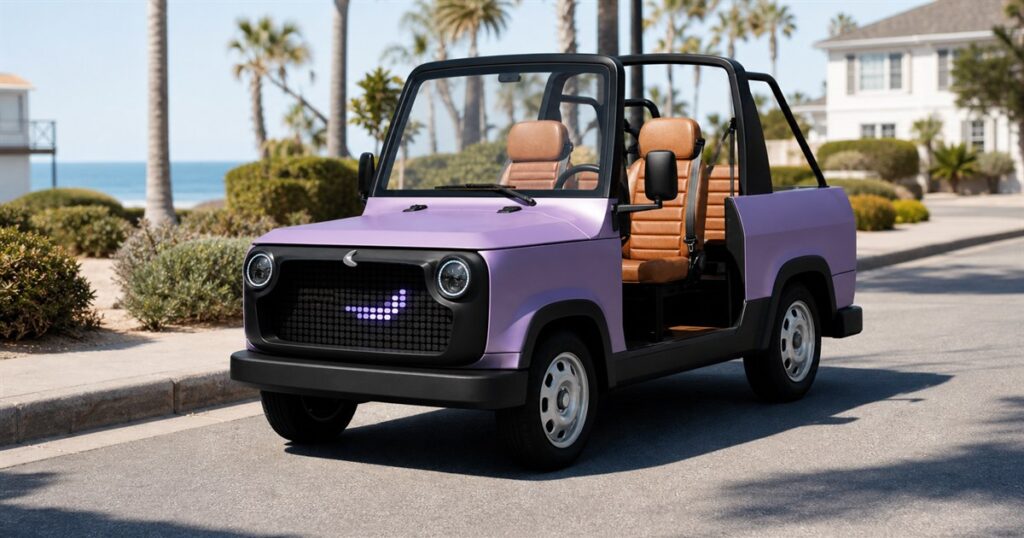
The Chip Life Utility Vehicle, or Chip LUV, is Chip Motors’ tiny electric neighborhood vehicle built for those short local trips that do not really need a giant SUV, a second mortgage, and a cupholder count that suggests you are hydrating an entire marching band. It is a compact, street-legal low-speed EV with room for four to six people, a friendly dot-matrix face, and a pitch that sounds like a golf cart went to charm school, got licensed, and started offering to park itself.
Chip Motors calls it a Life Utility Vehicle, which is both a product category and a polite way of saying, “What if your daily driver stopped behaving like it was training for interstate combat?” The vehicle is aimed at school runs, beach trips, groceries, neighborhood dinners, sports practice, coffee runs, and all the little local missions that make up most actual family driving.
A Tiny EV For The Errands That Run Your Life
On the official Chip Motors site, Chip is listed as a street-legal vehicle made for roads with lower speed limits. The company lists a 25 mph top speed, compatibility with roads posted up to 35 mph, and more than 100 miles of range per charge. In other words, it is not trying to be your cross-country road-trip machine. It is trying to be the cheerful little purple rectangle that handles the ten-minute drive to the pool without requiring you to pilot a living room on wheels.

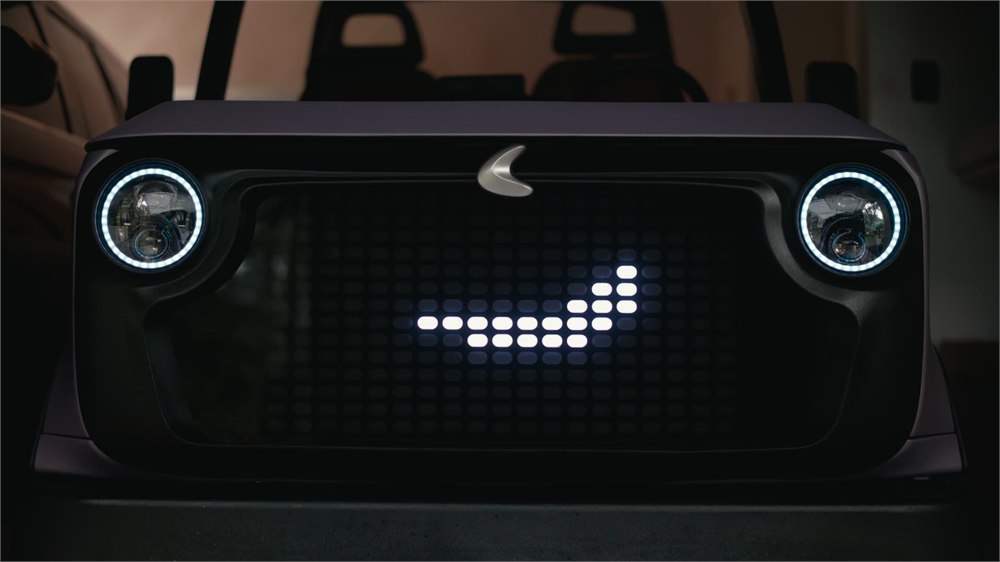
The design is the hook. Chip has a stubby upright body, round headlights, a simple open cabin, tan seating, and a black front grille that can show dot-matrix expressions. It looks less like a car trying to win a horsepower argument and more like a neighborhood appliance that developed social skills. That is a compliment. Most cars currently look angry enough to be denied boarding at a theme park.

Chip is offered in four-seat and six-seat versions, with a roof, doors, colors, front storage, and accessories listed as customization areas. The brand’s launch material also mentions practical daily-life touches such as a secure frunk, fold-down rear seating for bigger cargo, a hose-out interior, and local-trip use cases like groceries, beach gear, school, soccer, and coffee runs. It is the sort of vehicle that makes the most sense in a beach town, planned neighborhood, campus-like community, retirement area, lake community, or any place where half the driving map is basically “around here.”
The Part Where It Offers To Leave Without You
The strangest and most OddityMall part is Chip Go, the remote driving service Chip Motors is pitching for empty-vehicle moves. The idea is that a trained remote operator can move the vehicle when nobody is riding inside it, so Chip can find parking, come back to pick you up, head home, collect an order curbside, or freshen up with a wash or roof swap. It is not marketed as a fully autonomous robot taxi; the company describes it as a remote service for the empty vehicle.
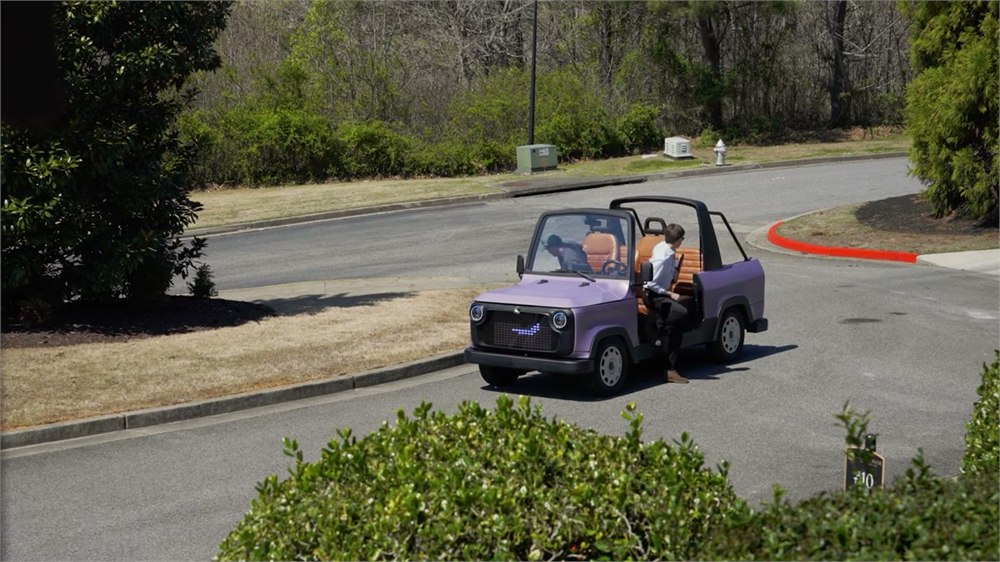
That is either brilliant or the start of a suburban sci-fi movie where your car has a better social calendar than you do. Either way, it is a deeply funny solution to a deeply boring problem: nobody wants to circle the lot while everyone else is already inside eating fries.
Here is the practical shape of what Chip is promising, without pretending it is a highway car in a tiny hat:
- A compact low-speed electric vehicle for short local roads and neighborhood trips.
- Four-seat and six-seat versions for families, friends, and the mysterious extra child who appears during every school run.
- A claimed 25 mph top speed and 100+ miles of range per charge.
- Chip Go remote empty-vehicle services for parking, pickup, errands, home return, and refresh trips.
- Customizable elements including color, seating, roof, doors, frunk, and accessories.
- A friendly dot-matrix grille face, because apparently the future of transport is a toaster that can wink.
What The Specs Mean In Normal Human Terms
A 25 mph top speed sounds slow if your mental image of driving is a freeway on-ramp. It sounds much more reasonable if your actual trip is three blocks to the pool, seven minutes to the elementary school, or a slow cruise to a neighborhood restaurant where the real enemy is parking and the car line has reduced everyone to a podcast with a pulse.
| Feature | What Chip Motors Lists | Why It Matters |
|---|---|---|
| Vehicle type | Life Utility Vehicle / low-speed EV | Built for short local roads, not highway travel |
| Top speed | 25 mph | Fits neighborhood, resort, campus, and lower-speed city use |
| Road context | Roads posted up to 35 mph | Aims at the U.S. low-speed vehicle use case |
| Range | 100+ miles per charge | Plenty for many local errands before recharging |
| Seating | 4 to 6 seats | Can cover a small family or a little crew |
| Remote service | Chip Go for empty-vehicle moves | Parking and pickup become the headline party trick |
There are obvious limits. Chip is not for the interstate, not for high-speed commuting, and not for people who need one vehicle to haul plywood, cross mountain passes, and intimidate every compact sedan within a five-mile radius. It is a local-use vehicle, and that focus is why it is interesting.

The low-speed vehicle category already exists, but Chip wraps it in a much more personality-forward package. Golf carts have long been used as informal neighborhood transportation in certain communities. Chip’s pitch is more purpose-built: street-legal local travel, family errands, weather and seating options, storage, a friendly vehicle face, and an optional remote-move service that turns parking into someone else’s tiny video game.
It Is Basically A Local Errand Companion With Wheels
Where Chip gets charming is in the gap between usefulness and absurdity. A secure front trunk for groceries is useful. A hose-out interior after a beach day is useful. A vehicle that can be configured with more seats is useful. A grille that smiles at you while it waits outside soccer practice is nonsense, but it is emotionally effective nonsense, and that counts for more than most spec sheets admit.
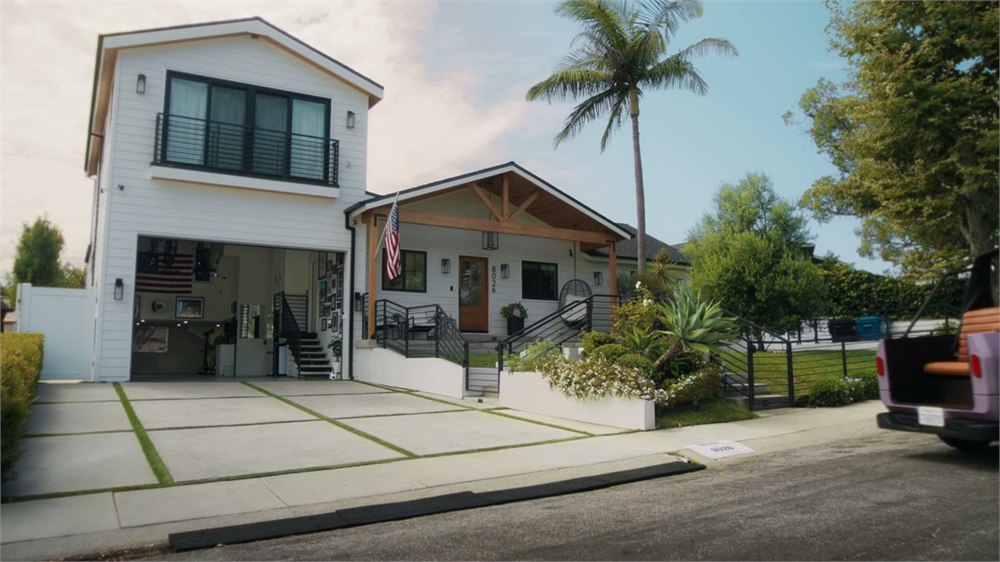
The company also leans into the social side of the product. This is not a grim last-mile pod designed to make spreadsheets proud. It is for open-air beach cruises, brunch without a parking hunt, evening neighborhood rides, groceries while someone else stays home, and the kind of errands that feel less irritating when the vehicle is small enough to seem invited.
For families, the strongest case is probably right-sizing. A lot of daily driving is local, repetitive, and weirdly over-vehicled. Chip does not replace a full-size car for everyone, but it could replace many tiny trips that currently involve warming up a much larger vehicle to move a few humans and a bag of snacks across town.

For neighborhoods, resorts, campuses, and beach communities, the visual appeal is just as important. Chip looks friendly. It is compact enough to feel approachable, and the purple launch vehicle has the kind of soft toy-like confidence usually reserved for boutique appliances and very expensive scooters. That is probably intentional. If people are going to rethink what counts as a daily vehicle, it helps if the thing looks like it wants to help instead of dominate a lane.
Key Details Before You Start Measuring The Driveway
Chip Motors says reservations are open now with a refundable deposit, and the company expects deliveries to begin in 2027. The company keeps the pricing details refreshingly straightforward, which is polite behavior for a vehicle with a digital face.
- Product: Chip Life Utility Vehicle, also called Chip LUV.
- Maker: Chip Motors, Inc.
- Use case: short local trips, school runs, groceries, beach rides, neighborhood errands, and low-speed roads.
- Versions: four-seat and six-seat configurations.
- Performance listed by the maker: 25 mph top speed and 100+ miles per charge.
- Remote feature: Chip Go, a service for moving the empty vehicle for parking, pickup, errands, home return, or freshening up.
- Current pricing listed by Chip Motors: four-seat version starting at $15,000, six-seat version starting at $18,000, with a $250 reservation deposit.
- Availability note: reservations are open, with deliveries expected to begin in 2027.
If your daily life includes local roads, kids, towels, groceries, coffee runs, and a repeated desire to abandon the car at the front door like a shopping cart with a conscience, Chip is exactly the sort of strange little vehicle that makes sense. It is not the car for every road. It is the car for the roads where most of real life quietly happens.
| Pros | Cons |
|---|---|
| Compact size fits short local trips better than a full-size SUV | Not intended for highway-speed driving |
| Four- and six-seat versions make it more family-friendly than many neighborhood EVs | Usefulness depends heavily on local road rules and speed limits |
| 100+ mile listed range should cover many errands between charges | Deliveries are expected to begin in 2027, so it is not an instant purchase |
| Chip Go remote empty-vehicle service is genuinely unusual | Remote operation raises natural questions about service coverage and comfort level |
| Friendly dot-matrix face gives it rare personality | The styling may be too playful for buyers who want a serious-looking vehicle |
| Open local-trip design suits beach towns, campuses, resorts, and neighborhoods | Weather protection depends on configuration choices |
| Starting price is far below many new full-size EVs | Still expensive compared with simpler golf-cart-style options |
Where to find This Electric Neighborhood Vehicle Parks Itself And Drives Home Empty
OddityMall may earn a commission from qualifying purchases at no extra cost to you.