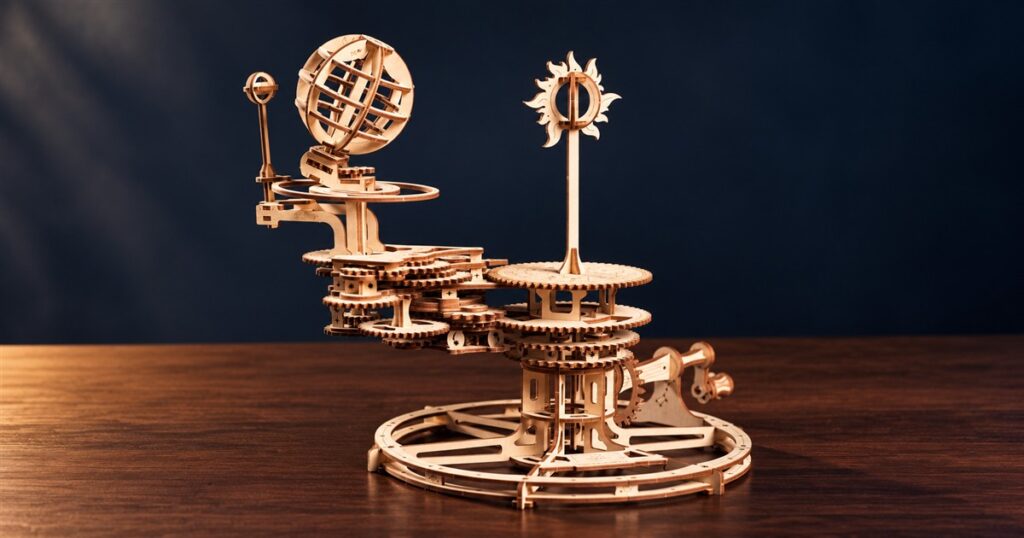
Some people keep a little plant on their desk. Some keep a framed photo. Then there are the people who would prefer to manage the Earth, Moon, and Sun with a small wooden crank. The UGEARS Mechanical Tellurion is for that third group, whose office decorating philosophy apparently includes becoming assistant manager of the cosmos.
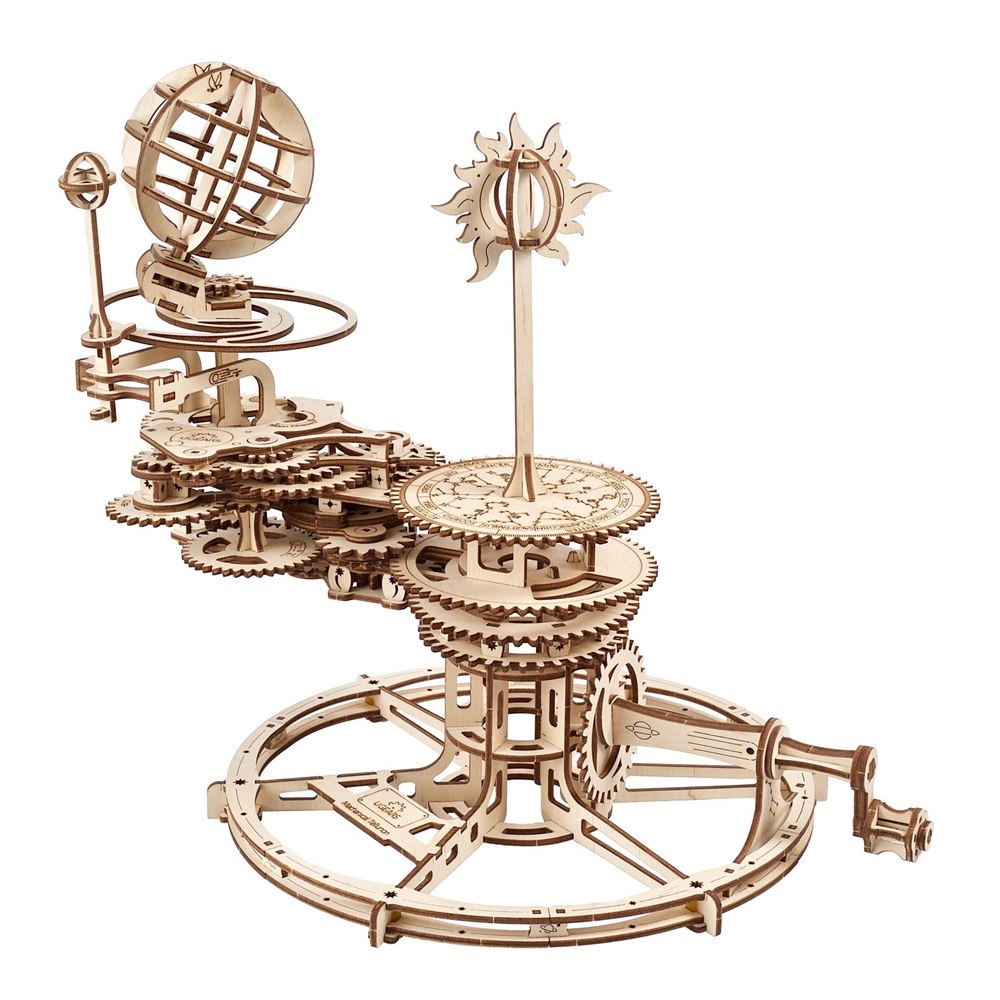
This wooden astronomy model is a build-it-yourself mechanical puzzle that demonstrates the relationship between our planet, its moon, and the Sun. Turn the handle and a stack of exposed gears gets to work, moving the model through its miniature celestial routine. It is the sort of desk object that invites a visitor to ask one polite question and accidentally receive an entire lunchtime astronomy presentation.
The important distinction is that you build the mechanism yourself. This is not a ready-made sculpture with a decorative knob attached. The kit arrives as laser-cut wooden components, and the finished machine is the reward for putting those pieces together. The satisfaction has two parts: making something complicated, then watching that complicated thing actually move.
A wooden Earth with a very manageable commute
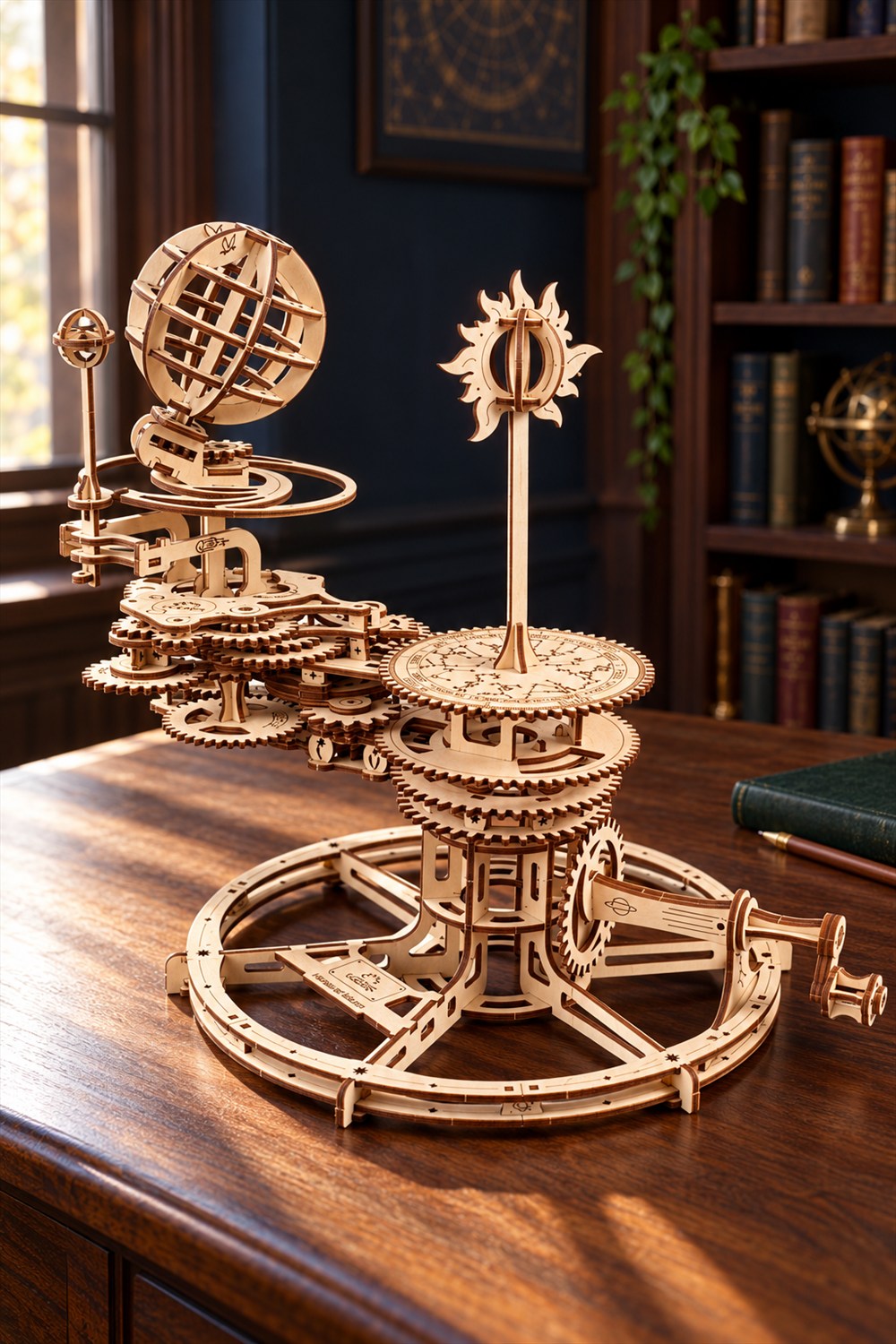
The model focuses on three celestial bodies instead of attempting to cram every planet into one crowded desktop solar system. There is a large openwork Earth, a smaller Moon, and a stylized Sun mounted on a tall post. Underneath, interlocking gears connect the hand crank to the moving assembly. You can see the mechanism doing its job, which is half the reason to own something like this.
UGEARS specifies that one complete turn of the handle represents one rotation of Earth on its axis, or one day. That gives the action a useful meaning. You are not simply spinning a collection of wooden circles and hoping something educational happens. Each turn advances the demonstration, letting you follow the relationship between daily rotation and the slower progression through the year.
Related posts:
 This Wooden Tourbillon Table Clock Kit Lets You Build a Tiny Observatory for Time
 This Playable Wooden Hurdy-Gurdy Model Kit Turns Puzzle Night Into A Medieval Jam Session
 16 Moon and Astronaut Themed Gadgets To Help Celebrate The Moon Landing Anniversary
 This Mirror Turns Into an Illuminated Moon Night-Light When It Gets Dark
Of course, this remains a tabletop representation. Those wooden bodies and their spacing are not a scale replica of the actual solar neighborhood. A truly scaled version would be a much less convenient gift and probably involve negotiations with several neighboring properties.
The tilt is part of the point
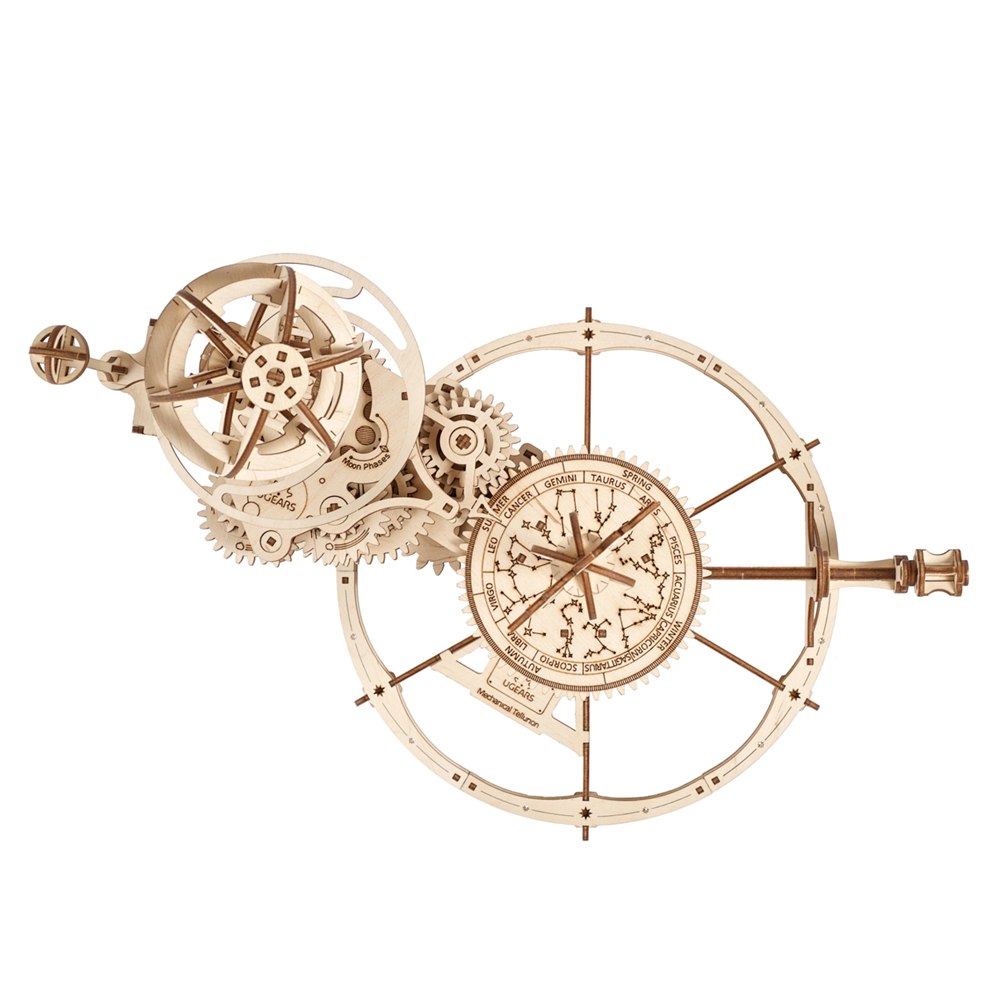
One of the model’s useful details is its representation of Earth’s 23.5-degree axial tilt. That tilt helps explain why the seasons change as Earth travels around the Sun. Instead of staring at a flat diagram and pretending it all makes sense, you can look at the positions of the model’s parts and turn the mechanism through the cycle.
The seasons are not caused by Earth simply getting closer to the Sun in summer. The changing orientation of a hemisphere toward the Sun affects the angle and duration of sunlight. Having a physical tilted globe makes that distinction easier to discuss. It also gives you a much better response to a child’s question than squinting thoughtfully at the ceiling.
The Moon adds another relationship to follow. Its changing position around Earth provides a way to talk through lunar phases, while the rotating globe supports a demonstration of day and night. The Sun here is a wooden symbol, not a lamp, so the model illustrates positions rather than projecting realistic sunlight across the globe.
- Turn the crank to follow the model’s daily motion.
- Use the tilted Earth to discuss seasonal changes.
- Track the Moon’s position relative to Earth and the Sun.
- Watch the exposed gears transfer motion through the mechanism.
- Use the marked dial and zodiac graphics as additional visual reference points.
That makes it appealing for someone who enjoys figuring out how things work. The model gives you something to point at, something to turn, and something to explain. Whether anyone in the room requested the explanation is a separate household matter.
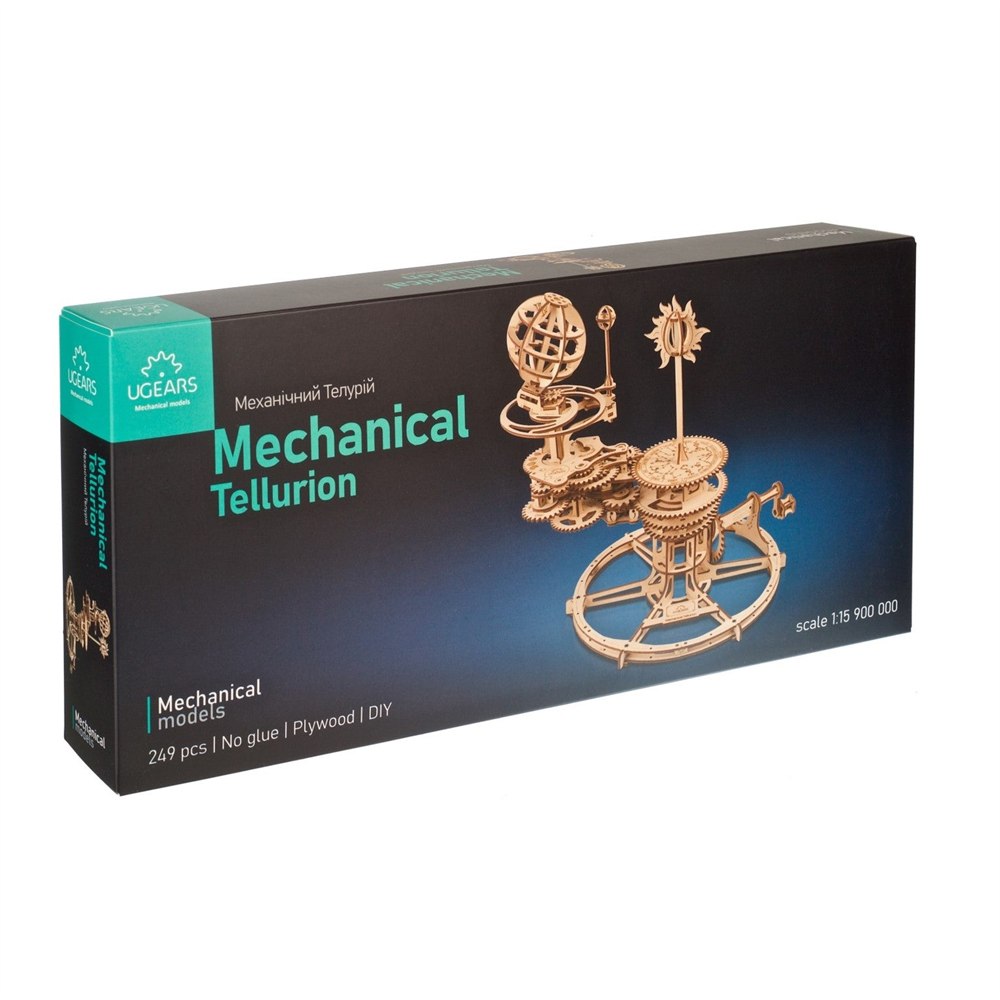
First, assemble your small corner of the universe
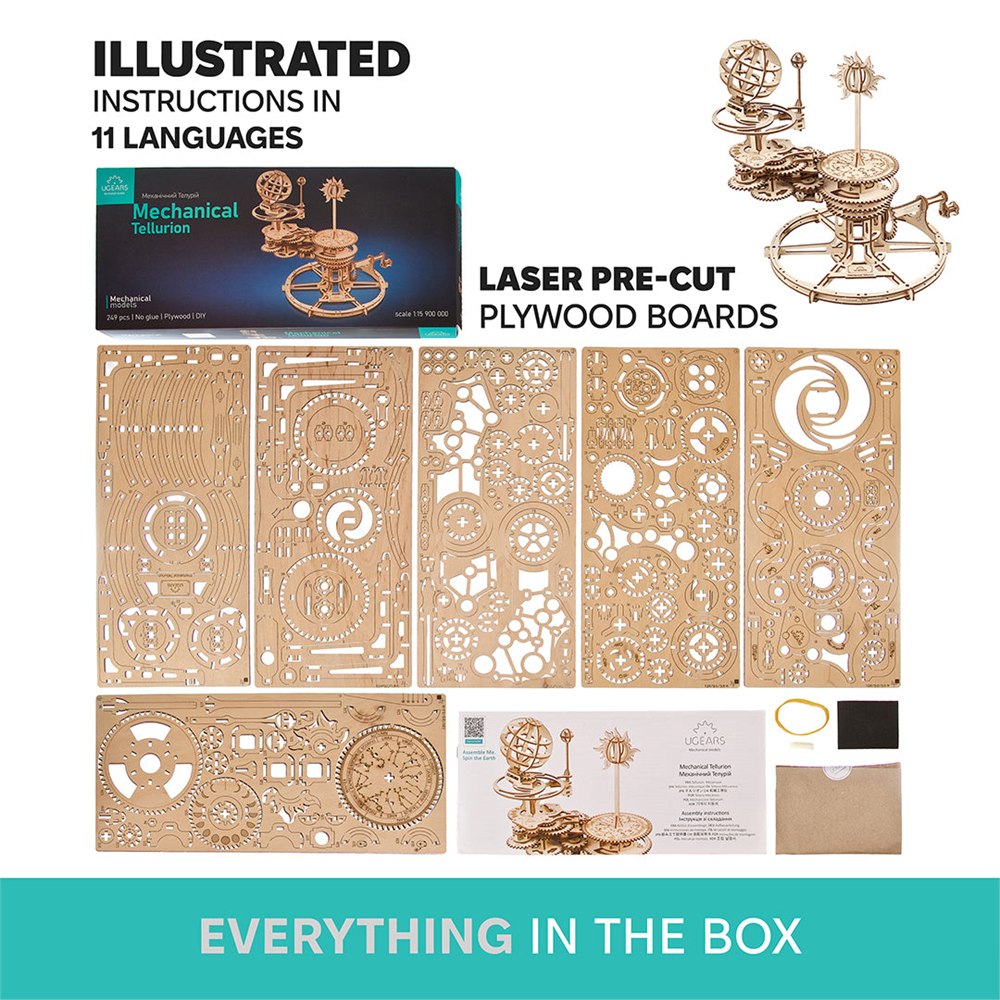
The kit contains 249 pieces and carries a medium difficulty rating from UGEARS. The recommended age is 14 and up. It is intended as a hands-on building project, so plan for a proper workspace and a patient approach rather than treating it like a five-minute party favor.
The pre-cut wooden parts fit together without glue. Illustrated instructions guide the construction, and UGEARS lists instructions in 11 languages. The finished result has the layered edges, pale wood surfaces, and intricate cutouts that make mechanical wooden models look like something an unusually ambitious clockmaker left on the workbench.
A useful approach is to keep the sheets and components organized as you work through the instructions. This is a gear-driven model, so fit and alignment matter. Racing through the build to reach the fun spinning part is understandable, but the gears do not award bonus points for enthusiasm.
| Detail | What the kit offers |
|---|---|
| Piece count | 249 wooden components |
| Difficulty | Medium |
| Recommended age | 14 and up |
| Finished dimensions | 40.5 x 26 x 30.5 cm |
| Power | Manual hand crank; no batteries |
| Assembly | Laser-cut parts, no glue required |
At roughly 16 by 10.2 by 12 inches, the finished model needs a real place to live. This is not a tiny trinket you slip between a keyboard and a coffee mug. Give it room for the moving assembly, and choose somewhere you can actually reach the handle. A beautiful mechanical model shoved behind a monitor is just an unusually elaborate dust collector.
You can set it to follow the date
UGEARS describes a manual tuning process for aligning the Tellurion with the time of year. You begin from a summer or winter solstice position on the seasons dial, orient the Earth appropriately, and turn the handle forward or backward by the corresponding number of days. The lunar position can then be adjusted using a lunar calendar.
After that setup, one turn each day lets you follow the progression. It is a wonderfully unnecessary little ritual for anyone who already enjoys winding a watch, tending a houseplant, or checking whether the sourdough starter is still speaking to them. Now the desk has a celestial maintenance schedule.
It does not run by itself, and there is no battery-powered motor quietly keeping everything synchronized. If you leave it untouched for a week, you will need to advance it accordingly. Think of it as an interactive model you operate, not an automatic astronomical clock that handles the calendar while you ignore it.
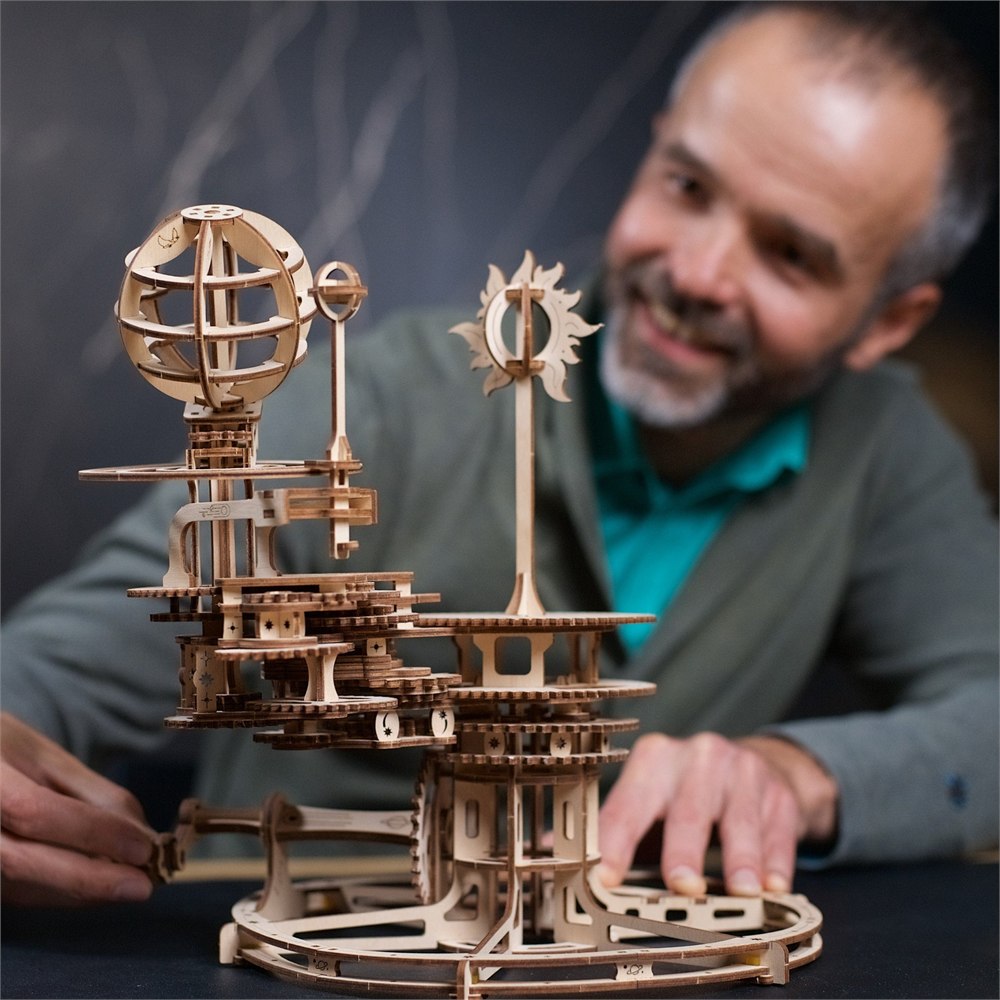
A gift with something to do after the wrapping is gone
The Tellurion makes the most sense for a puzzle builder, space enthusiast, or mechanically curious person who enjoys the construction as much as the finished object. It offers a longer relationship than a decorative globe: first the assembly, then the movement, then the inevitable urge to show someone how the mechanism works.
It could also be an engaging discussion piece for an older student learning about Earth and the Moon. The age guidance and small parts mean it is better considered a model-building project for teens and adults than a toy for little children. For someone who dislikes detailed assembly, a finished display model would probably be the kinder gift.
Visually, the appeal is hard to miss. The exposed gears look busy even when everything is stationary, and the open wooden globe gives the top a light, sculptural shape. Put it somewhere with good light and the cutouts and layered parts do plenty of decorating without needing a screen, an app, or a notification announcing that the Moon requires a firmware update.
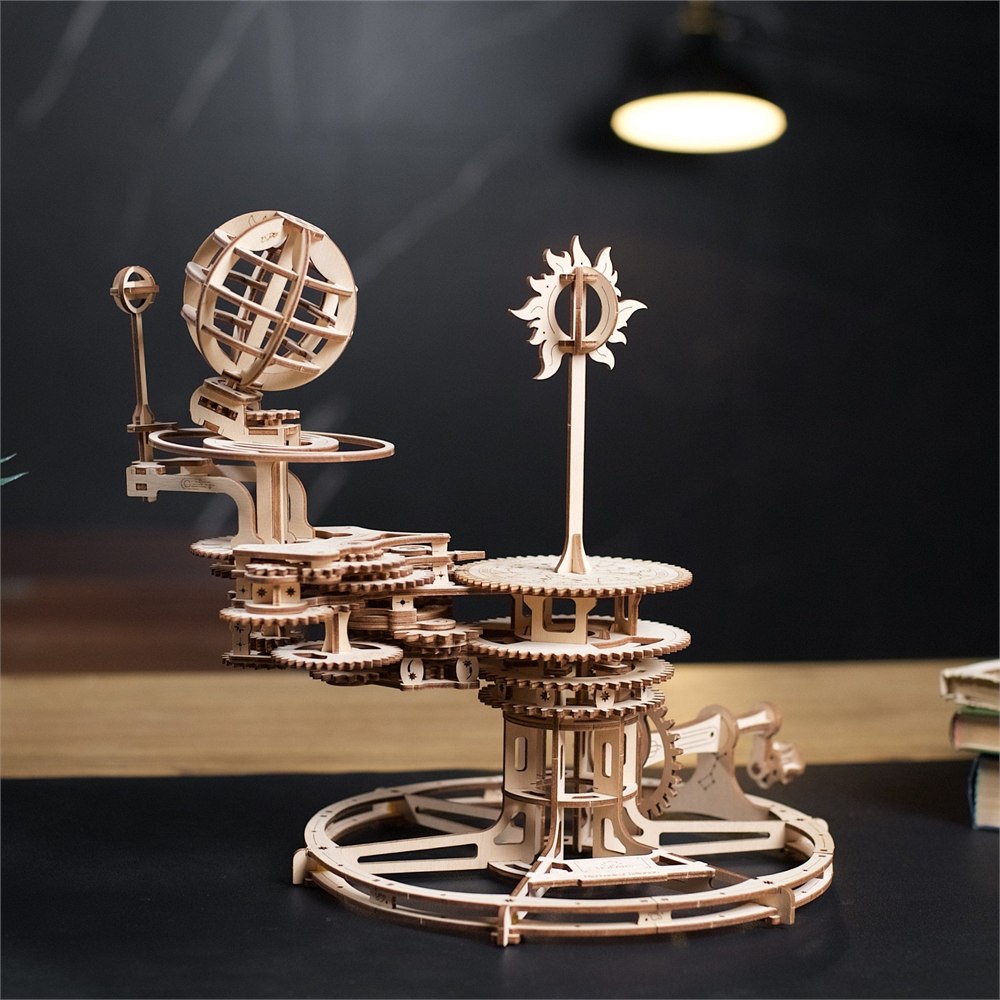
Product images: UGEARS.
The details before you take charge of Thursday
- UGEARS Mechanical Tellurion, model 70167.
- A 249-piece wooden assembly kit with medium difficulty.
- Represents the Sun, Earth, and Moon through a hand-driven gear mechanism.
- One handle rotation corresponds to one Earth day.
- Includes Earth’s axial tilt, a seasons dial, and zodiac graphics.
- No batteries or glue required; recommended for ages 14 and up.
- Finished size is 40.5 x 26 x 30.5 cm.
The Amazon listing is currently priced at $66.99, with stock available at the time of writing. Price and inventory can change. It is a kit to assemble, so the purchase buys both the building project and the finished wooden model, rather than a ready-to-display machine.
If your idea of relaxing involves carefully fitting wooden parts together until a small planetary system starts moving, this is a particularly charming way to spend some desk space. Finish the build, turn the handle, and enjoy being responsible for one whole day without having to answer a single meeting invitation from the Sun.
| Pros | Cons |
|---|---|
| Visible gears make the mechanism engaging to operate. | Detailed assembly requires patience and careful alignment. |
| Physical model supports astronomy discussions. | Sizes and distances are illustrative, not to scale. |
| No batteries or glue needed. | Manual operation; it does not keep time automatically. |
| Build project becomes a distinctive display piece. | Needs shelf or desk room for its moving structure. |
| Combines puzzle building with a working mechanism. | Small parts and age guidance limit its suitability for young children. |
Save this find.
Thank yourself later.
Your next great gift idea. Your someday space. Your collection of wonderfully weird things.
Save to PinterestPick a board. Keep the inspiration.
This Wooden Astronomy Model Moves the Earth and Moon With a Hand Crank
Where to find This Wooden Astronomy Model Moves the Earth and Moon With a Hand Crank
OddityMall may earn a commission from qualifying purchases at no extra cost to you.
Related posts:
This Wooden Tourbillon Table Clock Kit Lets You Build a Tiny Observatory for Time
This Playable Wooden Hurdy-Gurdy Model Kit Turns Puzzle Night Into A Medieval Jam Session
16 Moon and Astronaut Themed Gadgets To Help Celebrate The Moon Landing Anniversary
This Mirror Turns Into an Illuminated Moon Night-Light When It Gets Dark