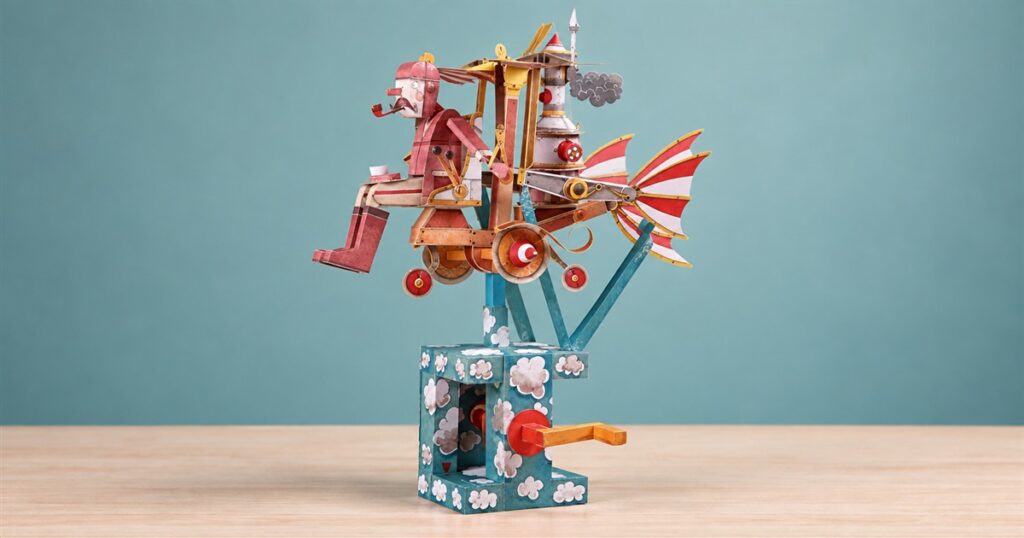
Most paper ends its working life as a receipt you cannot find when you need it. This paper gets to become a tiny flying machine with a seated pilot, a cloud-covered pedestal, and the sort of exposed mechanical nonsense that makes you lean closer. The Flying Dreamer paper automata kit is a hand-cranked model you build yourself, then operate whenever your desk needs a little less spreadsheet and a little more improbable aviation.
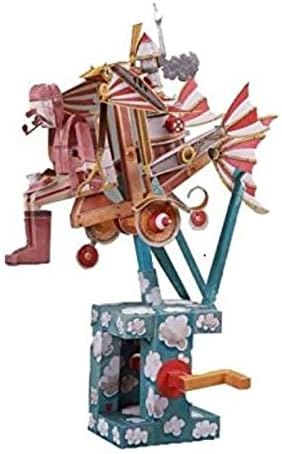
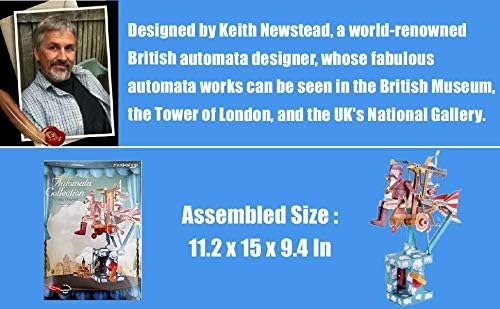
Designed by Keith Newstead and sold under the ModelShop name, Flying Dreamer turns a paper construction project into a moving display. You assemble the pieces, add glue where required, and supply the motion through a crank. The finished scene stays attached to its base. This is tabletop flight in the theatrical sense, so your ceiling fan can stand down.
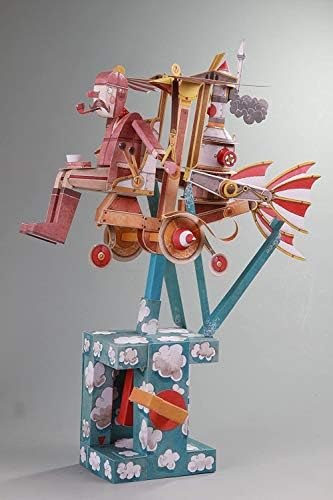
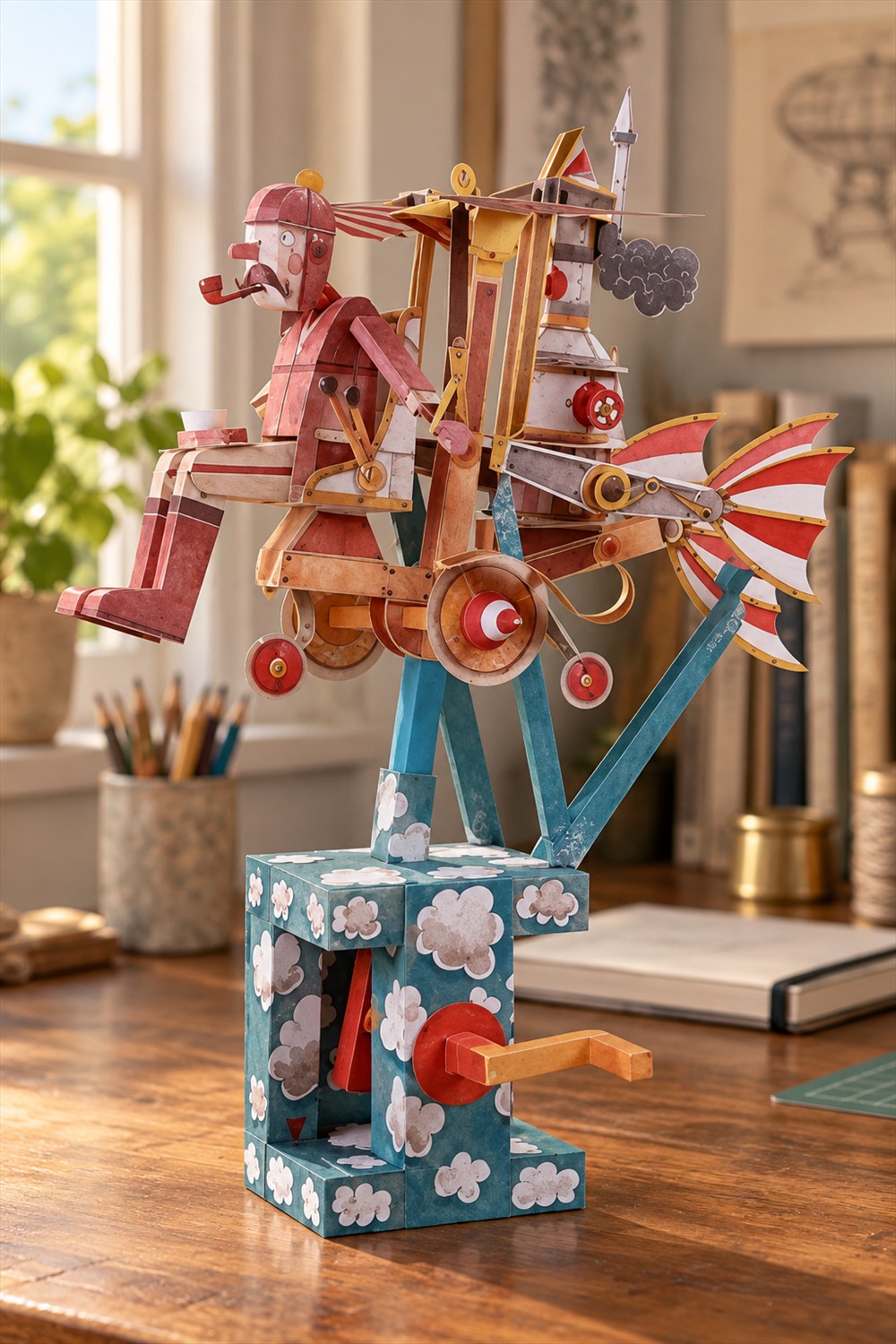
The appeal is easy to spot: a pink pilot sits out front with his legs dangling, while an elaborate contraption piles up behind him. Red-and-cream striped details, little red wheels, and tall teal supports make the whole thing look like an invention drawn by someone who had several excellent ideas and refused to choose between them.
A tiny flying machine with its workings on display
There is a lot happening above that base. The pilot has a long, angular profile and a wonderfully unbothered posture. Behind him, tan structural pieces frame a cluster of colored circles and striped surfaces. The rear fans out into a dramatic tail shape. It feels part early flying experiment, part traveling carnival, part daydream during a meeting that should have been an email.
Look lower and the fantasy gives way to a very practical arrangement. Teal supports connect the upper scene to a box-shaped pedestal decorated with clouds. A bright handle projects from a red circular piece on the side. That handle is your invitation to stop admiring the object and start making something happen.

The cloud pattern is especially good. Instead of trying to hide the stand, the design makes it part of the joke: the flying machine gets its own little patch of sky, conveniently placed at desk height. There is no need for a sprawling landscape or an enormous display cabinet. The visual story is contained in the object itself.
From one angle, you notice the pilot. From another, it is the layered construction and connections. That gives the finished model more to offer than a flat picture of a whimsical machine. You can look around it, inspect the structure, and follow how the different pieces share a relatively small amount of space.
The building is part of the entertainment
Flying Dreamer arrives as a paper kit, rather than a completed ornament. That distinction matters if you are choosing a gift. You are giving someone a project as well as the resulting display, and the person who likes assembling little things may enjoy that process as much as the finished crank-operated performance.
Set aside a clear work surface and treat the build as an activity, rather than something to rush through between unloading groceries and answering the door. Paper parts reward careful handling. A calm assembly session also makes it easier to keep track of what belongs where, which is useful when your future aircraft currently resembles an extremely ambitious pile of stationery.
- For craft fans: the finished object gives the assembly process a visible, moving payoff.
- For curious builders: exposed connections provide something to study after construction is over.
- For a shared activity: one person can work through a step while another checks the picture and keeps loose pieces organized.
- For a display shelf: the colorful pilot, striped tail, and cloud base create a complete little scene.
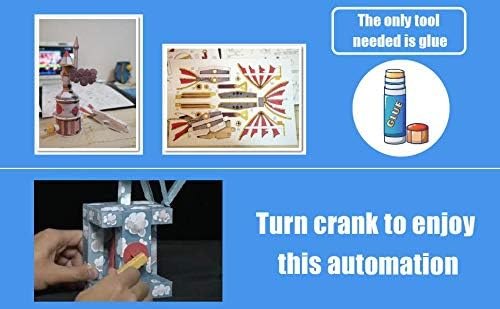
The listing identifies glue as the assembly aid you need. Have it ready before beginning, and follow the supplied instructions for placement. With a moving paper model, enthusiasm is useful; a generous blob of adhesive in the wrong place is less of an engineering breakthrough.
It is also worth choosing the recipient by temperament. Someone who likes patient, small-scale construction is a more natural match than someone who wants an instantly usable toy. The reward here comes from turning flat components into a structure that does something, and from knowing you helped that transformation along.
What you are building
| Part of the model | What to expect |
|---|---|
| Main scene | A seated paper pilot on a fantastical flying machine |
| Display structure | Teal supports above a cloud-patterned base |
| Controls | A side-mounted crank that you turn by hand |
| Construction | Paper pieces assembled into a three-dimensional model |
| Visual details | Striped tail elements, tan framing, and small red wheels |
The product imagery lists an assembled size of 11.2 by 15 by 9.4 inches. That is enough presence to plan a proper spot for it, rather than assume it will disappear beside a pencil cup. Give the projecting parts some breathing room, particularly if the destination is a shelf where other objects are constantly being shuffled around.
A stable surface makes more sense than a busy kitchen counter. You will want access to the crank, a clear view of the pilot, and space around the delicate paper details. Think miniature mechanical display, with all the fond fussing that description suggests.
A good excuse to look at how things move
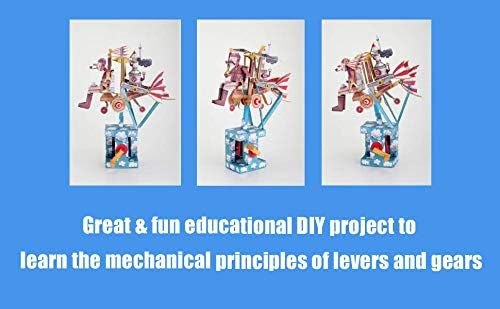
The kit is presented as a way to explore mechanical ideas such as levers and gears. The useful part is the direct relationship between your hand and the model: you supply an input, and the structure responds. It gives a curious builder a concrete reason to ask what is connected to what.
You can enjoy it without turning the coffee table into a classroom. A slow turn of the handle and a closer look at the connections are already an activity. The little pilot provides the entertainment; the visible mechanism supplies the follow-up question. That is a pleasing division of labor for an object made from paper.
The listed recommendation is for ages seven and up, with a small-parts warning that rules out children under three. Choose the level of adult help to suit the builder. An age label does not make every fiddly construction step equally comfortable for every child, and sharing the process can be part of the gift.
Adults are certainly not excluded from the fun. There is a particular satisfaction in a small project that ends with a physical object instead of another saved file. Once assembled, this one also offers an excellent answer to the question, “What exactly is that on your shelf?” You can simply turn the handle.
The details before takeoff
- Product: ModelShop Flying Dreamer paper automata kit.
- Designer: Keith Newstead.
- Operation: hand-cranked moving display, with assembly required.
- Assembly supply: glue is needed.
- Listed assembled size: 11.2 by 15 by 9.4 inches.
- Age guidance: seven and up; small parts, not for children under three.
- Best match: patient craft builders and people who like unusual mechanical shelf objects.
Flying Dreamer is listed on Amazon for $19.99 at the time of writing, sold by MT Style / Tainada Authorized and shipped by Amazon. It was shown in stock. Check the current listing before ordering, and remember that the purchase is the kit: your contribution is the building, the glue, and the tiny aviation department you will inevitably establish on the dining table.
Images: ModelShop product listing on Amazon.
| Pros | Cons |
|---|---|
| Combines a craft project with a moving display | Needs assembly before it can be enjoyed |
| Colorful, distinctive flying-machine design | Projecting paper details need careful handling |
| Direct hand-crank interaction | The display relies on someone turning the handle |
| Visible construction invites a closer look | Small parts make it unsuitable for very young children |
| Creates a complete scene on its own base | Needs shelf space and access to the crank |
Save this find.
Thank yourself later.
Your next great gift idea. Your someday space. Your collection of wonderfully weird things.
Save to PinterestPick a board. Keep the inspiration.
This Paper Flying Machine Kit Becomes a Hand-Cranked Moving Display
Where to find This Paper Flying Machine Kit Becomes a Hand-Cranked Moving Display
OddityMall may earn a commission from qualifying purchases at no extra cost to you.