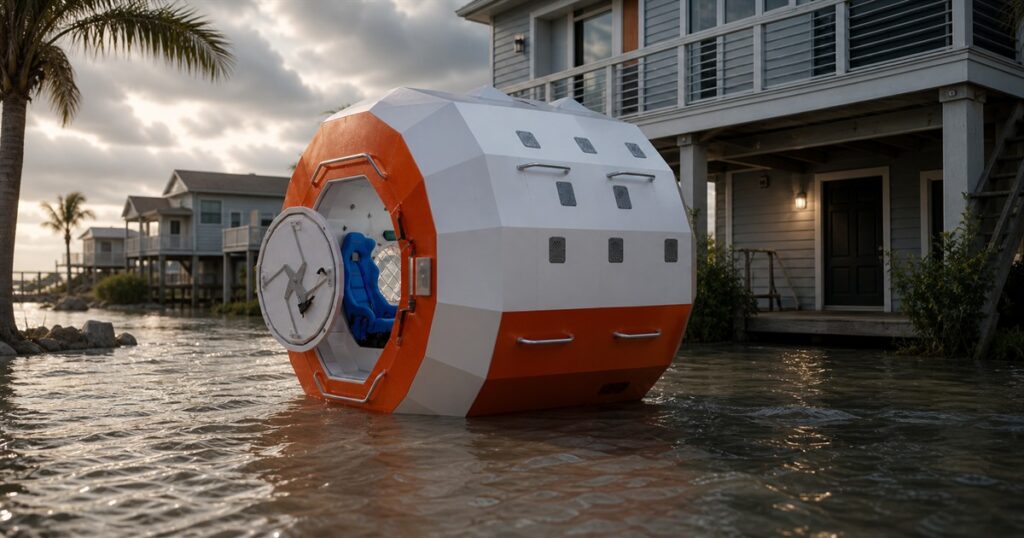
At some point, every emergency plan turns into a drawer full of batteries, a suspicious granola bar, and one flashlight that only works when it feels respected. The LifePods W01 takes that same household anxiety and escalates it into something much more dramatic: a floating survival capsule that looks like a lifeboat, a tiny bunker, and a very serious orange-and-white marshmallow all met during a flood drill.
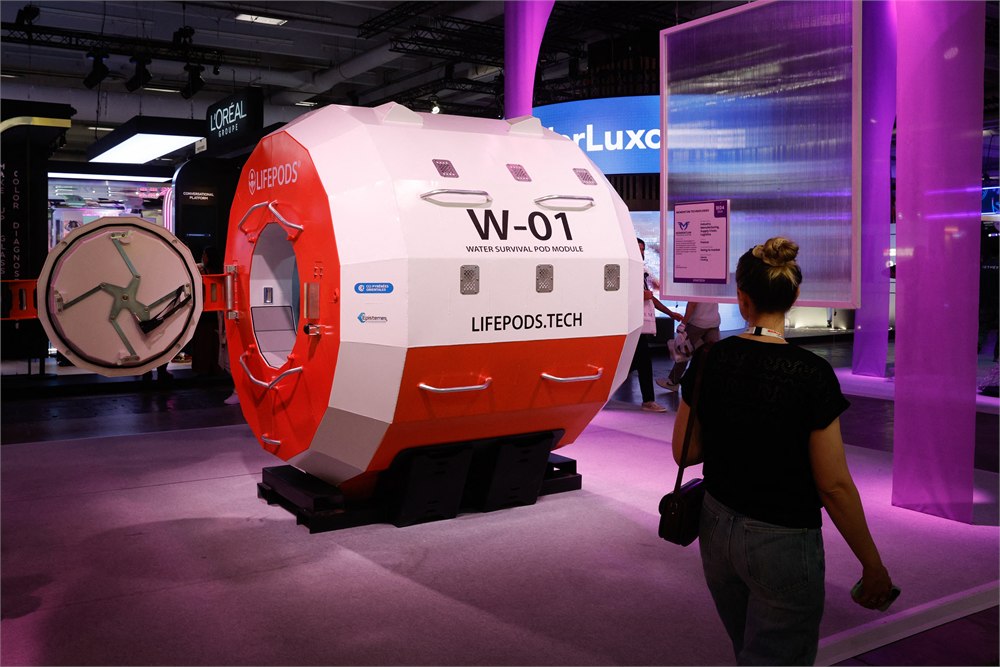
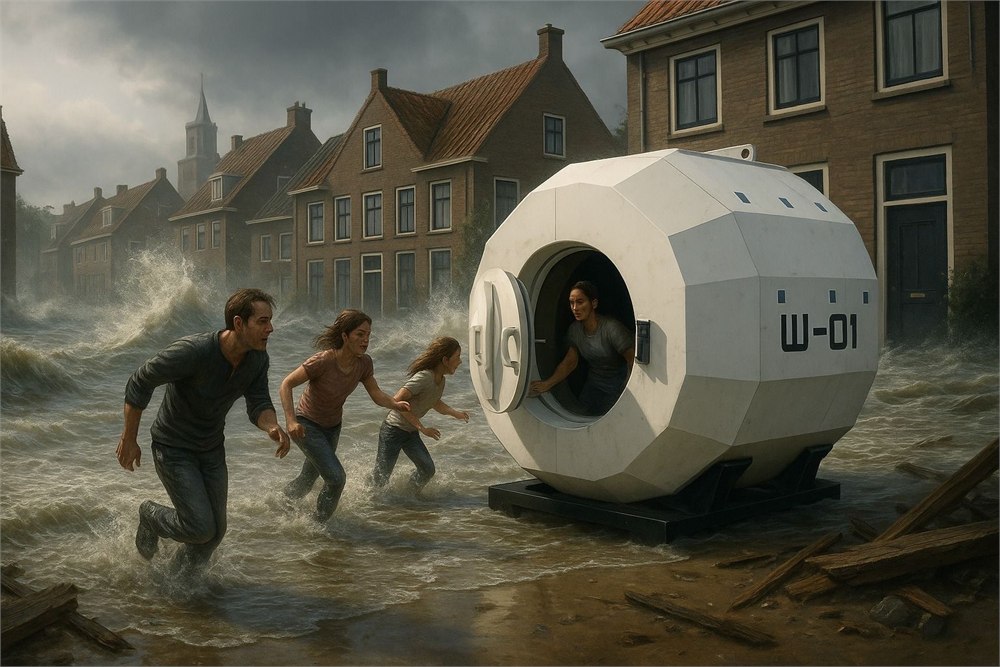
The W01 is the flood-and-tsunami model in the LifePods lineup from Momentum Technologies, a French company building protective capsules for disaster response, civil security, defense, and critical infrastructure. Unlike an underground bunker, this one is made for the kind of water-related emergency where the ground has stopped being a helpful place. The company positions it as a last-resort shelter for tsunamis, flash floods, marine submersion, and dike or dam failures.
That is a heavy-duty job description for something that, from the outside, resembles a futuristic escape barrel with manners. The W01 has a faceted capsule body, orange end sections, a circular hatch, exterior grab handles, and a compact interior fitted with bright blue anti-shock bucket seats. It is designed to float, resist debris impacts, and keep occupants together until rescue teams arrive. In other words, it is not a weekend floatie. It is the thing your pool noodle sees in a mirror and decides to get serious about life.
A Floating Pod For When Evacuation Misses Its Calendar Invite
Momentum Technologies says the W01 was developed for situations where evacuation is no longer possible. That phrase has the casual horror of a calendar notification arriving two hours after the meeting, except the meeting is floodwater. The idea is that the capsule can be placed near homes, coastal sites, harbor installations, infrastructure, or other vulnerable areas, then used as temporary protection when people cannot safely move away from the hazard.
The official W01 page describes a marine-grade 5083 aluminum structure with a buoyancy system, integrated ballast, and interior equipment. The English specifications section also lists a double-hull structure in high-density polymer and Kevlar, positive buoyancy, and a low center of gravity for automatic self-righting. That mix makes the public materials a little broad on construction language, so the practical takeaway is simple: this is a purpose-built floating refuge with a sealed hull concept, not a backyard shed that has been told to believe in itself.

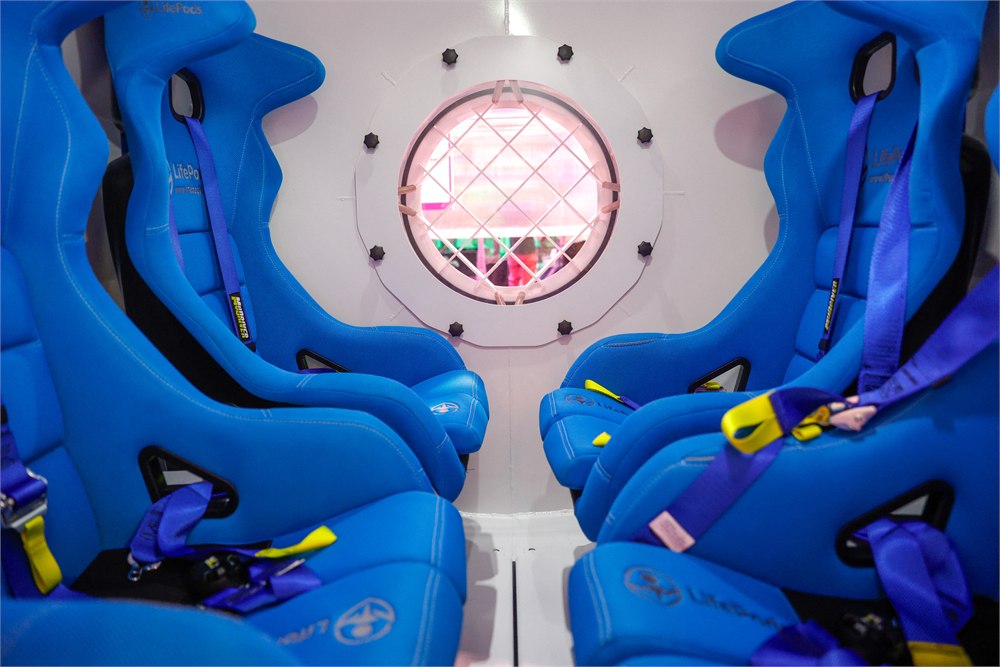
Inside, the W01 is listed for 2 to 4 people, with anti-shock bucket seats and 4-point harnesses. New Atlas reported that the show model was described as fitting up to four adults plus four children, with kids on adults’ laps, but the official current spec page gives the cleaner confinement capacity as 2 to 4 people. For a product like this, where configuration and certification matter, the official spec is the number to take seriously before anyone starts inviting the entire family reunion into a capsule.
The W01 also includes an integrated EPIRB GPS distress beacon, which is the kind of feature you very much want when your expensive safety pod has successfully performed Step One, floating away from danger, and now needs Step Two, helping someone find you before the family starts voting on who gets the last snack.
What The W01 Is Built To Handle
The strangest thing about the LifePods W01 is that it is both extremely niche and weirdly easy to understand. Most people do not need a floating disaster capsule parked near the garage. But people living near flood zones, low-lying coastal areas, dam corridors, industrial facilities, ports, island properties, or isolated sites can probably imagine the use case a little too vividly.
- It is designed as a last-resort shelter for water-related disasters, not as a boat you casually take fishing.
- The capsule is meant to remain buoyant and self-righting using passive design rather than active propulsion.
- Interior bucket seats and harnesses are intended to keep occupants secured during violent water movement or debris impacts.
- The integrated EPIRB GPS distress beacon is there to help rescuers locate the capsule after the immediate event.
- Momentum says it can deliver worldwide and perform site-specific wave and flood studies for placement.
That placement-study detail is important because this is not the kind of object where “near the fence, beside the decorative flamingo” counts as installation planning. The company is talking about strategic placement based on local flood and wave risk. It is less impulse buy, more emergency-management conversation that probably involves maps, serious faces, and at least one person saying “hydrodynamic” without irony.
| W01 Detail | Listed Information |
|---|---|
| Primary purpose | Temporary protection during tsunamis, flash floods, marine submersion, and dike or dam failures |
| Occupant capacity | 2 to 4 people on the official specification page |
| Hull concept | Floating, sealed capsule with positive buoyancy and low-ballast self-righting design |
| Interior | Anti-shock bucket seats with 4-point harnesses |
| Rescue aid | Integrated EPIRB GPS distress beacon |
| Oxygen autonomy | Up to 6 hours with integrated tanks, depending on configuration |
The self-righting part is the detail that separates the W01 from a panic room with a swimming problem. Momentum says the W01 uses passive hydrodynamic stability, positive buoyancy, and a low center of gravity to automatically right itself. That matters because floodwater does not politely keep your emergency shelter at a flattering angle. If the pod is doing its job, it needs to be able to get shoved, spun, and generally bullied by water without turning into the world’s worst carnival ride.
New Atlas also noted that Momentum showed the LifePods family at VivaTech and Eurosatory 2026, with the W01 aimed at flood protection and the B01 aimed at land-based ballistic and industrial protection. That broader family context helps explain why the W01 looks like serious safety equipment rather than a consumer camping pod. The target audience appears to include institutions, municipalities, infrastructure operators, and buyers with very specific risks, though Momentum’s site also frames the W01 around families and small groups.
It Is Not A Magic Bubble, And That Is Worth Saying
The W01 is fascinating partly because it lives in the awkward space between practical disaster preparation and movie-prop psychology. A floating capsule sounds comforting until you remember that real emergencies involve ventilation, rescue time, placement, supplies, training, maintenance, and the bleak human truth that nobody reads the manual until water is already touching the doormat.
Momentum lists oxygen autonomy of up to 6 hours with integrated tanks, depending on final configuration and survival options. That is a clear reminder that this is temporary protection, not a floating apartment. The W01 is designed to help people survive the acute danger window and be located by rescuers, not to host a three-day board game retreat while the neighborhood becomes a canal system.
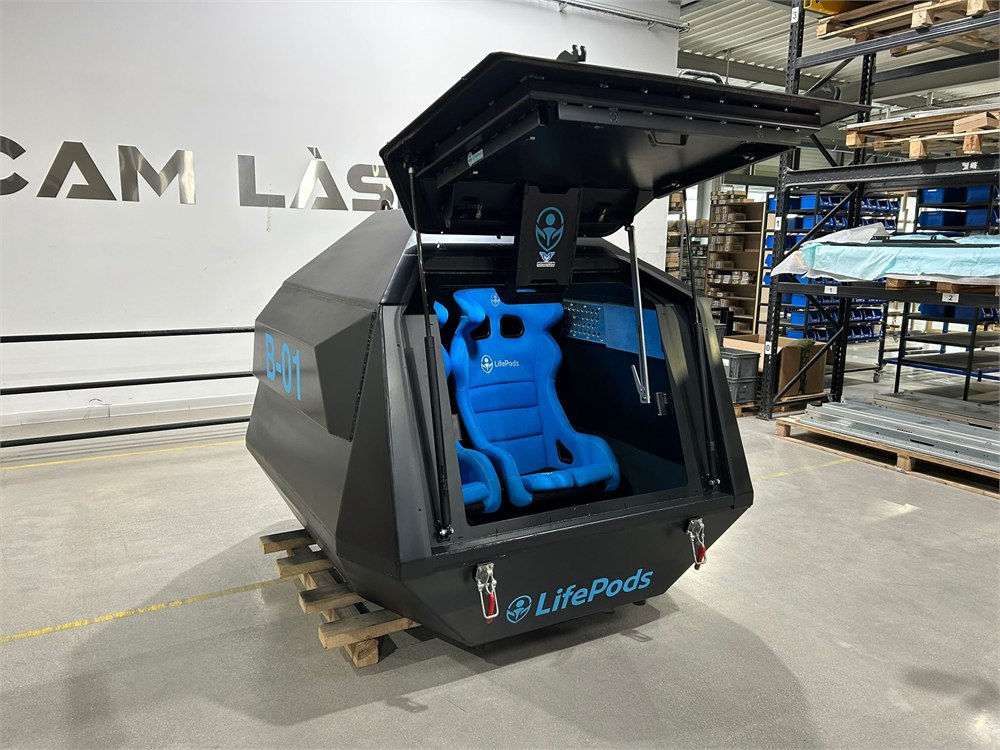
It is also worth separating the W01 from the more armored LifePods B01. The B01 is the land-based model discussed for ballistic, blast, and fire protection, while the W01 is the water-survival capsule. The shared design language makes them look like cousins from the same high-stress family, but their jobs are different. If the B01 is for “outside is currently doing security-threat things,” the W01 is for “outside has become soup.”
The official W01 applications include tsunamis and submersion waves, severe floods, marine submersion, and dam failures. That is a grim little menu, but at least it is specific. Specificity is what keeps unusual safety products from becoming expensive talismans. A product like this only makes sense if the risk profile, placement, occupant plan, communication plan, and rescue expectations all line up. Otherwise you just bought a very intense conversation piece.
Who This Floating Survival Capsule Is Actually For
For everyday homeowners in mild-weather areas, the W01 is probably overkill in the same way a submarine is overkill for a birdbath. But for properties near coastal surge zones, flood-prone rivers, industrial sites, remote facilities, resorts, emergency agencies, or communities downstream from dams, the idea becomes easier to understand. It is an engineered refuge that can be staged before trouble, then used when movement outside is more dangerous than staying put inside a floating shell.
The bigger question is whether buyers are treating it as a certified safety system or a fascinating object with big claims still moving through validation. New Atlas reported that early flotation tests were described as encouraging, while also noting the lack of independent data in the public materials it reviewed. Momentum’s own language points toward industrialization, certification, and commercial deployment. That means serious buyers should ask about certification status, local regulations, maintenance, anchoring, occupant training, survival options, and rescue coordination before treating this as the final boss of emergency preparedness.
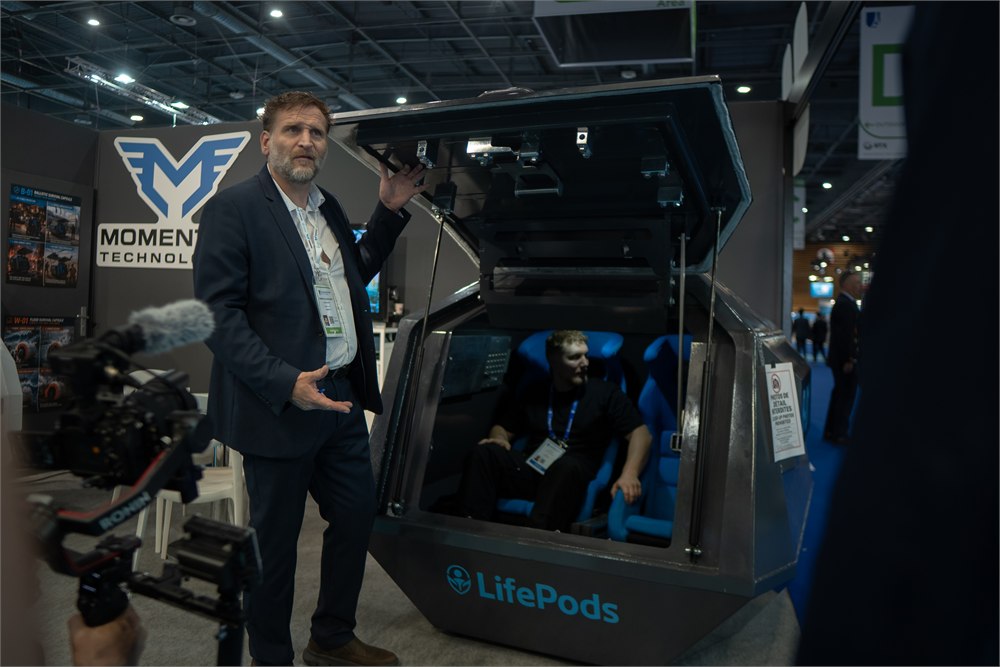
Still, as an object, it is hard not to stare at. The W01 has that rare product quality where you instantly understand the pitch even if you are not sure whether your insurance agent would know what box to check. It is a floating, self-righting, beacon-equipped capsule for people who may need to wait out violent water events without depending on a truck, a boat, or the heroic punctuality of public infrastructure.
Key product details and features include:
- Product type: floating disaster-survival capsule for flood, tsunami, marine submersion, and dam-failure risk zones
- Maker: Momentum Technologies, under the LifePods protective capsule brand
- Model: W01, the water-focused capsule in the LifePods lineup
- Capacity: 2 to 4 people on the official current specification page
- Safety equipment: anti-shock bucket seats, 4-point harnesses, and integrated EPIRB GPS distress beacon
- Design notes: positive buoyancy, low center of gravity, and automatic self-righting concept
- Availability: worldwide delivery and site placement studies are listed by the company
The LifePods W01 is listed by Momentum Technologies with an indicative public price of 35,000 to 40,000 EUR excluding VAT, ex works, with the final figure depending on configuration and survival options. Delivery, installation, and site-specific placement work are not included in that base pricing language, so this is very much a quote-and-plan product rather than a casual cart-add. It is available through LifePods / Momentum Technologies, with quote and demo requests handled from the official W01 page.
| Pros | Cons |
|---|---|
| Purpose-built for severe flood and tsunami refuge scenarios | Extremely specialized for buyers with specific water-risk exposure |
| Self-righting buoyancy concept is well matched to violent water movement | Public materials still point to certification and deployment work in progress |
| Interior seats, harnesses, and beacon are practical rescue-focused details | Capacity is limited, so household planning matters before purchase |
| Can be positioned where evacuation routes may fail | Placement, delivery, maintenance, and training are likely significant projects |
| Visually clear, compact alternative to fixed flood shelters | The price puts it closer to institutional safety hardware than ordinary consumer gear |
Where to find This Floating Survival Capsule Keeps People Sheltered During Floods
OddityMall may earn a commission from qualifying purchases at no extra cost to you.