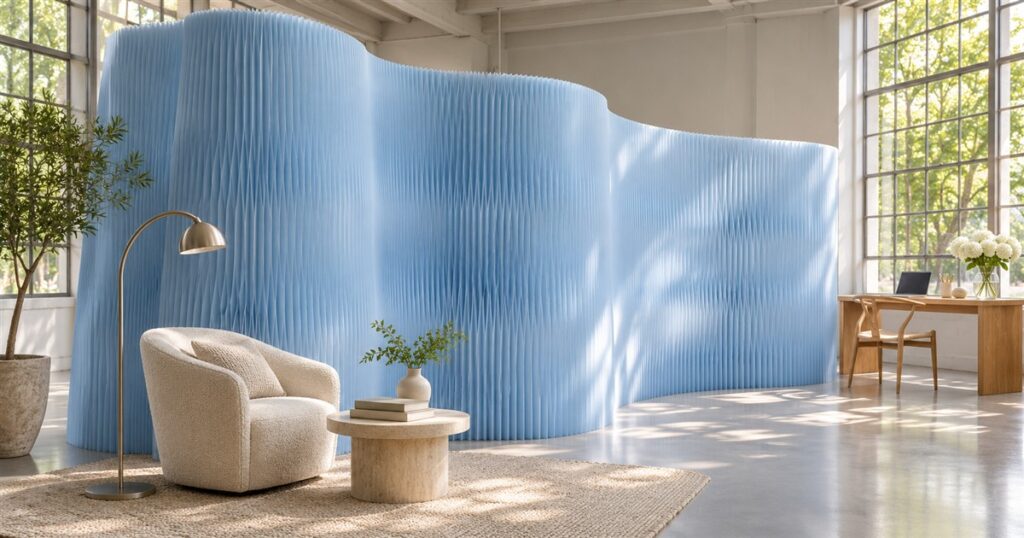
Open-plan living is lovely until your office, dining room, and pile of things you meant to put away become the same room. The molo sloped softwall offers an unusually elegant response: unfold a paper wall and give your surroundings some boundaries. Finally, a household member willing to respect those.
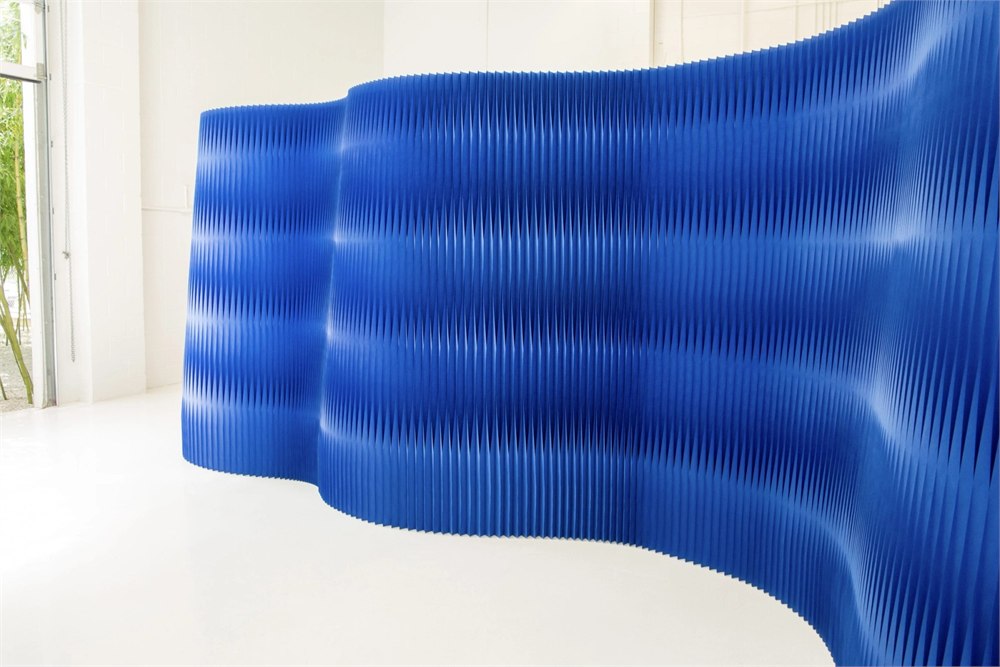
This is a freestanding room partition made from layers of paper arranged in a flexible honeycomb structure. It expands to as much as 15 feet long, bends into sculptural arrangements, and compresses back to roughly the thickness of a book. That is a considerably more cooperative wall than the ones currently holding up your ceiling.
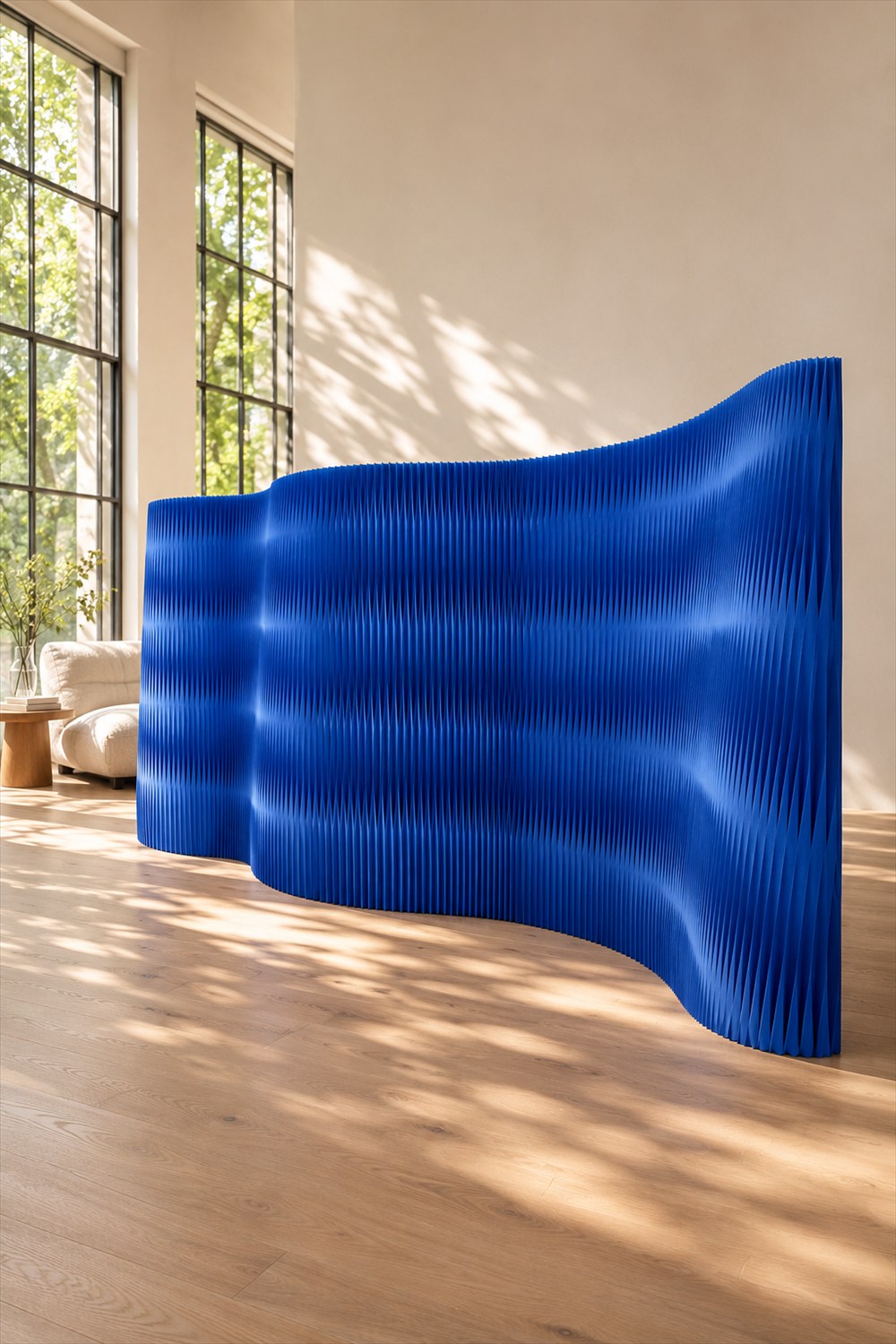
The sloped version adds an angled face to molo’s established softwall idea. One side presents vertical pleats; the other reveals the cellular structure inside. Light catches those openings differently as you move around it, making an everyday room divider look like somebody folded a small architectural landscape into existence.
A paper room divider with actual presence
Designed by Stephanie Forsythe and Todd MacAllen, sloped softwall treats a partition as something you can rearrange. Instead of deciding where a permanent wall should go and living with the consequences, you can reshape the boundary as the room’s needs change. A reading corner today might become a backdrop for a gathering tomorrow.
The important word is partition. This is a way to define zones and create visual privacy within an existing room. It does not turn an open floor plan into a collection of enclosed bedrooms, and it certainly does not make a paper structure a substitute for a load-bearing wall. Your upstairs bathroom still requires its current support arrangement.



What makes the design compelling is how much visual substance it gets from thin layers. From one angle, the surface looks like closely spaced vertical ribs. From another, the sloped cut opens up a field of little cells. Shadows become part of the pattern, so the same blue can look pale, saturated, or surprisingly deep across a single curve.
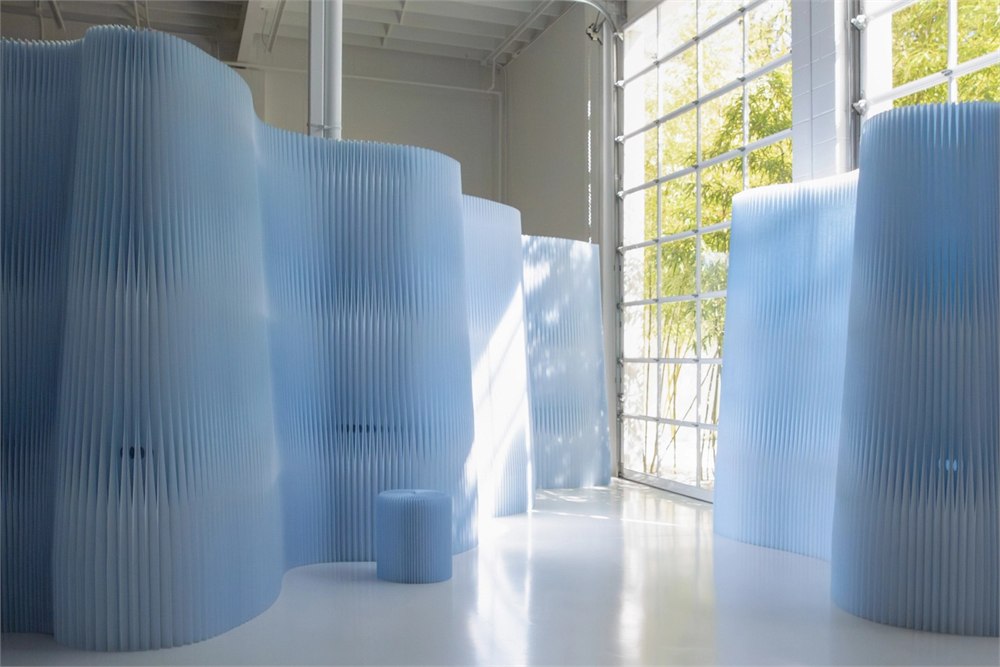
Stretch it out, curve it around
Molo lists an expanded length of up to 15 feet, or 4.5 meters, with shorter lengths possible between the compressed and extended positions. That gives the partition scope to span a room or form a more compact enclosure. The usable arrangement still depends on the space you have and the shape you choose.
The flexible honeycomb geometry is doing the work here. Rather than moving a rigid panel through a doorway and hoping your knuckles survive, you are dealing with a structure designed to compress and bend. Molo describes it as easily movable, although the product page does not supply a weight for every possible configuration.
Its end panels are magnetic, allowing pieces from the softwall and softblock system to connect into longer partitions. That modular approach is useful if one sweeping curve is not quite enough sweeping curve. It also means a larger installation is a composition of pieces, not necessarily one miraculous wall pulled endlessly out of a tiny package.
For someone planning a home workspace, the practical questions are fairly straightforward:
- Where should the divider interrupt a sightline without blocking the route through the room?
- How much floor area will the chosen curve occupy?
- Will one partition provide the desired boundary, or does the plan need connected pieces?
- Where will the compressed partition live when the room needs to open up again?
- Which side of the sloped structure should face the main seating or working area?
That last detail is part of the fun. The two faces do not look identical, so orientation becomes a design choice. You can emphasize the orderly pleats or the more exposed cellular texture. It is decorating with a little more geometry and a little less moving a vase three inches to the left.
The useful details, without the architectural poetry
A dramatic installation photograph can make any furnishing seem mysterious. The basic idea here is refreshingly understandable: a flexible paper structure makes a temporary boundary, and its angled surface gives that boundary a distinctive appearance. These are the main details molo identifies for sloped softwall.
| Detail | What it means |
|---|---|
| Structure | Layers of paper formed into flexible honeycomb geometry |
| Expanded length | Up to 15 feet / 4.5 meters |
| Storage | Compresses to roughly book thickness |
| Connections | Magnetic end panels connect compatible system pieces |
| Surface | Vertical pleats on one side; angled cellular exposure on the other |
| Purpose | Visual division, sound absorption, and sculptural backdrops |
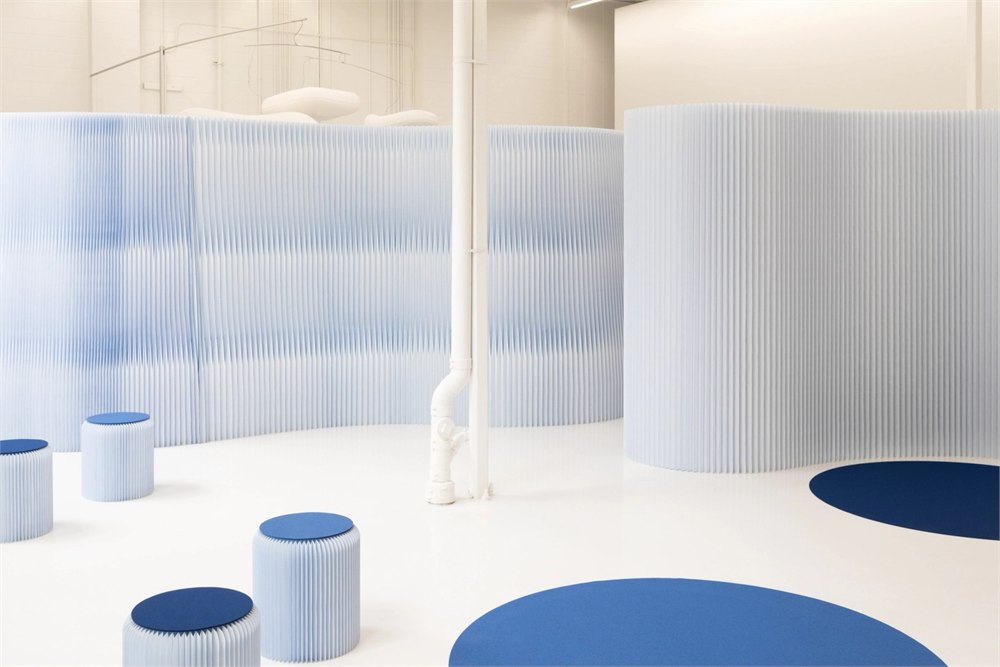
Notice that the length figure is not a promise about the exact footprint of every arrangement. A curved partition uses space differently from a straight run. Before planning an entire layout around it, ask molo about the dimensions and configuration that suit your room. A beautifully drawn floor plan remains considerably cheaper to revise than a room full of furniture.
Blue paper, changing light
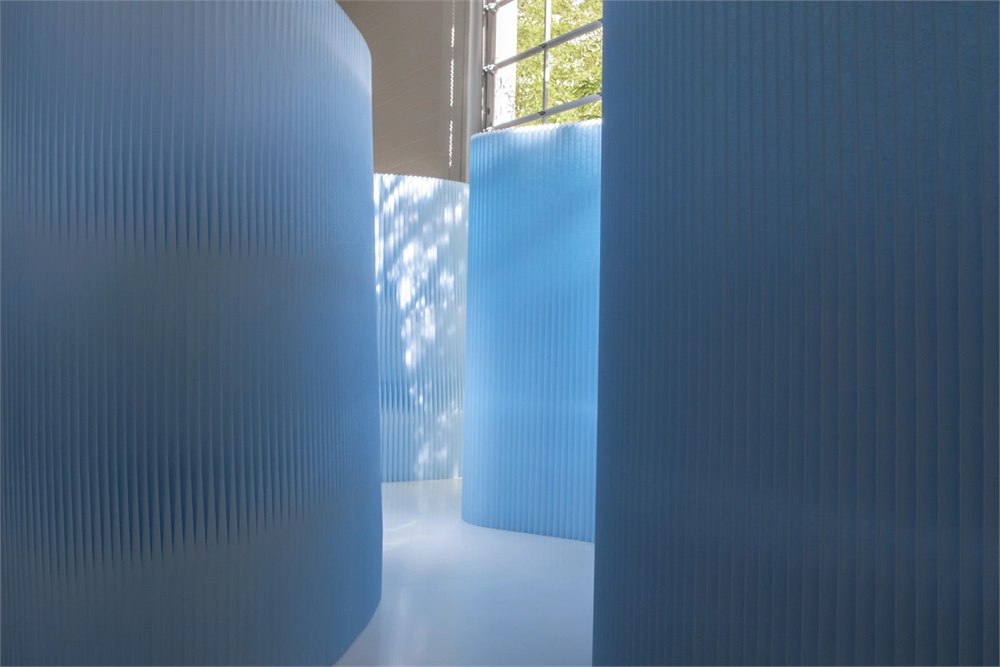
The glacier blue and deep blue papers were developed with Gmund, the German paper manufacturer. Glacier blue brings a softer, airy appearance, while deep blue produces stronger shadows and a more saturated presence. Neither needs a busy pattern printed across it; the folds supply plenty of visual activity on their own.
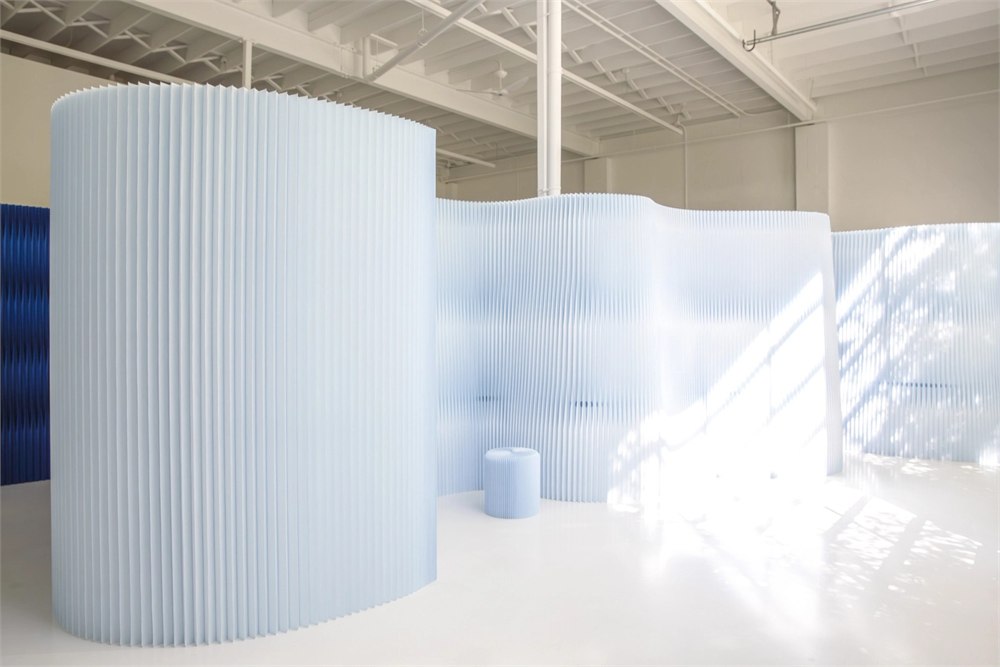
In a bright room, that structure gives daylight something interesting to do. The folds catch highlights while the cells fall into shadow. As lighting and viewing angles change, the color reads differently. There is no need to invent a hidden lighting system to explain the effect. It is paper, geometry, and the light already in the room getting along unusually well.
Molo introduced the new sloped configuration and blue papers at ORGATEC 2026. It belongs to a wider collection of flexible partitions, furniture, and lighting, but those neighboring objects are separate products. The stools and other furnishings pictured in installations should be treated as styling context, not assumed contents of a room-divider order.
A boundary for your eyes, not a recording booth
Molo describes softwall as absorbing sound as well as delineating visual privacy. That can be a useful part of its appeal in open spaces, but sound absorption and soundproofing are different things. The product page does not promise that placing this beside your desk will prevent everyone else from hearing your meetings.
Think of it as a way to shape the experience of a shared room. A visible boundary can make a work area feel more intentional, conceal part of a seating area, or give an event a defined backdrop. It cannot guarantee silence from a coffee grinder, an enthusiastic roommate, or the person who believes every video call requires theatrical projection.
The material also deserves practical consideration. This is a paper furnishing, so ask about care, handling, and suitability for your particular setting before ordering. Molo provides use guides and documentation for its materials; the relevant specifications should match the configuration you are considering. A striking photograph is excellent inspiration, but it is not a complete installation plan.
What to know before ordering
The strongest reason to consider sloped softwall is the combination of flexibility and visual character. Plenty of partitions can hide a corner. Far fewer can turn that boundary into a rippling paper sculpture and then compress when the room needs to be open again. For people whose spaces serve several purposes, that adaptability is the interesting part.
- Freestanding paper partition designed by Stephanie Forsythe and Todd MacAllen for molo.
- Flexible honeycomb construction expands up to 15 feet and compresses for storage.
- Sloped cellular face gives the divider its distinctive light-and-shadow effect.
- Magnetic ends allow compatible pieces to form longer arrangements.
- Glacier blue and deep blue papers are made in collaboration with Gmund.
- Intended for visual division and sound absorption, without a soundproof-room promise.
Pricing is available on request from molo, which directs buyers to contact its team to discuss a purchase. Confirm your preferred material, dimensions, quantity, delivery details, and current lead time when requesting a quote. There is no verified single retail price to attach to every possible arrangement.
Manufacturer photographs courtesy of molo. The new configuration was also covered by Archiproducts during ORGATEC 2026. Your floor plan may still be open, but at least it can now have a few tactfully folded opinions.
| Pros | Cons / considerations |
|---|---|
| Flexible shape adapts to changing layouts | Curves require their own floor space |
| Compresses to roughly book thickness | Storage still needs a suitable location |
| Distinctive sloped honeycomb texture | Paper care and handling deserve attention |
| Magnetic connections support larger arrangements | Additional pieces require a separate purchasing plan |
| Provides visual division and sound absorption | Does not promise soundproof isolation |
| Two expressive blue paper options | Price and configuration require an inquiry |
Save this find.
Thank yourself later.
Your next great gift idea. Your someday space. Your collection of wonderfully weird things.
Save to PinterestPick a board. Keep the inspiration.
This Expandable Paper Room Divider Stretches to 15 Feet and Folds Like a Book
At a glance
Product snapshot
- Listed price
- Price on requestPrices and availability can change. Check the seller for current details.
- Where to find it
- molo
- Category
- Furniture Design