There is a special kind of confidence that arrives just before you put the wrong tiny screwdriver into the wrong tiny screw. It lasts about two seconds. Then the screw becomes a shiny little bowl, your repair becomes a project, and everyone in the house learns that you know several creative words.
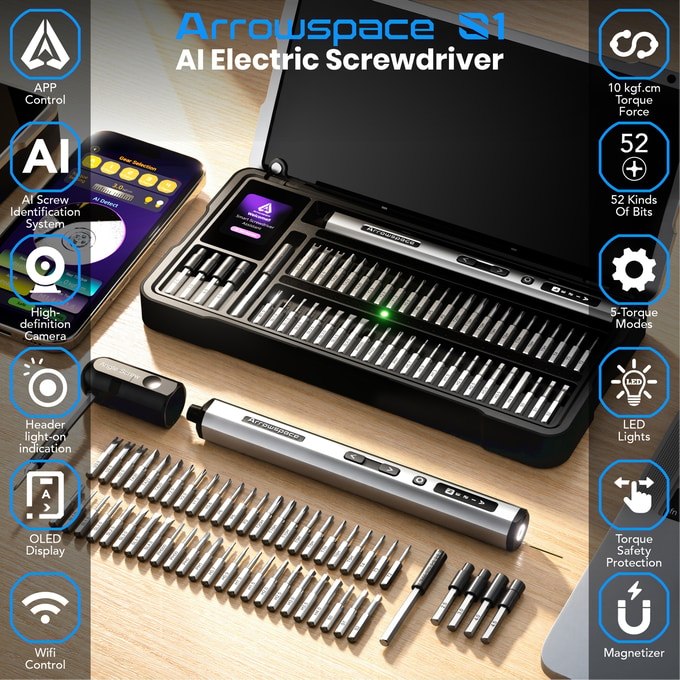
The Arrowspace S1 is a camera-equipped precision electric screwdriver designed to interrupt that ceremony. It looks at a screw head, identifies its type and size, and sends the result to a smart storage case that lights up the matching bit. Finally, a toolbox with something more helpful to contribute than a mysterious leftover washer.
Created by the Arrowmax team and offered through crowdfunding, the S1 combines visual recognition, powered driving, a companion app, and a 52-bit kit. Its most interesting trick happens before anything turns: helping you figure out which of those nearly identical metal sticks belongs in your hand.
A screwdriver that looks before it twists
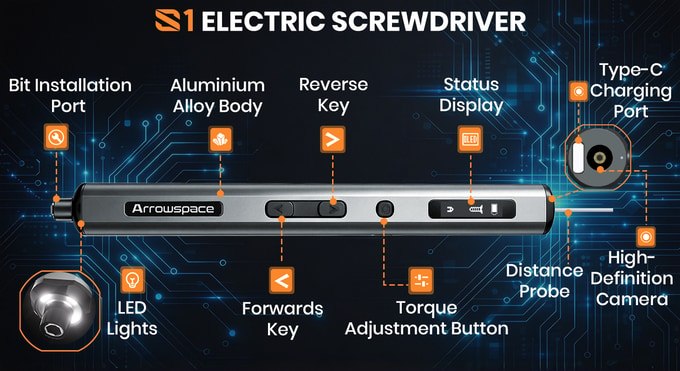
The camera sits at the rear of the driver. A contact probe rests against the screw surface to hold the camera at a consistent working distance. That physical spacing matters when the subject is a tiny fastener rather than a family portrait. You hold it squarely over the head, let the recognition system examine it, and then check the suggested match.
Arrowspace describes the system as recognizing both drive type and size. That is the distinction that makes this more useful than simply announcing, with tremendous technological confidence, that you are indeed looking at a screw. Knowing the general shape is one thing. Choosing between neighboring sizes is where the squinting begins.
Related posts:
 This Tractor Engine Repair Set Lets Your Kid Work On Their Own Tractor
 This Bubble Window For Your Fence Allows Your Dogs To Peek To The Other Side
 PetNow Smart Pet Camera Gives a Live View Of Your Dog On Smartphone
 This Makita Autofeed Screwdriver Will Save Your Time and Your Back During Long Projects
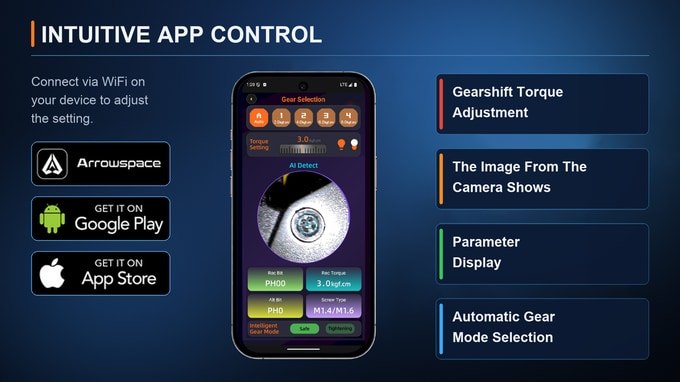
The companion mobile app displays the captured image alongside the recognized profile, size, and recommended bit. You can see what the camera saw instead of accepting a mysterious verdict from the handle. It is still sensible to confirm the actual fit before applying force. Recognition assistance is not a permission slip to attack damaged hardware.
The case joins the conversation
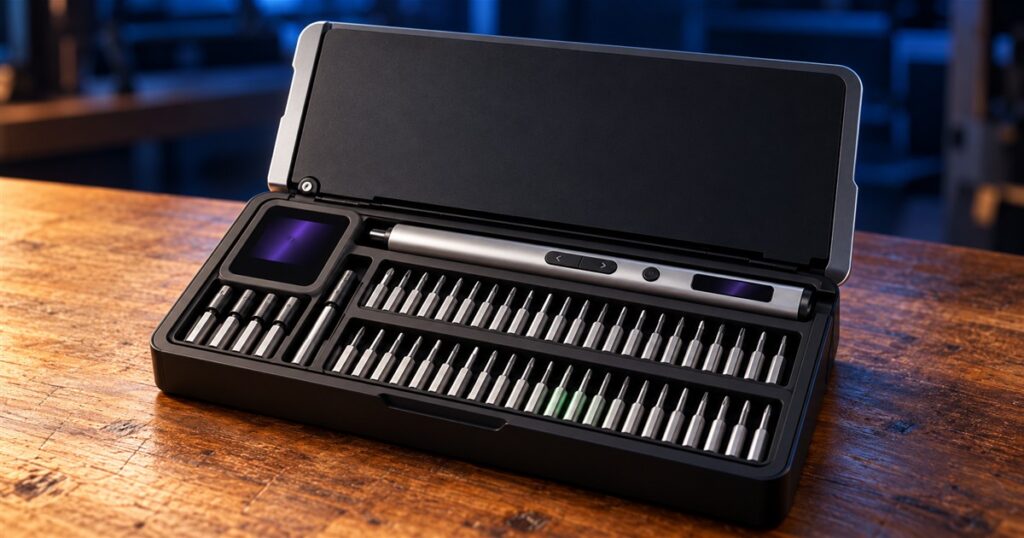
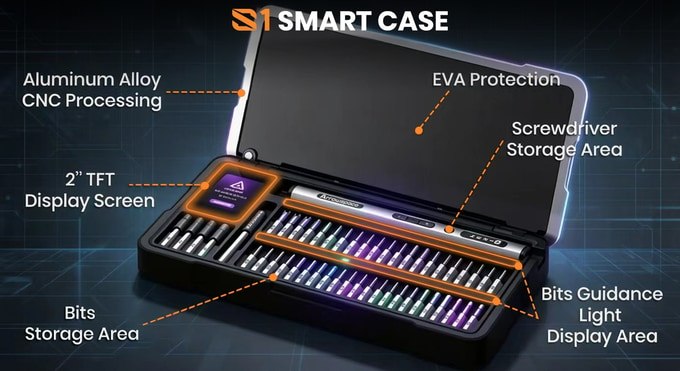
Once a screw is identified, the matching case shows the result on its TFT color display and illuminates the corresponding bit slot. This is the part that feels especially satisfying. A precision kit can contain dozens of useful bits and still make finding one feel like searching for a particular grain of rice.
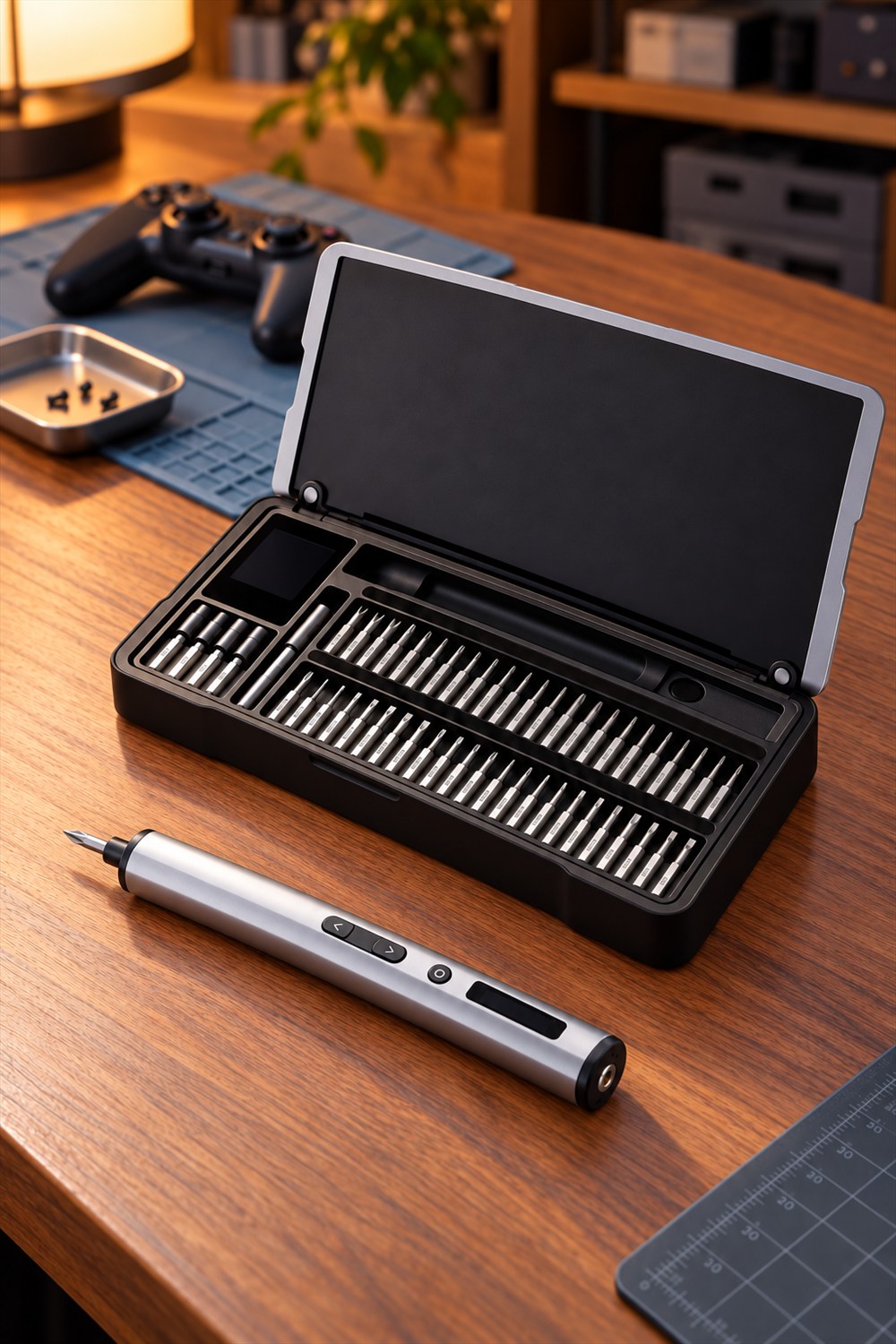
The layout keeps the driver, bits, and guidance display together. Arrowspace describes a CNC-machined aluminum-alloy case frame with protective material inside. The campaign images show two long bit rows, a driver storage area, and the small display grouped at one end. Everything gets an assigned seat, which is more organization than most repair benches achieve before lunch.
You still remove the bit, fit it to the driver, and perform the repair yourself. The appeal is a shorter route from an unfamiliar fastener to a plausible tool choice. It does not unscrew a laptop while you make coffee, although someone will surely ask it to.
The intended workflow breaks into a few practical steps:
- Position the rear camera squarely over the fastener using the contact probe.
- Check the recognized head type and size in the app or on the case display.
- Find the indicated bit using the illuminated storage slot.
- Confirm the bit seats properly and check the torque setting for the actual job.
- Drive the screw with the appropriate direction and controlled pressure.
Power for small jobs, with the numbers kept straight
The stated electric torque range is 1–10 kgf·cm. The app allows torque customization, and an Auto Torque Assist feature uses the identified screw to select a preset baseline. Arrowspace also says the tool remembers the last torque setting. That last detail deserves a glance before moving from one job to another; yesterday’s setting is not automatically today’s good idea.
The maker explicitly notes that appropriate torque depends on the fastener, material, and application. A screw head cannot tell you everything about the plastic boss or threaded part underneath it. Follow the equipment manufacturer’s specifications and treat automatic selection as assistance, particularly when expensive or fragile objects are involved.
| Feature | What Arrowspace specifies | Practical distinction |
|---|---|---|
| Electric torque | 1–10 kgf·cm | The powered driving range |
| Manual torque rating | Up to 30 kgf·cm | A mechanical hand-force rating, not motor output |
| Bit set | 52 S2 steel bits, stated HRC60 hardness | Check the included profiles against your equipment |
| Driver display | OLED status display | Shows torque level, direction, and battery status |
| Charging | USB-C, approximately 70 minutes with a compatible supply | The charging estimate is a maker claim |
| Bit guidance | Case display and illuminated matching slot | Helps locate the recommended bit |

The separate manual rating is easy to misread, so it is worth keeping the two figures apart. Arrowspace describes a mechanism that switches to manual operation when electric torque is insufficient. That does not turn the motor into a 30 kgf·cm motor. It means your wrist can supply additional force within the stated mechanical limit.
Nor does the maximum rating mean that every stubborn screw should receive the maximum effort. The entire attraction of a precision driver is control. If the bit slips, stop and reassess rather than letting a small repair develop a soundtrack.
Useful details beyond the camera
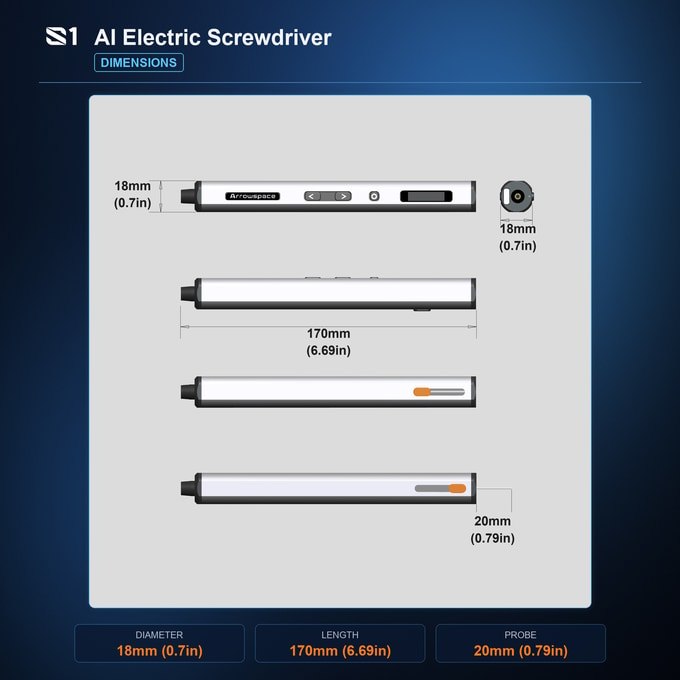
The aluminum-alloy driver body carries physical controls and an OLED readout. Torque level, rotation direction, and battery status are visible on the tool, so the handle supplies useful information while you work. The campaign’s diagrams also identify the USB-C port, rear camera, distance probe, and work lights near the bit end.
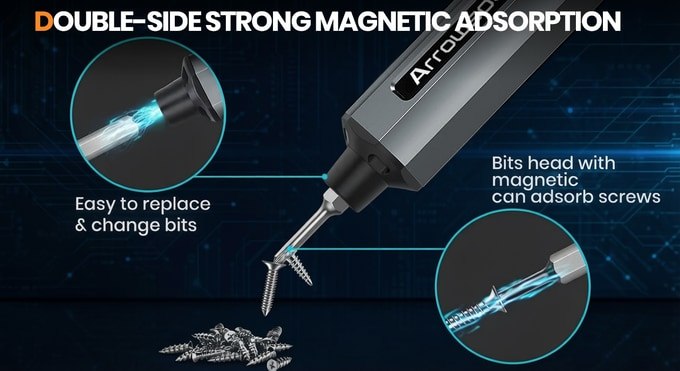
The 52 included bits are specified as S2 steel with an overall HRC60 hardness rating. Extended bits are intended to reach recessed fasteners, while a magnetic holder retains compatible bits during use. Those are ordinary workshop conveniences, but ordinary conveniences are precisely what you miss when a bit disappears beneath the refrigerator.
Arrowspace also shows an optional right-angle attachment for access where a straight driver is awkward. It is sold separately. The presence of an accessory in a demonstration does not mean it lives in every reward box, a distinction worth remembering before planning an entire repair around it.
The standard kit shown in the reward graphic contains the electric driver, illuminated smart case, 52-bit set, and power-tip extension. Buyers should compare the selected reward against their actual needs, especially if their equipment uses uncommon fastener profiles or needs unusually long reach.
Who might appreciate the extra guidance?
RC builders, model makers, electronics hobbyists, and people who regularly open small devices are the obvious audience. The camera-and-case pairing addresses a recurring annoyance for anyone who owns enough bits to need a map. It may be less compelling if your repair toolkit consists of one screwdriver and a firm belief that everything is Phillips.
There is also more equipment to manage here than with a basic manual set: a powered driver, an electronic case, and a companion app. The visual guidance is the reason to consider that complexity. If you already recognize your usual fasteners instantly, a simpler kit may accomplish the same physical job with fewer moving parts in the routine.
This is a crowdfunded product, so the descriptions and performance figures are the maker’s claims rather than results from our own bench testing. Backers should read the current campaign, compatibility information, reward contents, and delivery estimates before committing. A polished case can organize bits; it cannot organize away crowdfunding risk.
The small-screw briefing
- Camera-assisted precision screwdriver designed to identify screw type and size.
- Rear contact probe helps establish the camera’s working distance.
- Smart case displays the result and lights the matching bit position.
- 52 S2 steel bits and a power-tip extension are shown in the standard kit.
- Adjustable electric torque, Auto Torque Assist, and a separate manual mode.
- OLED driver display and USB-C charging.
- Optional right-angle accessory is separate from the standard kit.
The campaign’s reward graphic advertises a single-kit early-bird tier at $129 USD and a Kickstarter-special tier at $149 USD. Earlier launch material advertised a lower limited offer; available tiers can change. Shipping is separate, with the campaign’s table listing $16 for one kit, and the final pledge total and delivery estimate should be checked before backing. The seller platform is Kickstarter.
Inline product images: Arrowspace/Arrowmax campaign imagery hosted on Kickstarter. The promise is delightfully specific: spend less time auditioning bits and more time doing the repair. Your screwdriver may finally know which bit it wants. The screw you dropped on the carpet remains your problem.
| Pros | Cons and considerations |
|---|---|
| Camera and illuminated case address bit identification and retrieval | Recognition still needs a fit check by the user |
| Adjustable powered torque with visible status | Appropriate torque also depends on the material and application |
| Organized 52-bit kit with an extension | Confirm profiles and reach for your particular equipment |
| Manual operation supplements the powered range | The manual rating is not the electric output |
| Optional angle attachment adds an access option | That accessory costs extra |
| Distinctive guidance for frequent precision work | Crowdfunding carries delivery and final-product uncertainty |
Save this find.
Thank yourself later.
Your next great gift idea. Your someday space. Your collection of wonderfully weird things.
Save to PinterestPick a board. Keep the inspiration.
This Camera-Equipped Screwdriver Identifies Screws and Lights Up the Matching Bit
Where to find This Camera-Equipped Screwdriver Identifies Screws and Lights Up the Matching Bit
OddityMall may earn a commission from qualifying purchases at no extra cost to you.
Related posts:
This Tractor Engine Repair Set Lets Your Kid Work On Their Own Tractor
This Bubble Window For Your Fence Allows Your Dogs To Peek To The Other Side
PetNow Smart Pet Camera Gives a Live View Of Your Dog On Smartphone
This Makita Autofeed Screwdriver Will Save Your Time and Your Back During Long Projects