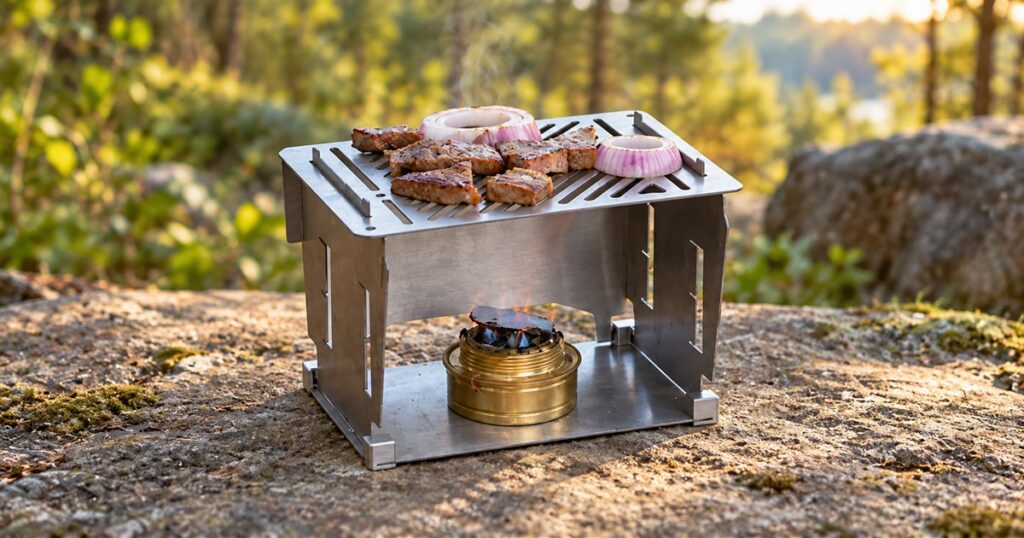
Camping has a way of turning a perfectly competent adult into someone crouching over a pan, negotiating with a twig. Dinner is either barely warm or rapidly becoming evidence. Camprit’s FlameMage titanium camping stove offers a pleasantly mechanical response: move the fire closer to the food, or move it farther away. Your beans have entered the adjustable-height era.
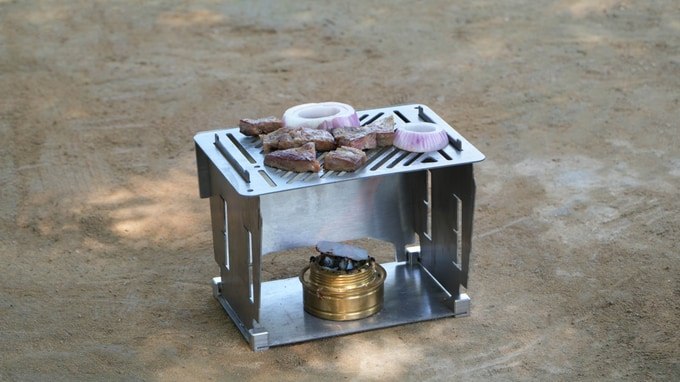
The FlameMage is a flat-packing outdoor cooking system with an adjustable fuel panel, interchangeable cooking surfaces, and Mini and Plus sizes. It comes from Camprit, the camping line under Eck Design, and is currently being funded through Kickstarter. The central idea is simple enough to appreciate before your first cup of campsite coffee: the stove changes the distance between the heat source and whatever you are attempting to feed people.
There is no digital display to squint at. No app wants to meet your sausages. The controls are built into the arrangement of the metal panels, which feels appropriate for a piece of equipment destined to spend time beside a bag of damp socks.
Four fuel settings, with one clever distinction
Camprit describes four fuel configurations: H, M, L, and F. The first three place the fuel panel at different heights inside the stove. High brings the heat nearer the cooking surface for jobs such as searing, grilling, and quicker boiling. Medium is the everyday position, while low increases the distance for gentler cooking and warming.
The fourth setting is a little different. F means removing the fuel panel and putting the fuel setup on the base. It is a way to carry fewer components, rather than a fourth elevated shelf. That distinction matters when you are trying to understand what actually arrives in this small titanium kitchen.
Related posts:
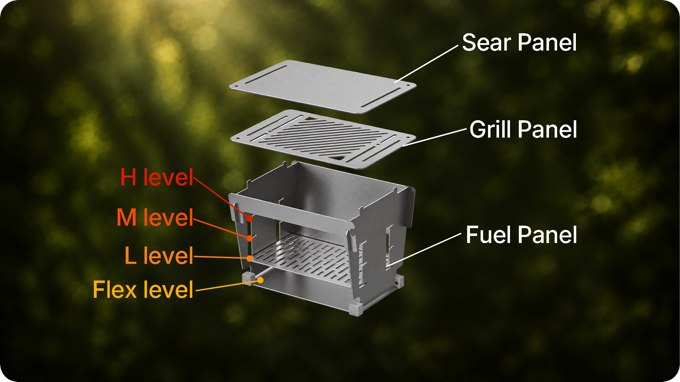
Moving the heat source changes the cooking arrangement; it does not turn a handful of twigs into a thermostatically controlled oven. Fuel choice, the fire itself, and outdoor conditions still affect the result. Think of the levels as useful positions to work with, rather than promises of exact cooking temperatures.
It is an appealing setup for someone who enjoys doing a little actual cooking outside. If your entire meal plan is boiling water and pouring it into a pouch, you may have less use for all these arrangements. If you arrive with onions and opinions about browning, the extra flexibility starts to make sense.
A grill, a searing surface, or your own pot
The Base Stove can be used without a top cooking panel for a more open arrangement. Add the slotted Grill Panel for direct grilling or to support suitable cookware. Switch to the solid Sear Panel when you want a continuous cooking surface. Camprit also shows the searing panel being used to cook, slice, and serve, keeping that particular meal on one surface.
Pot-free cooking is an option for meals that suit the panel. Soup still has some fairly firm opinions about needing walls. You can keep using cookware when the recipe requires it, so this is less about abolishing pots and more about choosing which bits of kitchen deserve backpack space.
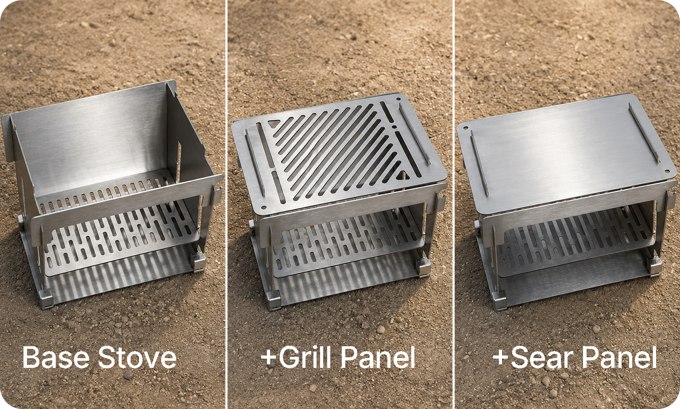
- Grill Panel: a slotted surface for grilling and suitable small cookware.
- Sear Panel: a solid surface for direct cooking when the food allows it.
- Base Stove: an open configuration when a top panel is unnecessary.
- Adjustable fuel panel: three raised positions, plus the option to remove it and use the base.
- Two-level arrangements: different ways to put more than one cooking surface to work.
The two-level idea has two versions. In one, the fuel stays on its panel and food can be cooked above and below it. In the other, the fuel moves down to the base and the freed-up fuel panel becomes another cooking surface. These are physical arrangements, so the available room and heat distribution depend on the setup you choose.
This is the sort of feature that makes a camp cook start planning a slightly more ambitious lunch. It also gives the person washing up a reason to ask how ambitious, exactly.
The weight depends on how much stove you bring
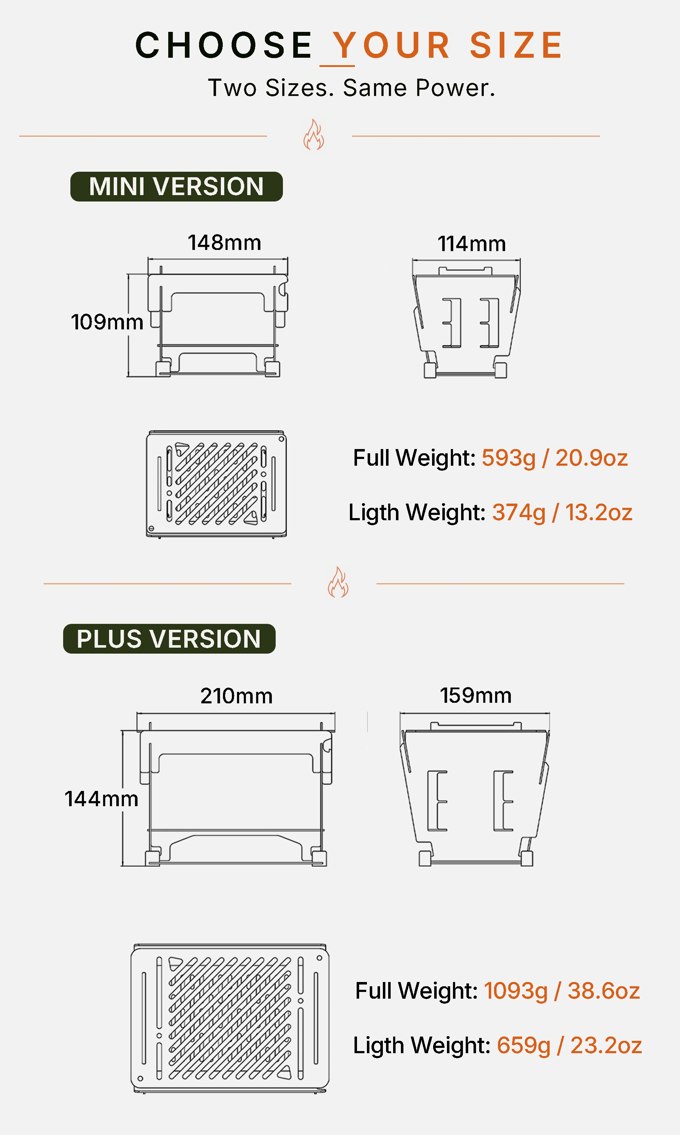
The campaign’s specification graphic distinguishes full and light configurations. The Mini is listed at 593 grams in its full setup and 374 grams in its light setup. The Plus is listed at 1,093 grams full and 659 grams light. In other words, the headline lightweight figure is not the weight of every panel piled together.
| Campaign specification | Mini | Plus |
|---|---|---|
| Shown dimensions | 148 × 114 × 109 mm | 210 × 159 × 144 mm |
| Full configuration | 593 g | 1,093 g |
| Light configuration | 374 g | 659 g |
| Suggested use | Solo trips and simpler meals | More cooking room and more diners |
The appeal is being able to bring the configuration that matches the trip. Packing every surface gives you more options. Leaving unnecessary panels behind reduces the load. This is a more useful decision than stuffing everything into the bag and then declaring the bag mysteriously heavy.
Both versions are designed to pack flat. Camprit describes unfolding the stove for use, then taking it apart and stacking the panels when packing away. The resulting bundle trades the awkward volume of a little metal box for a stack that is easier to arrange among other gear. Let everything cool before that packing victory lap.
Several fuel options, with the right setup
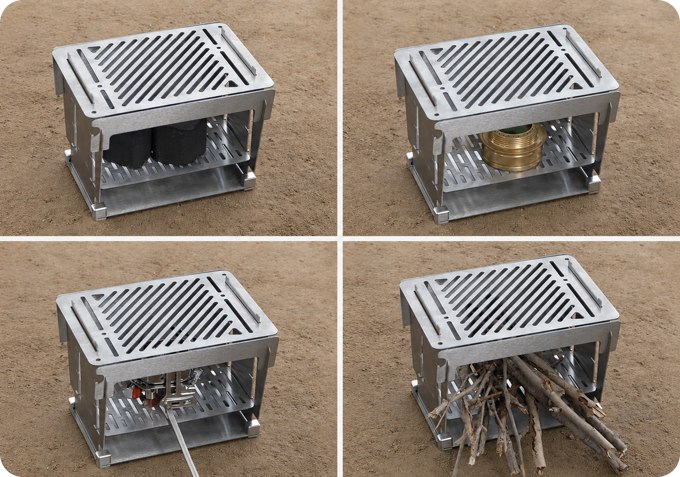
Camprit shows gas, solid fuel, an alcohol burner, and twigs as possible heat sources. That gives the stove more flexibility than a cooking system built around one fuel format. It does not mean those fuels are poured into the same place or used without their appropriate burner and equipment.
Choose the compatible setup for the fuel you intend to use and check what your selected reward includes. The stove frame and cooking panels are the central product; a photo of a burner is not a promise that every pictured accessory comes in every package.
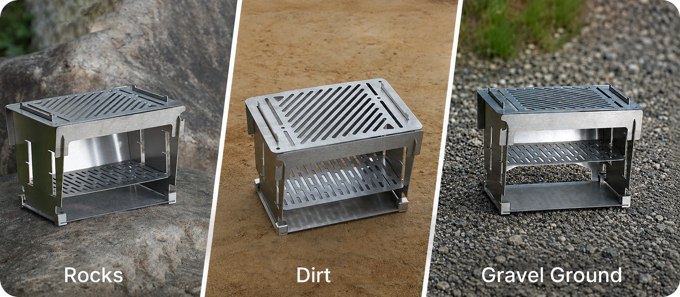
The side and back panels provide some shelter for the flame. They do not create indoor cooking permission or cancel local fire restrictions. This remains outdoor cooking gear, to be used on a stable, suitable surface under the rules of the place you are camping. A scenic overlook is much nicer without an incident report.
Titanium that acquires a little character
The maker specifies uncoated pure titanium panels, with a listed thickness of 1.5 millimeters. Camprit positions the material as suitable for direct food contact and repeated outdoor cooking. We have not put the stove through long-term testing, so its durability promises remain the maker’s claims.
There is a visual bonus to the material: heat can change its surface color. The campaign shows the gold, violet, blue, and smoky tones that develop as titanium’s surface oxide changes. Those colors are not a decorative paint finish. Your stove can gradually look less like fresh equipment and more like something that has a favorite campsite.
Mini is the more compact choice for solo meals. Plus offers more space when you want a larger cooking area or have company. Neither decision requires pretending to be an expedition leader. You are allowed to want a nicer lunch within walking distance of the car.
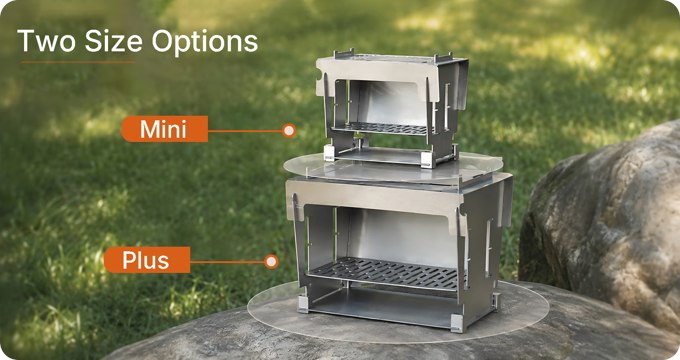
Product images: Camprit’s official FlameMage campaign.
The useful details before dinner
- Flat-packing titanium camping stove in Mini and Plus sizes.
- H, M, and L fuel-panel positions, plus an F configuration using the base.
- Grill and searing surfaces support different styles of outdoor cooking.
- Two dual-level cooking arrangements.
- Mini weighs 374 g light or 593 g full; Plus weighs 659 g light or 1,093 g full.
- Fuel options require the appropriate equipment and permitted outdoor conditions.
- Currently a crowdfunding project, with estimated delivery in January 2027.
At the time of writing, the Kickstarter campaign lists a Mini Super Early Bird reward at HK$541, approximately US$69, and a Plus reward at HK$698, approximately US$89. Shipping is charged later through the post-campaign survey. Reward quantities, currency conversions, and final shipping charges can change.
The campaign is scheduled to end October 7, 2026, with January 2027 shown as the estimated delivery month. Backing a campaign is not the same as ordering an in-stock stove, and delivery is not guaranteed. For campers who like a little mechanical ingenuity with their meal, though, FlameMage gives the humble cooking fire several new seating arrangements.
| Pros | Cons / considerations |
|---|---|
| Adjustable distance between fuel and food | Settings do not provide exact temperature control |
| Several cooking surfaces and two-level options | Carrying all panels increases weight |
| Flat-packing design in two sizes | Needs cooling and packing after use |
| Supports multiple fuel setups | Correct burners, accessories, and site permissions still matter |
| Uncoated titanium construction | Long-term performance has not been independently tested here |
| Current campaign offers Mini and Plus rewards | Shipping costs extra; crowdfunding delivery is not guaranteed |
Where to find This Titanium Camping Stove Moves the Fire Closer to Your Food
OddityMall may earn a commission from qualifying purchases at no extra cost to you.