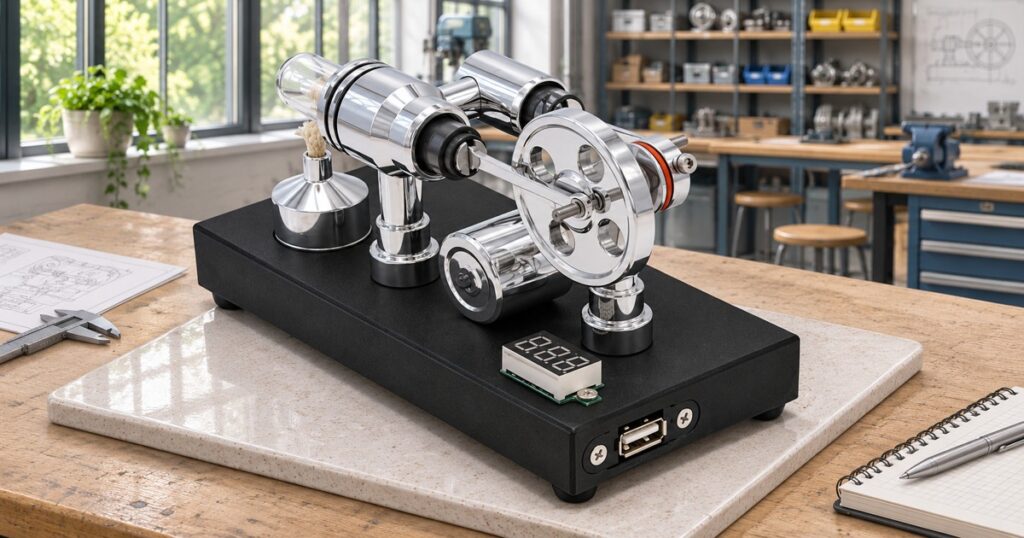
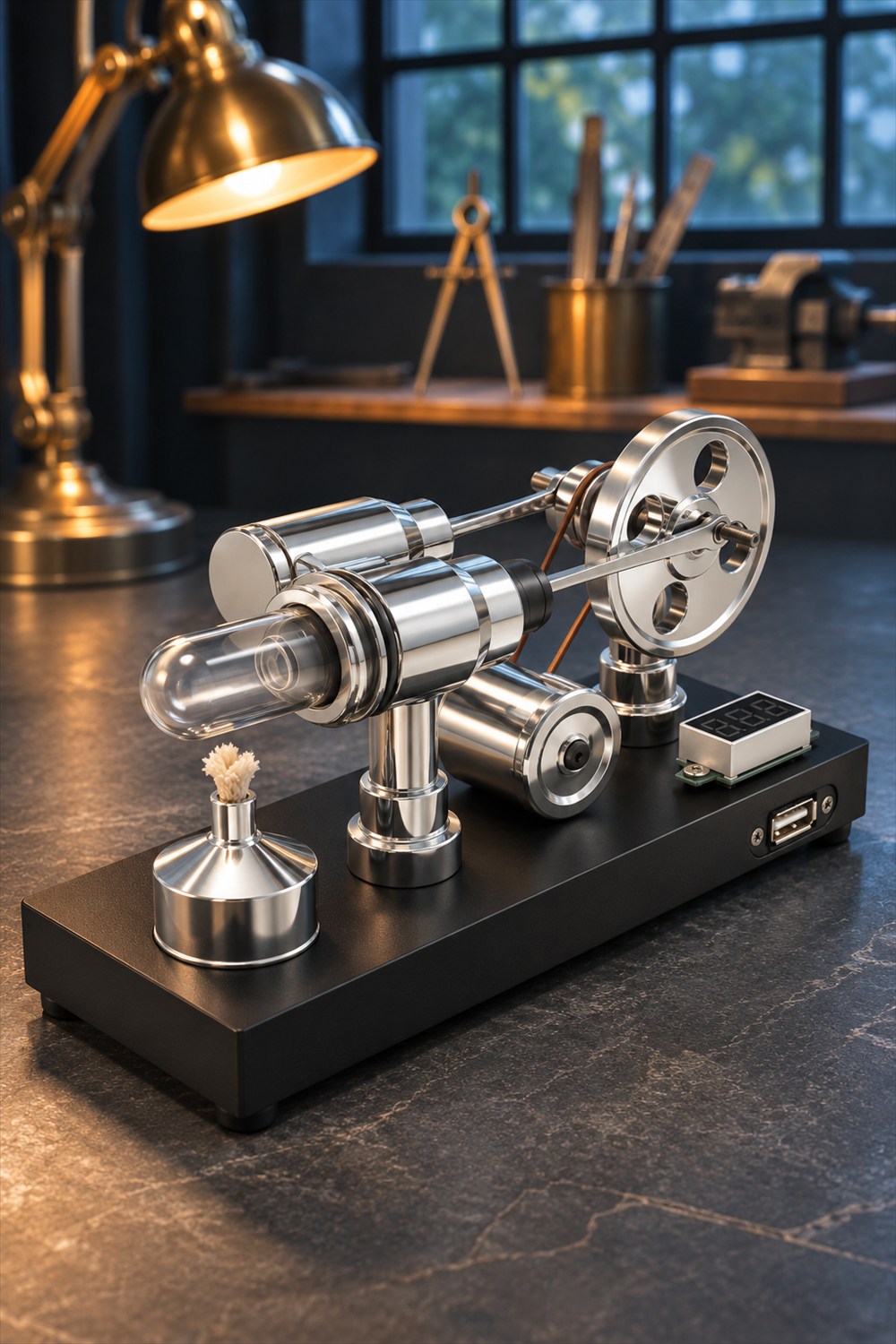
Some people can look at a spinning wheel and leave it at that. Others are already tracing a silver rod backward with a finger in the air, trying to work out who pushed whom. NikolaToy built its mirror-polished Stirling engine model for the second group. A small burner sits at one end, a flywheel takes up the other, and practically everything you’d want to point at is out in the open.

There’s a little digital voltmeter on the black base, too. It’s an amusing piece of casting: one half of this machine looks as if it belongs in the window of a Victorian instrument maker, while the other looks quite prepared to tell you what time your microwave thinks it is. The display actually has a job. It lets you look away from the moving metal for a moment and see an electrical reading.
Follow the rod, not the shiny part
The obvious place to look is the flywheel. It’s large relative to the rest of the mechanism, has holes you can see straight through, and flashes in the light as it turns. But start at the other end and the whole business makes more sense. The small wick burner sits below the end of the horizontal cylinder. Heat enters the engine there; the flame stays outside. Nothing inside has to explode to get the wheel around.
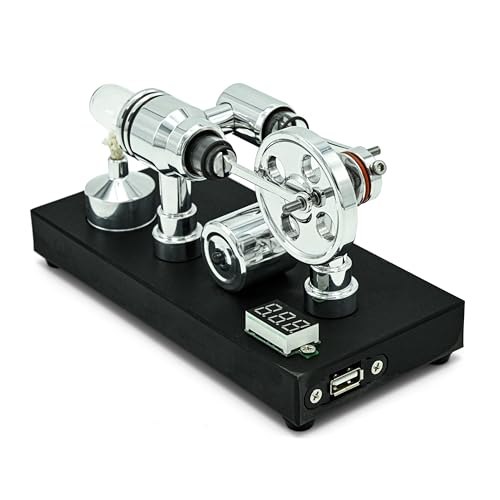
A Stirling engine works with gas enclosed inside it. As that gas moves between warmer and cooler regions, its pressure changes. The timing matters: the engine gets more work from expansion on the warm side than it spends compressing the cooler gas. That difference is what you get to see as useful motion. The polished cylinder won’t let you watch individual molecules report for duty, but the piston rod gives away the result.
Look where the rod meets the wheel. The attachment sits off center. As the piston travels back and forth, the joint traces a circle around the axle, turning a straight-line stroke into rotation. Once moving, the flywheel stores energy and carries the linkage through the portions of the cycle where the piston isn’t giving it much of a shove. A heavy wheel sitting perfectly still, on the other hand, is just a very confident paperweight.
Related posts:


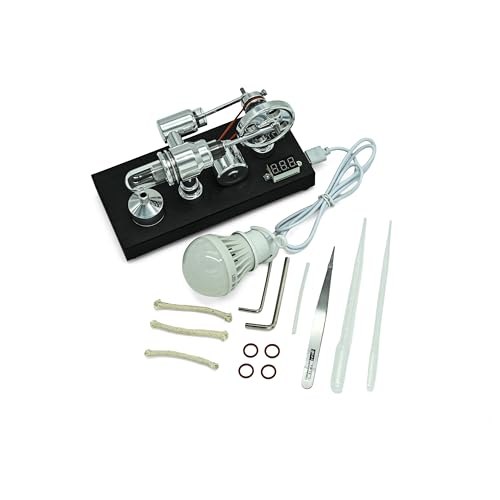
A demonstration that works from both sides of the bench
A useful game for two observers is to pick different parts. One person follows the rod and says when it changes direction. The other watches the wheel and tries to spot the corresponding position of the off-center pin. Then swap. It takes a surprisingly short time to discover why engineers draw little diagrams, and a pleasantly long time before anybody feels the need to bring out the diagrams.
- From the side, follow the rod along the cylinder axis to see its back-and-forth travel.
- From the wheel end, watch the pin’s circular path rather than trying to count flashes in the polished rim.
- At the front edge, look at the voltmeter once you’ve figured out which bits move. It gives you a second kind of observation to compare with the first.
The black rectangular base helps here. Each bright metal piece stands out against it, and there’s a clear front edge to orient yourself by when somebody turns the model around between demonstrations. If you’ve ever tried explaining a complicated mechanism by saying “the little silver thing next to the other little silver thing,” you’ll appreciate having a landmark.
| Part to watch | What it tells you |
|---|---|
| Burner and cylinder end | Where heat reaches the engine from outside |
| Piston rod | How far the visible linkage travels back and forth |
| Flywheel and crank pin | How rotation relates to the rod’s changing position |
| Digital voltmeter | The electrical potential difference at the measurement point |
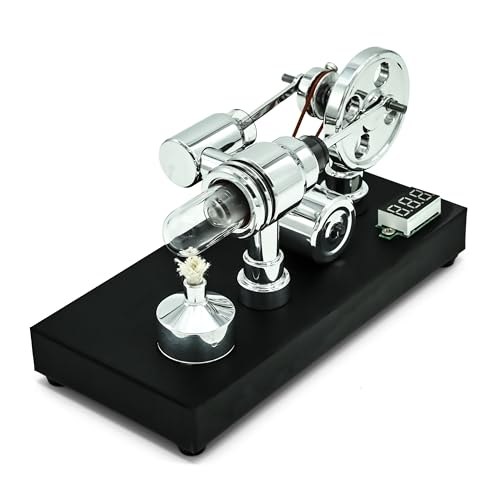
About that USB port
The rectangular USB socket on the front makes a modern observer’s hand drift instinctively toward a phone cable. Give the phone the afternoon off. A voltage reading is only one piece of information about an electrical source. It doesn’t tell you how much current the source can supply to a particular device, or how well its output holds up under load. That’s why the voltmeter makes sense as part of a demonstration without making the engine a substitute for a wall charger.
It also gives a teacher an unusually good follow-up question. If all you saw were the digits, could you tell which way the wheel was turning? If all you saw were the wheel, could you read off the voltage? In both cases you’re missing something. Having both on the same little base makes that distinction easier to grasp than two separate drawings on opposite ends of a whiteboard.
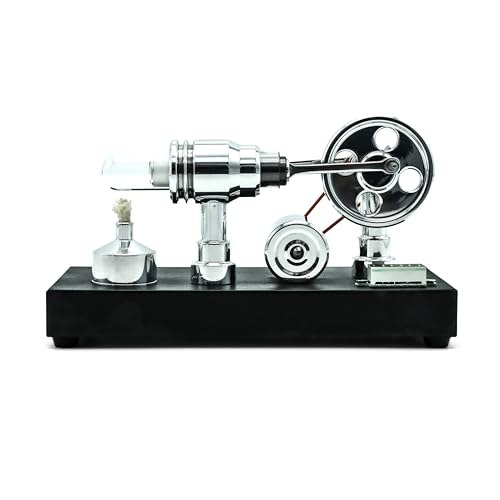
Where a little heat engine belongs
As a stationary display, the mirror finish is half the fun. Light from a nearby window draws bright lines along the cylinders and makes their different profiles easy to see. It would sit nicely among drafting instruments or mechanical models. For an actual run, the requirements change: the seller calls for adult supervision, a stable heat-resistant surface, clearance from flammable materials and enough time afterward for hot parts to cool completely.
That rules out a surprisingly large percentage of the average office desk, starting with the stack of receipts you’ve been meaning to file. Choose the demonstration spot before bringing an audience over. Give people a view from the side without asking anyone to lean over the burner. Save the up-close inspection of the links and the finish for when the model is cool and stationary.
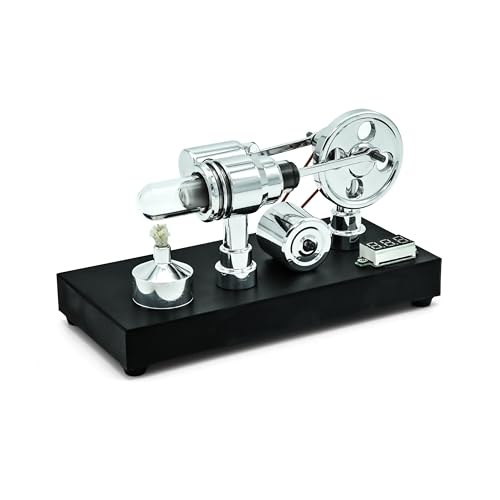
For gift purposes, think about what the recipient likes to do at a museum. Somebody who walks past the cutaway machinery in search of the gift shop may see a nice silver ornament. Somebody who waits for the crank to come around one more time so they can check a theory has probably found their present. The real attraction is being able to go back to the very same joint, with a better question, whenever you please.
The bench notes
- Working NikolaToy Stirling engine model with an external burner and visible mechanical linkage.
- Mirror-polished metal components mounted on a black rectangular display base.
- Exposed flywheel, digital voltmeter and front-facing USB socket.
- Best suited to supervised demonstrations and mechanical display collections.
NikolaToy lists the mirror-polished model for $69.99 on Amazon, with Amazon handling shipping. Look for the version with the digital voltmeter on the base if that’s the detail your resident gear enthusiast has their eye on.
| Pros | Cons |
|---|---|
| The exposed linkage lets several people follow the same motion. | The gas cycle itself stays hidden inside the cylinder. |
| The voltmeter adds a measurable result to the demonstration. | Voltage alone doesn’t establish useful charging power. |
| The polished assembly doubles as a display piece when cool. | Running it requires a suitable heat-resistant space and supervision. |
Save this find.
Thank yourself later.
Your next great gift idea. Your someday space. Your collection of wonderfully weird things.
Pick a board. Keep the inspiration.
This Stirling Engine Model Turns Heat Into Motion You Can Watch
At a glance
Product snapshot
- Listed price
- $69.99Prices and availability can change. Check the seller for current details.
- Where to find it
- Amazon.com
- Category
- Geeky Stuff