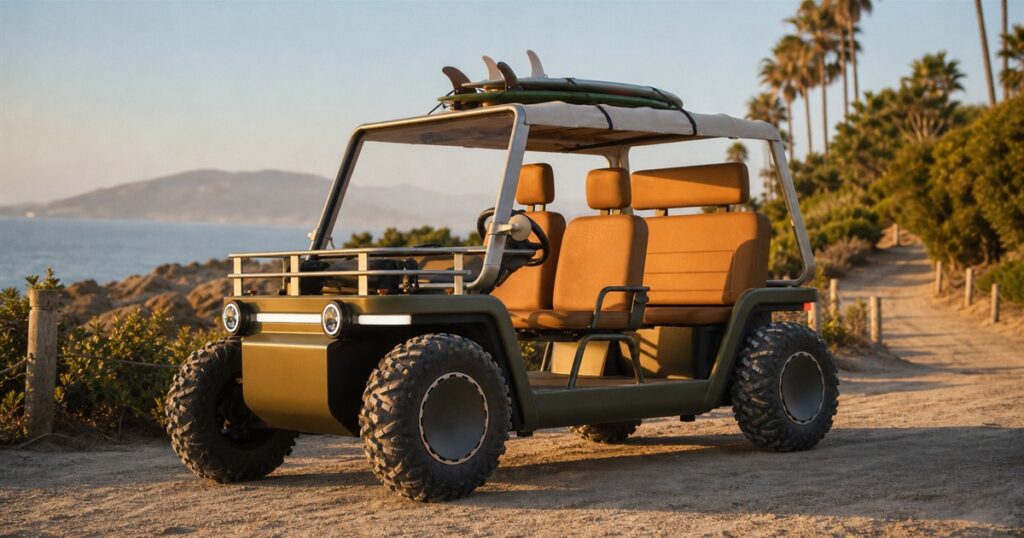
Somewhere between the golf cart that your uncle insists is basically a truck and the dune buggy that makes every beach town look like it has a mayor named Scooter, there is now a street-legal electric buggy that appears to have been designed by people who looked at normal cars and said, “what if everyone calmed down?”

It is called the Amble One, and it is an open-air electric runabout built for short local trips, resort roads, coastal villages, neighborhood errands, and the sacred human ritual of going somewhere slowly enough to remember you have a face. It has no doors, very little screen energy, four seats, giant 28-inch tires, and the kind of tidy aluminum-and-canvas look that makes a regular golf cart seem like it was assembled during a lunch break.
The big idea is not to replace the highway car that takes you three states over while you eat dashboard fries. The Amble One is aimed at short-range mobility: the beach trip, the hotel shuttle, the dinner run, the town loop, the “we need milk but I refuse to make this feel like a commute” mission. It is street legal in its intended L7E category, which means it belongs to the world of lightweight quadricycles rather than full-size cars.
That distinction matters, because this thing looks recreational, but it is not just a patio chair that learned about batteries. Amble lists a 12 kWh lithium-ion battery, a 15 kW rear-wheel-drive motor, independent suspension, a top speed of 65 km/h, and more than 100 km of range. In American-brain units, that is roughly 40 mph and more than 62 miles, which is plenty for a machine whose emotional support animal is a coastal village.

A Tiny EV For People Who Think Cars Got Too Serious
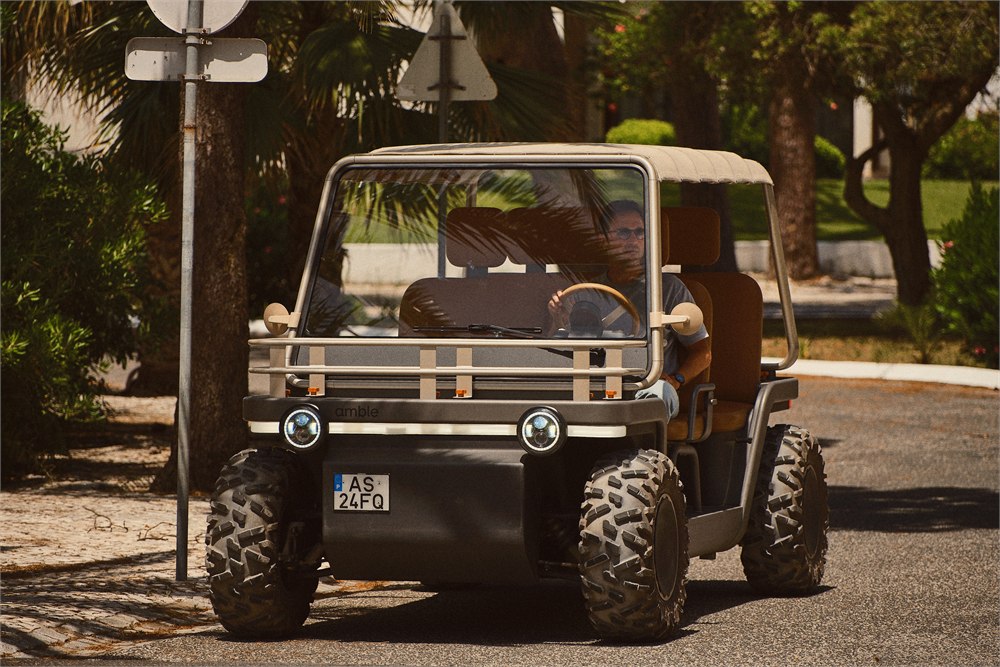
The best part of the Amble One is that it does not seem embarrassed by what it is. It is not trying to cosplay as a crossover, a truck, or a dentist-office shuttle. It is a four-seat electric buggy with an open cabin, a waterproof soft top, a front rack, a simple cockpit, and enough visual charm to make the phrase “local mobility platform” slightly less punishable.
Related posts:



Amble says the vehicle uses an aluminum frame, a recycled polymer body, outdoor fabrics, organic cork, and marine-grade canvas. Those are refreshingly physical materials for a modern EV, especially one that avoids the giant glowing tablet interior where every function is hidden behind a menu called “vibes.” This one leans into physical controls, visible structure, and seats that appear ready for sunscreen, sand, and someone announcing they are “just going to rinse off quickly” before tracking half the beach inside.
The cabin is set up for four people, with supportive seats, headrests, customizable back seats, a rear cargo system with straps, and a modular accessory approach. Amble describes a simple hand screw-in system that lets baskets, boxes, back-of-seat pockets, weather protection, and cargo pieces attach directly to the frame without tools.
- Four-seat open-air layout for short local trips and resort-style driving.
- 12 kWh lithium-ion battery paired with a 15 kW, 48V rear-wheel-drive motor.
- More than 100 km of stated range and a 65 km/h top speed.
- Waterproof soft top, outdoor fabrics, cork, canvas, and aluminum detailing.
- Tool-free accessory mounts for baskets, storage, weather gear, and cargo add-ons.
- Independent suspension and 28-inch wheels for light off-road and rough-path confidence.
The Specs Are Small-Car Serious, But Beach-Town Weird
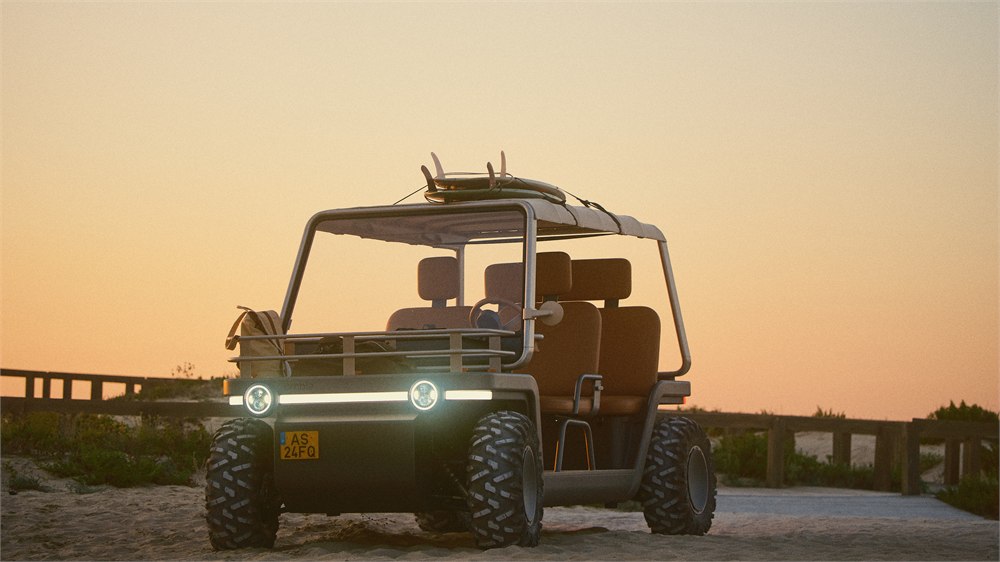
There is a funny tension here. The Amble One looks relaxed enough to make a linen shirt seem like safety equipment, but its spec sheet is unusually specific. It is 3,200 mm long, 1,480 mm wide, and 1,850 mm tall, with a listed weight of 450 kg. That puts it into a compact footprint, but not into toy territory. It is more like someone built a tiny utility vehicle for humans who are done pretending every errand requires a sealed steel living room.
| Amble One detail | Listed figure |
|---|---|
| Vehicle type | Open-air street-legal electric buggy |
| Battery | 12 kWh lithium-ion |
| Motor | 15 kW, 48V, rear-wheel drive |
| Range | More than 100 km |
| Top speed | 65 km/h |
| Charge time | 5.5 hours on 220/230V AC |
| Vehicle category | L7E |
The most charming spec might be the 28-inch wheel size, because it gives the Amble One that delightful “tiny expedition vehicle” stance. It is not pretending to be a hardcore off-road rig, but it does look like it could handle the rough road to the rental cottage, the gravel path behind a resort, or the emotional terrain of having to parallel park a normal SUV near a beach restaurant.
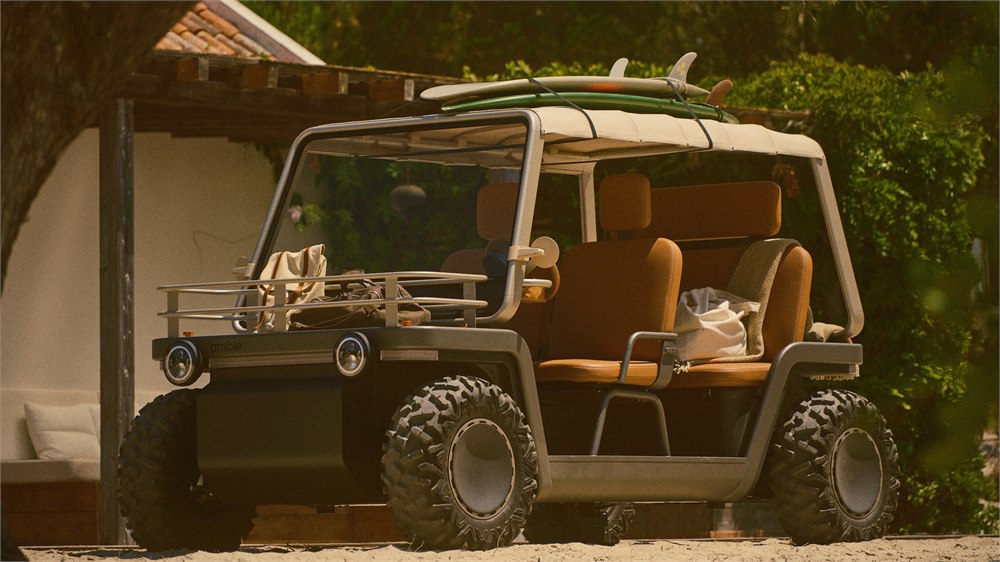
Amble also notes that the photos on its website show the real pre-production vehicle, with final details possibly changing. That is worth remembering, because this is still a reservation-era machine, not something sitting in a big-box store next to patio cushions and a suspiciously cheap kayak.
Built Around Touch, Air, And Not Doomscrolling At Stoplights
The no-doors, no-screen-heavy approach is not just a styling decision. It is basically the product philosophy. Amble describes the vehicle as open by design, meant to keep people connected to the place they are moving through. That is a very elegant way to say your passengers will know exactly when you drive past a bakery, a pine grove, or a drainage ditch with ambition.
This openness also means the Amble One is not for everyone. If your idea of luxury is climate control set to exactly 68 degrees and total separation from weather, insects, and the public, this little buggy may feel like being gently bullied by fresh air. But for resorts, coastal towns, village roads, vacation homes, large properties, campuses, and low-speed communities, it makes a surprising amount of sense.
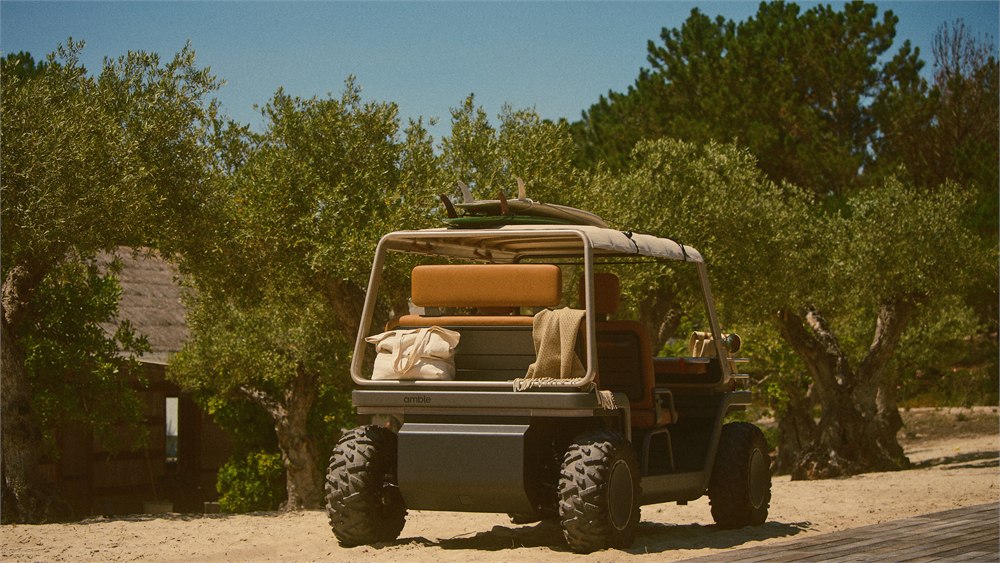
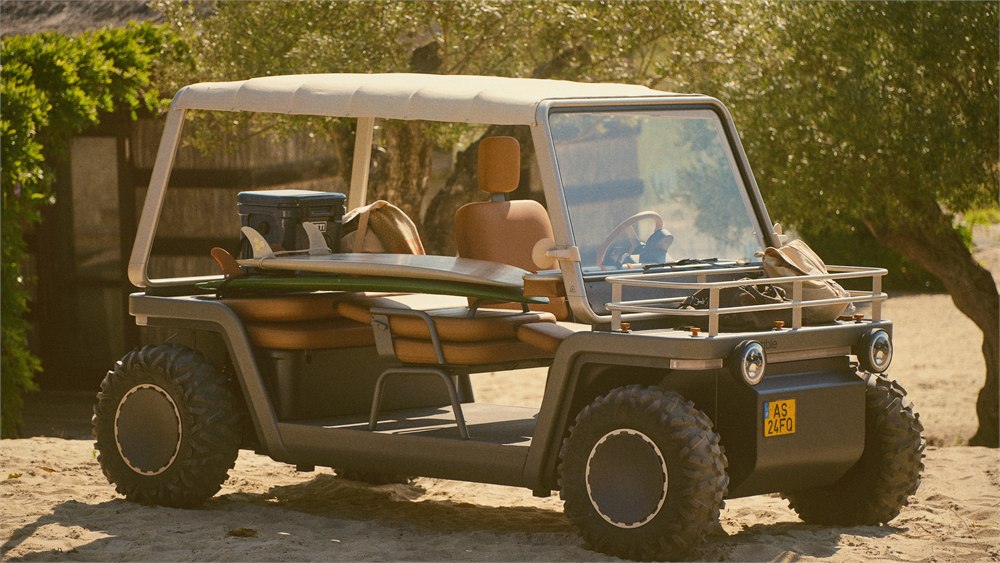
The modular frame details are especially useful because small vehicles live or die by storage. The Amble One can be dressed up with baskets, boxes, rear straps, back-of-seat pockets, and weather pieces, which is exactly the sort of flexibility you need when a quick ride somehow becomes three towels, two bags, a cooler, and one person carrying a hat that has become a lifestyle.
It is also visually different from a typical side-by-side or neighborhood electric vehicle. The round headlights, flat front rack, tan interior, exposed frame, and soft top give it a warm utility look. It is practical, but also slightly theatrical, like a Moon buggy took a hospitality design class and started charging for bottled water.
Reservations, Price, And Who This Is Actually For
Amble says reservations for the street-legal Amble One are open, with individual deliveries planned for 2028. Fleet interest appears to be aimed at hospitality and destination properties, and the company says 2027 fleet orders are closed while 2028 delivery inquiries remain open.
The official site lists a refundable reservation deposit of €100 and a starting price of €20,000 plus VAT. Launch coverage and Amble materials describe that as roughly $25,000, depending on market, tax, and final configuration. That is not impulse-buy money unless your impulse buys have parking spots, but it is right in the strange and interesting zone between a premium golf cart, a neighborhood EV, and a lifestyle vehicle that wants to make errands feel like a tiny vacation.
Images courtesy of Amble.
It is probably not the vehicle for people who need highway speeds, weather isolation, long-distance range, or traditional car safety expectations. It is very much for the person, resort, neighborhood, or beach-town regular who wants short trips to feel less like transportation and more like someone finally removed the cubicle walls from driving.
- Product: Amble One street-legal electric buggy.
- Use case: short local trips, resorts, coastal towns, villages, campuses, and light off-road paths.
- Seats: four-person open-air layout.
- Powertrain: 12 kWh battery with 15 kW rear-wheel-drive motor.
- Range and speed: more than 100 km range and 65 km/h top speed listed by Amble.
- Materials: aluminum frame, recycled polymer body, waterproof soft top, outdoor fabrics, cork, and marine-grade canvas.
- Availability: reservations open, with individual deliveries planned for 2028.
- Price: refundable €100 reservation deposit; starting price listed at €20,000 plus VAT, roughly $25,000.
| Pros | Cons |
|---|---|
| Distinct open-air electric design for short local trips. | Not meant for highway-speed or long-distance driving. |
| Four seats make it more useful than many tiny EV runabouts. | Open cabin will not suit harsh weather or comfort-first drivers. |
| Tool-free accessory mounting adds real storage flexibility. | Final production details may differ from pre-production photos. |
| 12 kWh battery and 100+ km range fit the intended use case. | The starting price is far above ordinary golf-cart territory. |
| Large 28-inch tires and independent suspension give it visual and practical grit. | Availability is reservation-based, with individual deliveries planned for 2028. |
| Physical controls and natural materials give it more character than screen-heavy EVs. | Street legality and use rules can vary by market and vehicle category. |
Where to find This Street-Legal Electric Buggy Makes Short Trips Feel Like Beach-Town Business
OddityMall may earn a commission from qualifying purchases at no extra cost to you.